
February 2023 — As I look down the beach I can hardly believe what I’m seeing! It looks like it could be a surf lifesaving carnival and I’ve never been to one. Or some kind of carnival anyway, and with my usual curiosity I want to see what’s going on.
I immediately head towards it, even if I can only have a quick look and take a few photos. We’re trying to find the off-leash area for the dog and have discovered the carnival in the process. I so badly want to investigate, at least a little!
A childhood memory: a picture of surf lifesavers, five or six of them, pushing a big wooden boat with oars out into the surf, their heads covered in cotton caps tied under the chin. Another picture: a surf lifesaving carnival, 1950’s, probably in Sydney, a parade of men, again with the caps, marching with the leader proudly holding a big flag aloft displaying the club colours. It was probably on Bondi Beach, even then a famous, almost mythical place.
Things have changed a lot since then. The wooden boats have been replaced by inflatables with outboard motors, and with jet skis; helicopters roam the skies above popular beaches;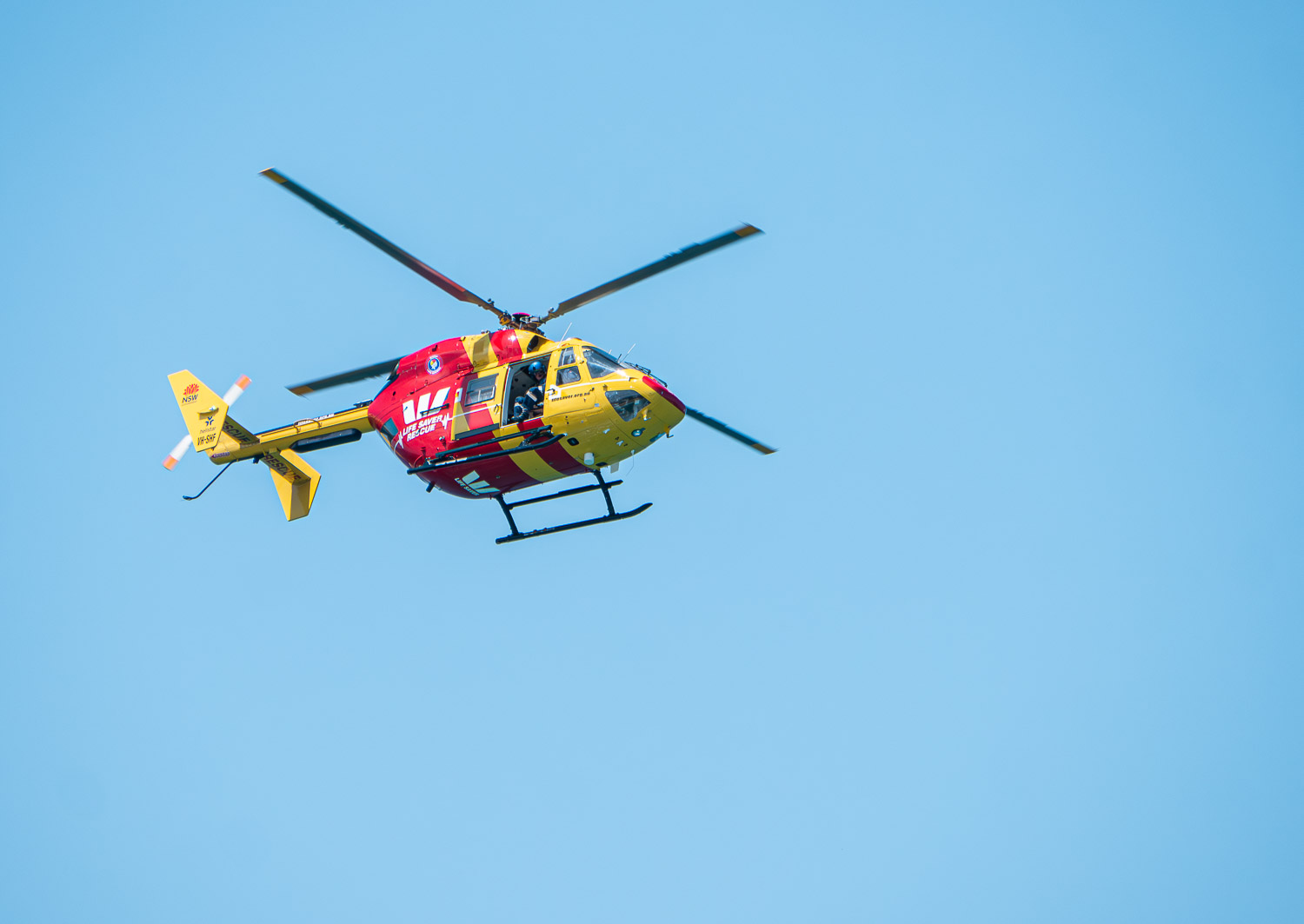
eight-foot surfboards have been replaced by much shorter and lighter rescue boards with hand grips; there is now a national governing body, and Surf Life Saving Australia has grown to be one of the biggest volunteer organisations in the world. There are almost 190,000 members, and over the years more than 685,000 people have been saved from drowning. There are now 314 clubs around the country, and it’s all funded by government grants, fundraising, corporate sponsorships, and community donations. One thing hasn’t changed – they all still wear the little caps tied under the chin.
SLSA exists to save lives, create great Australians and build better communities. Through its coastal safety, lifesaving, education, sport and recreation programs and services, SLSA generates significant social and economic benefits for the Australian community each year.
A recent audit demonstrated that for every dollar invested $20 is returned to the economy; the yearly worth to the community is $6.5 billion; and over sixteen million volunteer hours are logged each year. Australia’s intrinsic and passionate beach culture results in 300 million beach goers visiting the coast every year, but Australian beaches are among the most dangerous and unpredictable in the world. SLSA, a unique not-for-profit community organisation, has grown from the need to manage the hazards associated with this inherent beach culture.
Apart from local carnivals and competitions, that are the training ground for skilled lifesavers, there is The Aussies – the annual Australian Surf Life Saving Championships where members from Australia’s 314 surf clubs compete in more than 480 beach and ocean events. It is the largest event of its kind in the world, and compares in size to the Commonwealth Games, with as many as 5 to 7 thousand competitors in youth, open, and masters categories. Events cover all the skills required to save a life, from water skills to beach skills to first aid and team events – including sprinting, board rescue, wading, surf swimming, ironman/woman and a surf boat competition. It’s huge! Surf lifesaving has become a national sport.
But what we come across is not The Aussies. What we come across is the nippers.
Nippers includes the Junior Development Program which is designed to ensure children have fun at the beach, while participating in lessons that will provide them with a pathway to become a qualified surf lifesaver and a junior competitor. As they progress through the various age groups, nippers will undergo lessons in wading, running, ocean swimming, board paddling, and lifesaving skills as well as learning the basics of resuscitation and first aid.
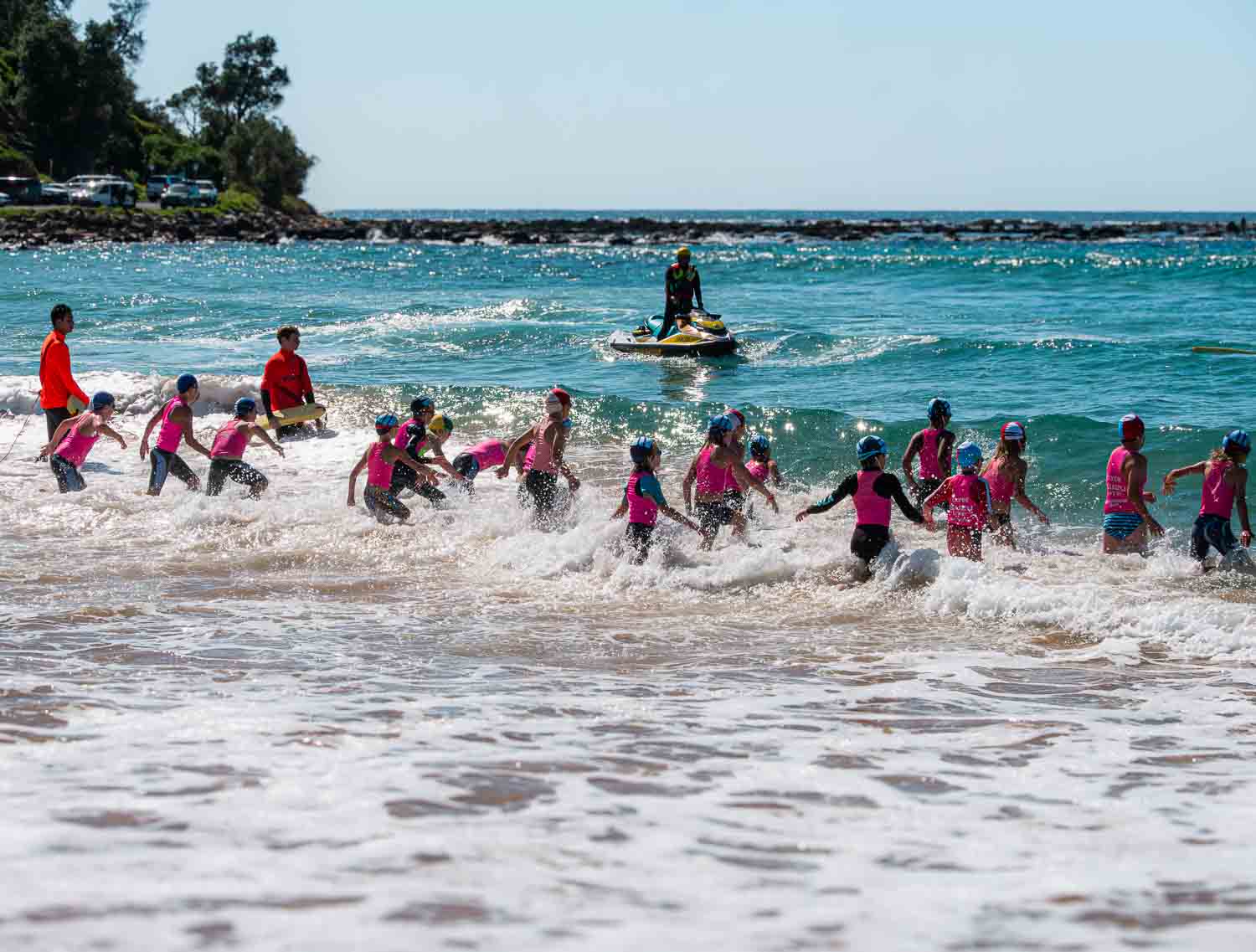
This event is the Far South Coast Branch Junior Carnival 2023 on Broulee Beach. It’s a riot of kids in electric pink and acid green,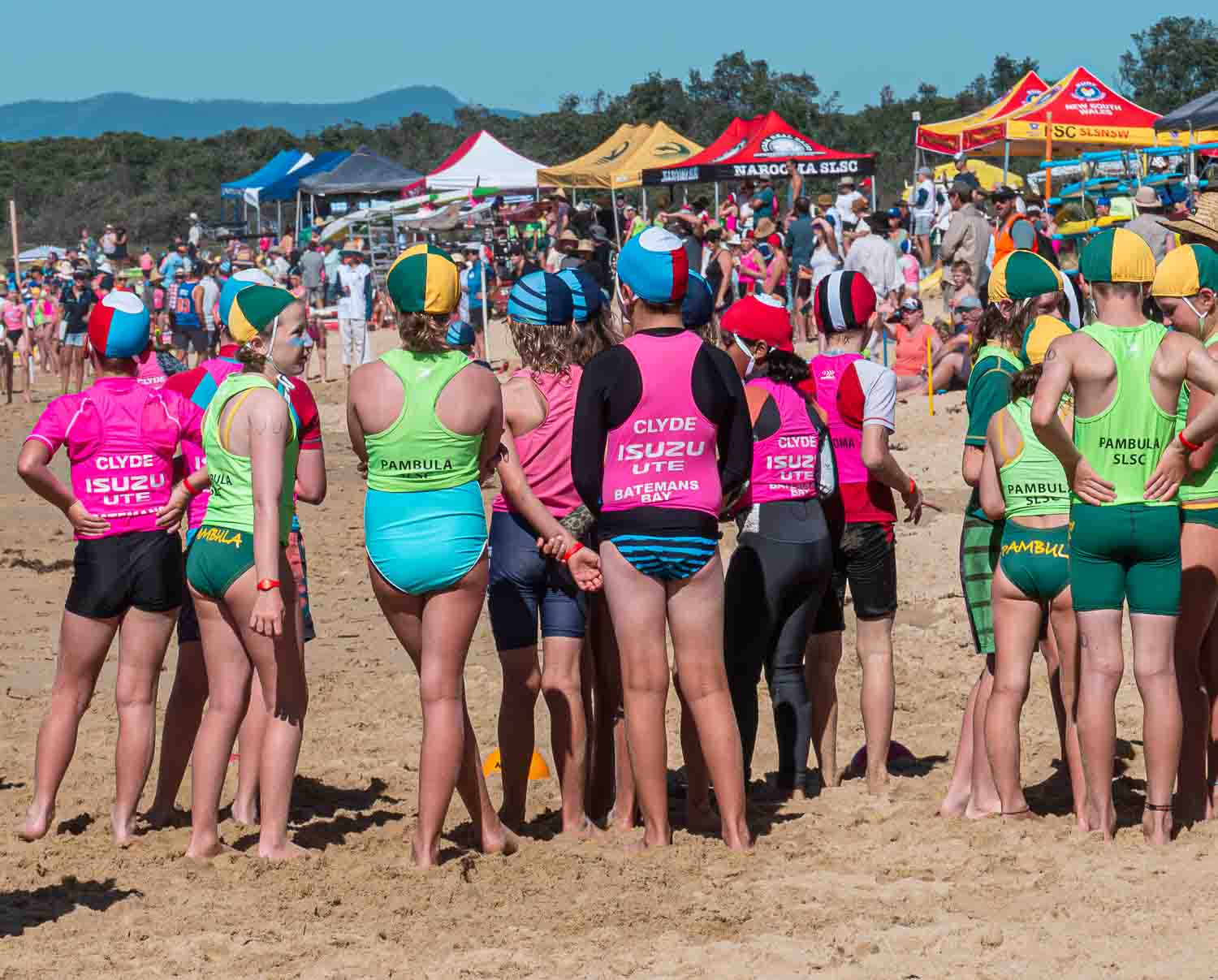

which I initially think are club colours. But no, they are simply for visibility. Then I notice every child has his/her age category marked on their leg or upper arm – Under11, U12, etc. The oldest are U14. Later a bit of sleuthing tells me that the participating clubs are Moruya, Pambula, Tathra, Broulee, Bermagui, Batemans Bay, and Narooma – all names I’m familiar with, all towns on the NSW far south coast. Each club has a tent and mountains of equipment.
There must be hundreds of people here: officials, race supervisors, parents, families, and of course the NSW branch of SLSA in its iconic red and yellow colours.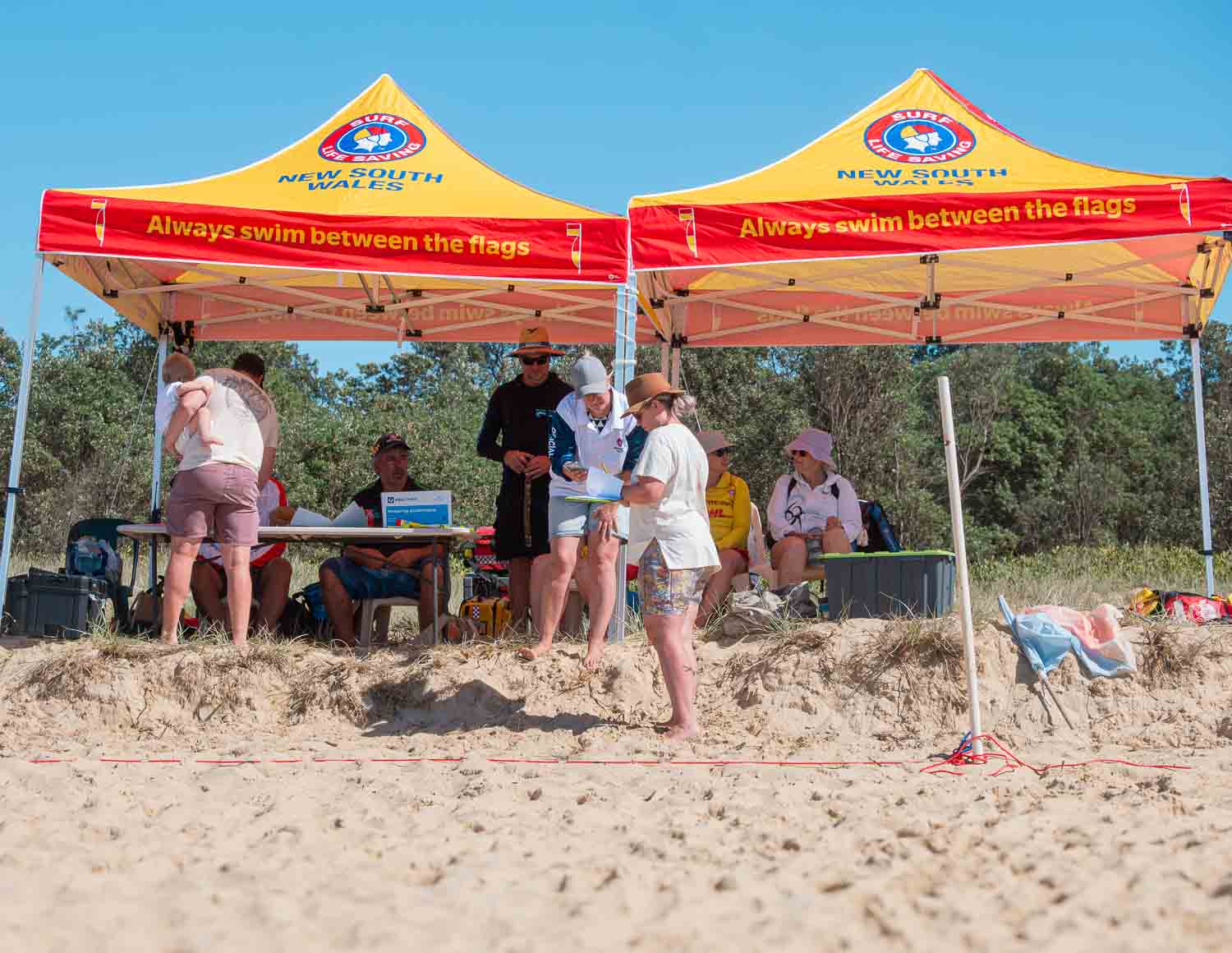
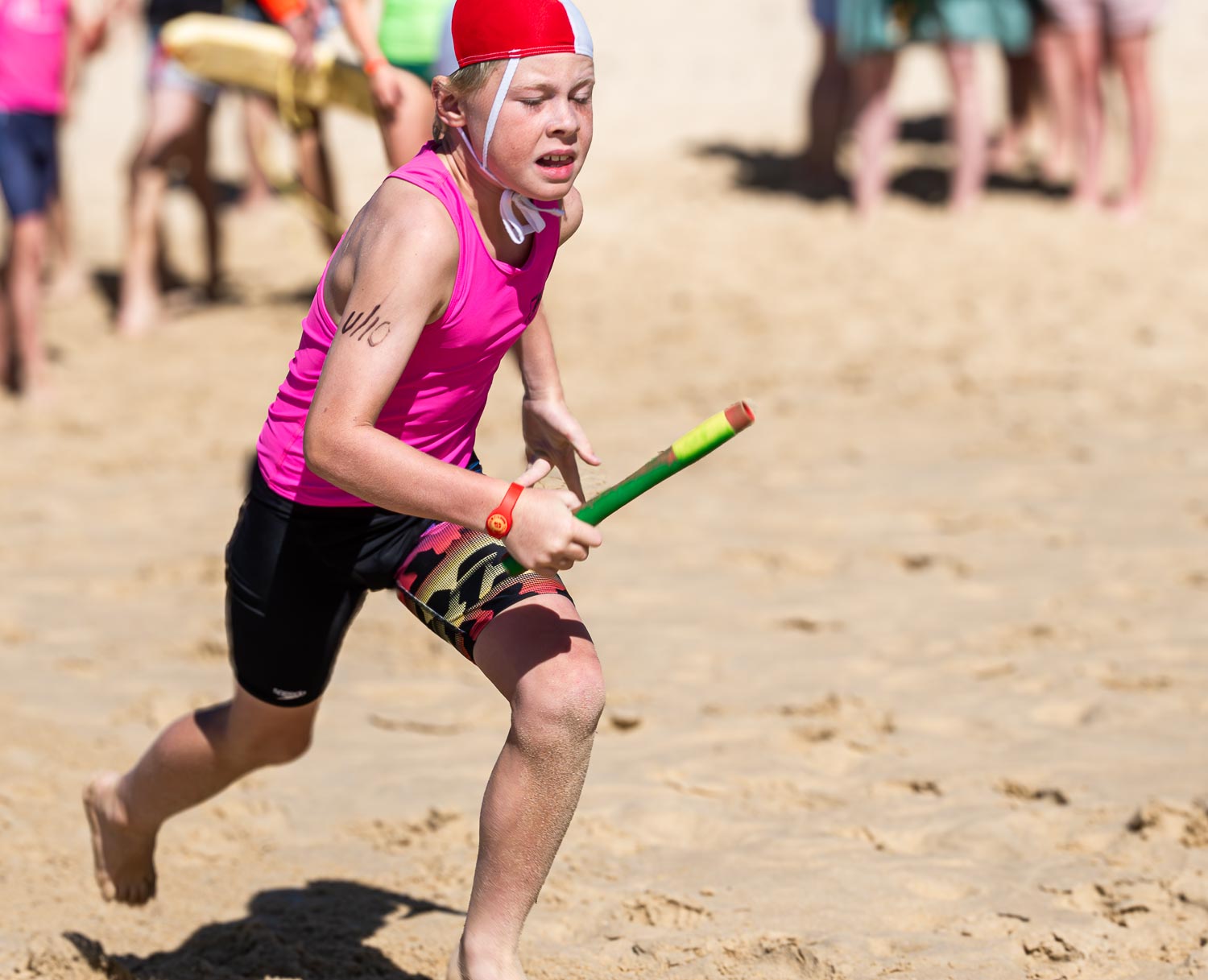
I watch the kids prepare for, and then run relays.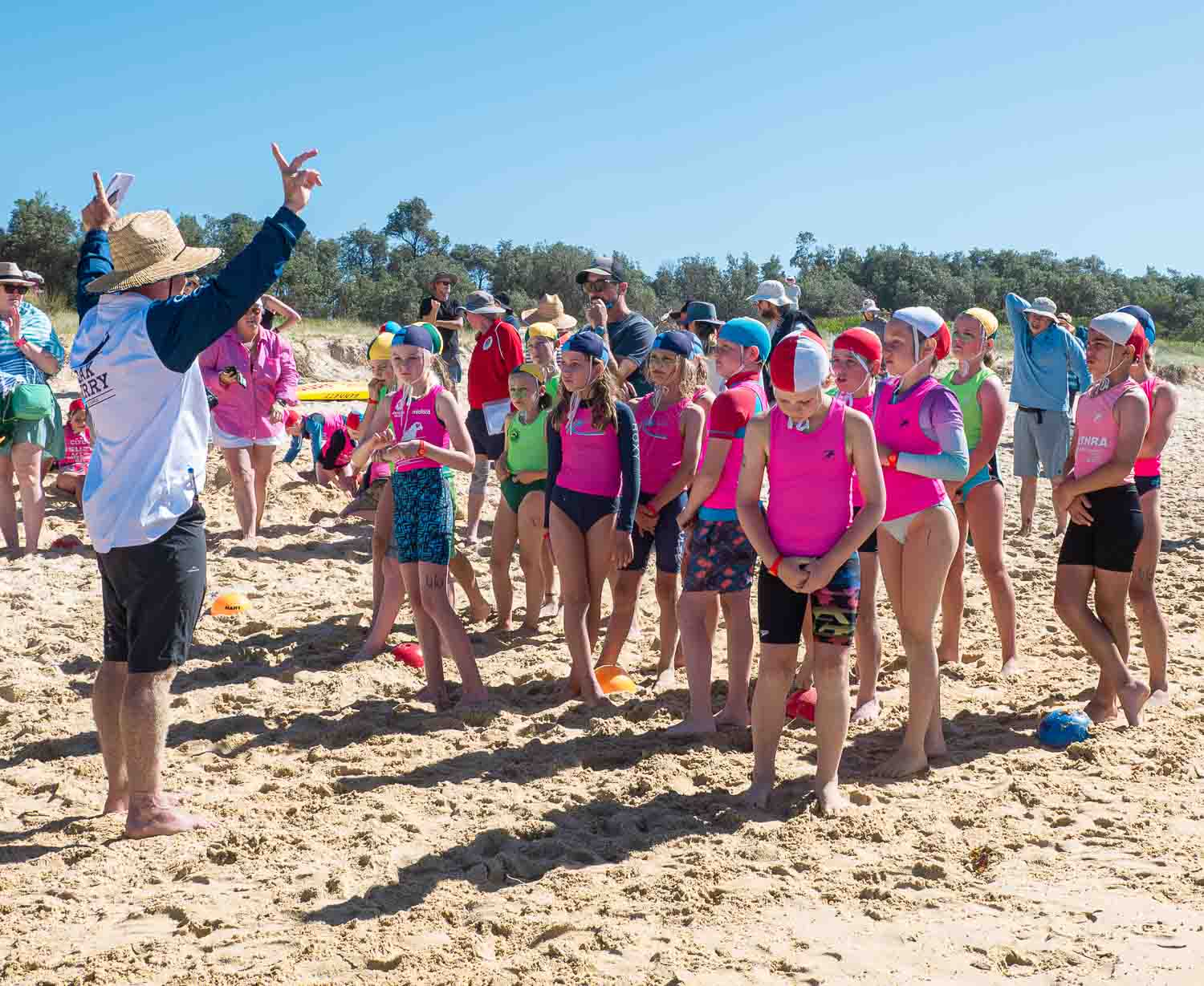

Meanwhile out on the water there are paddling races. I think they keep their legs bent to stop their feet slowing them down by dragging in the water. That’s my guess anyway. They’re paddling on something that seems to be the offspring of a marriage between a boogie board and a surf board.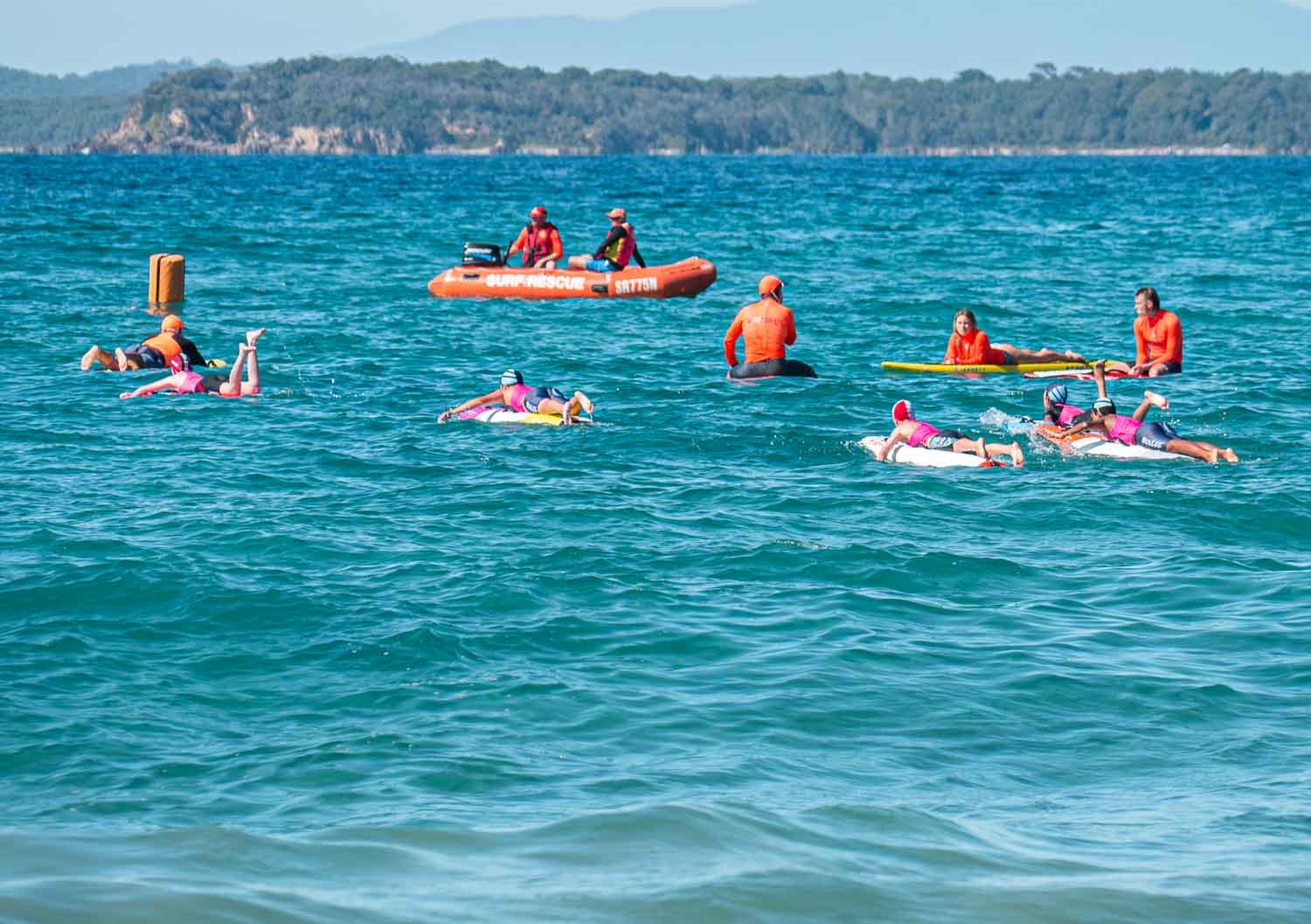
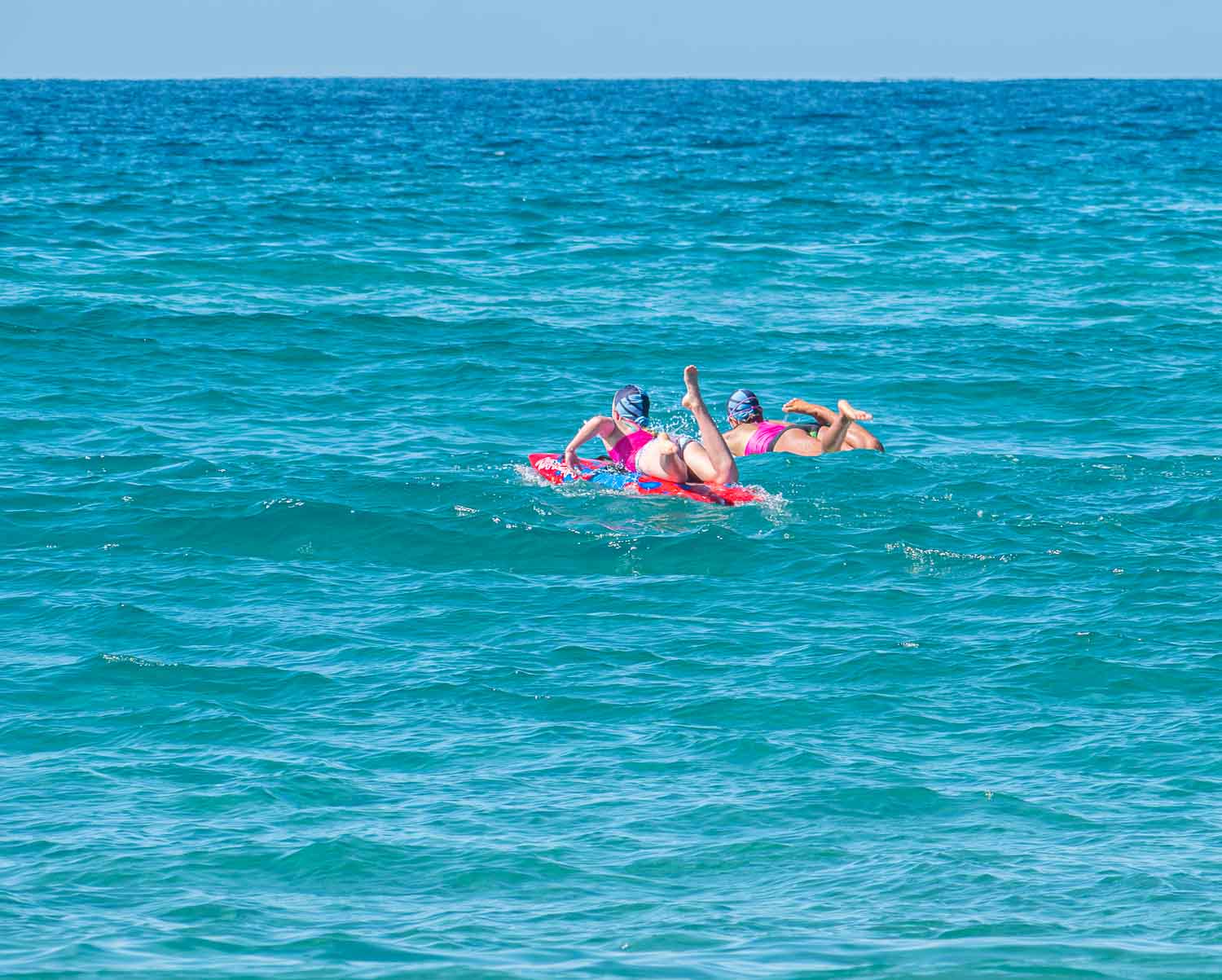
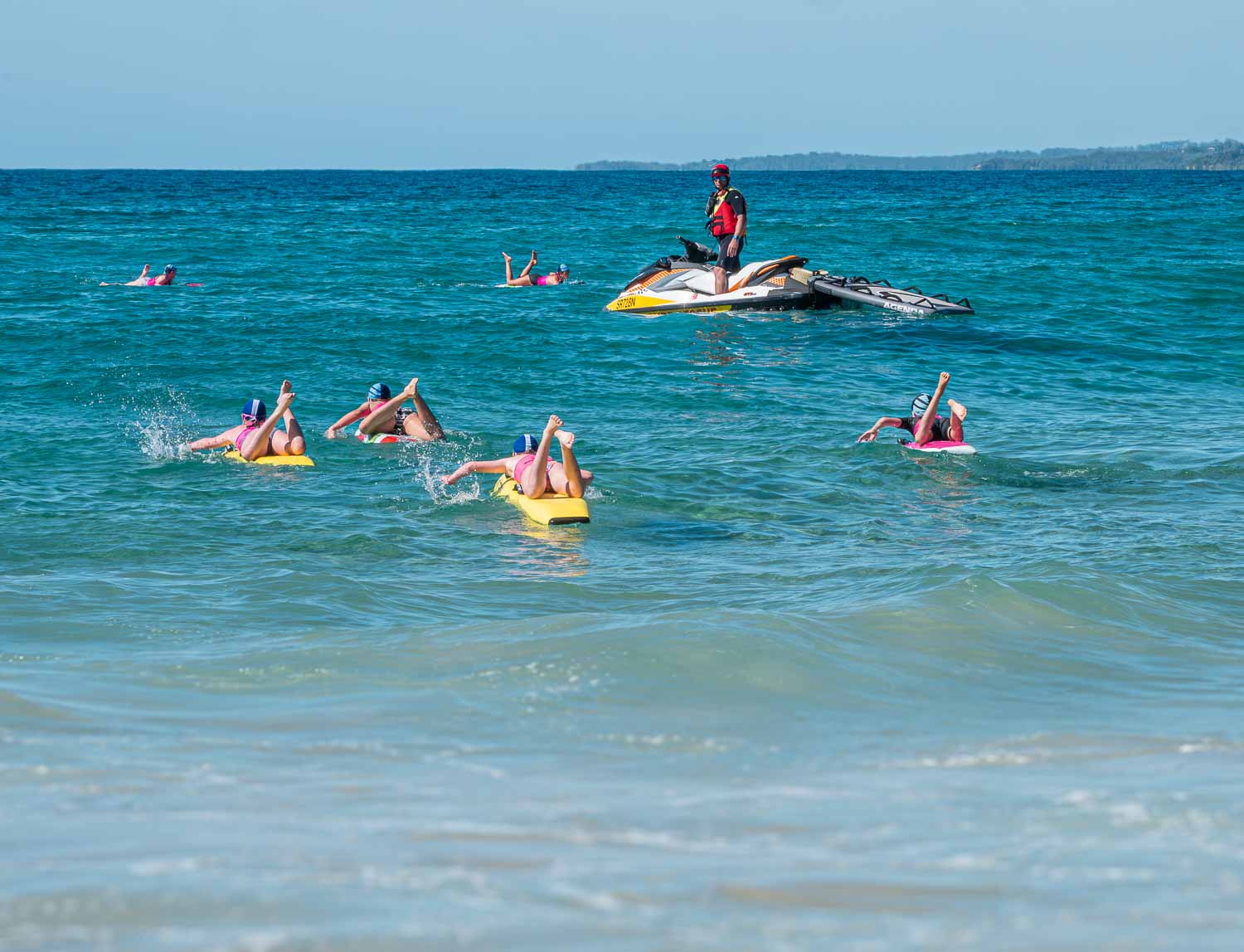
Here you can see a rescue board with the handgrips along both sides for a drowning person to hold on to.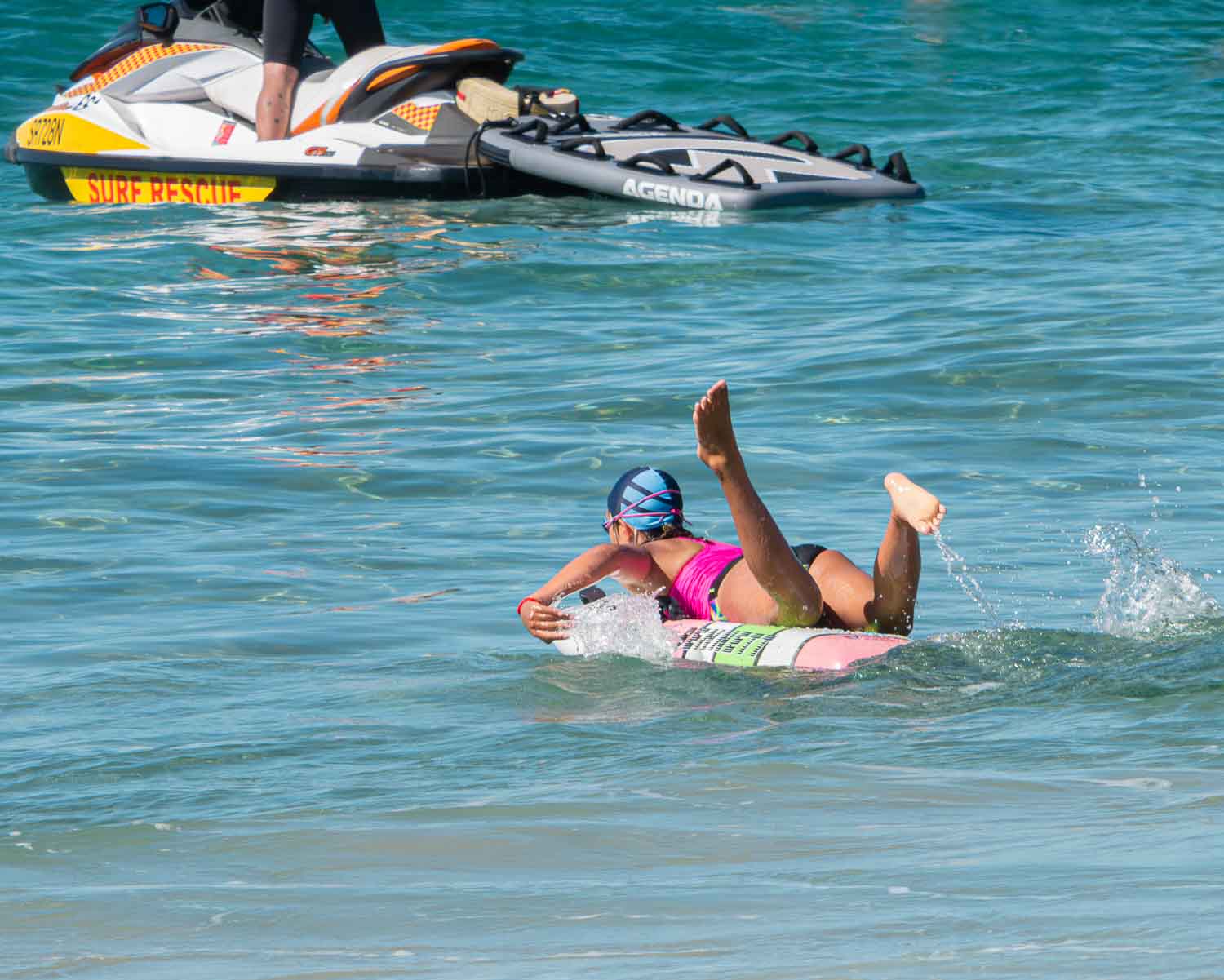
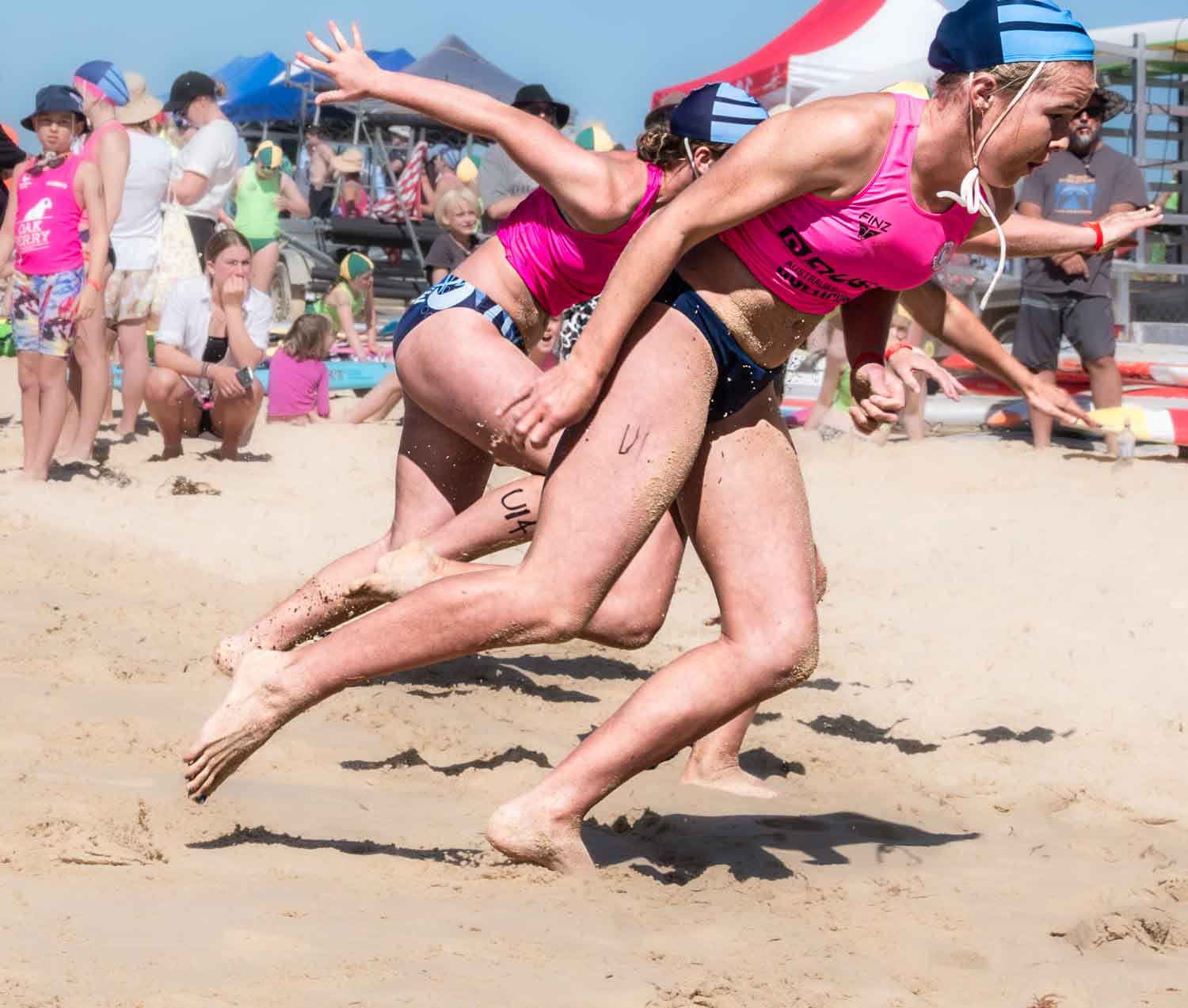
This next race went across the sand rather than along it. And weirdly the kids began lying on their bellies facing away from the direction they were to run in. They jump up and turn and run like mad things for a flag baton across the sand. There’s one less baton than the number of kids entered.


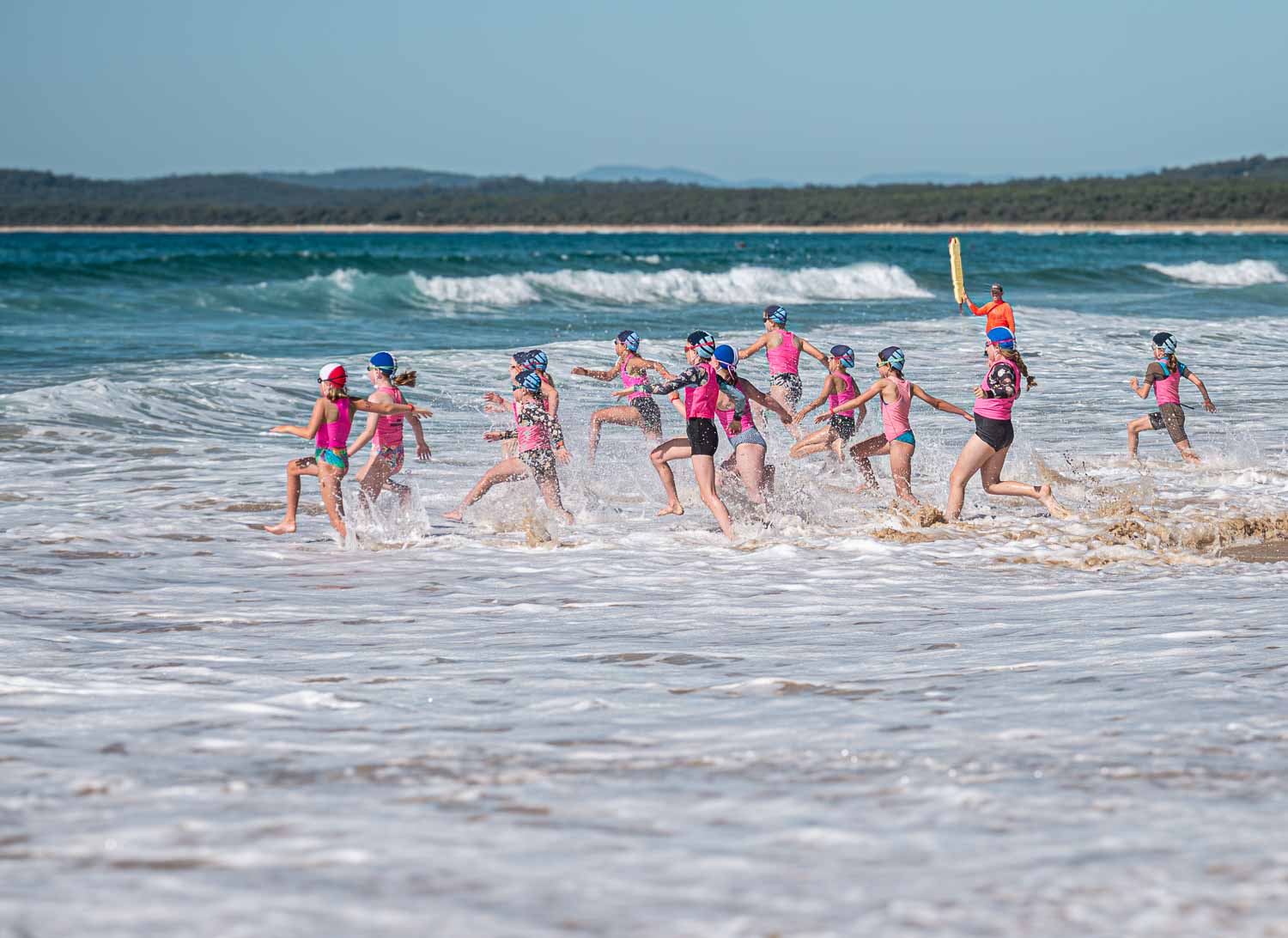
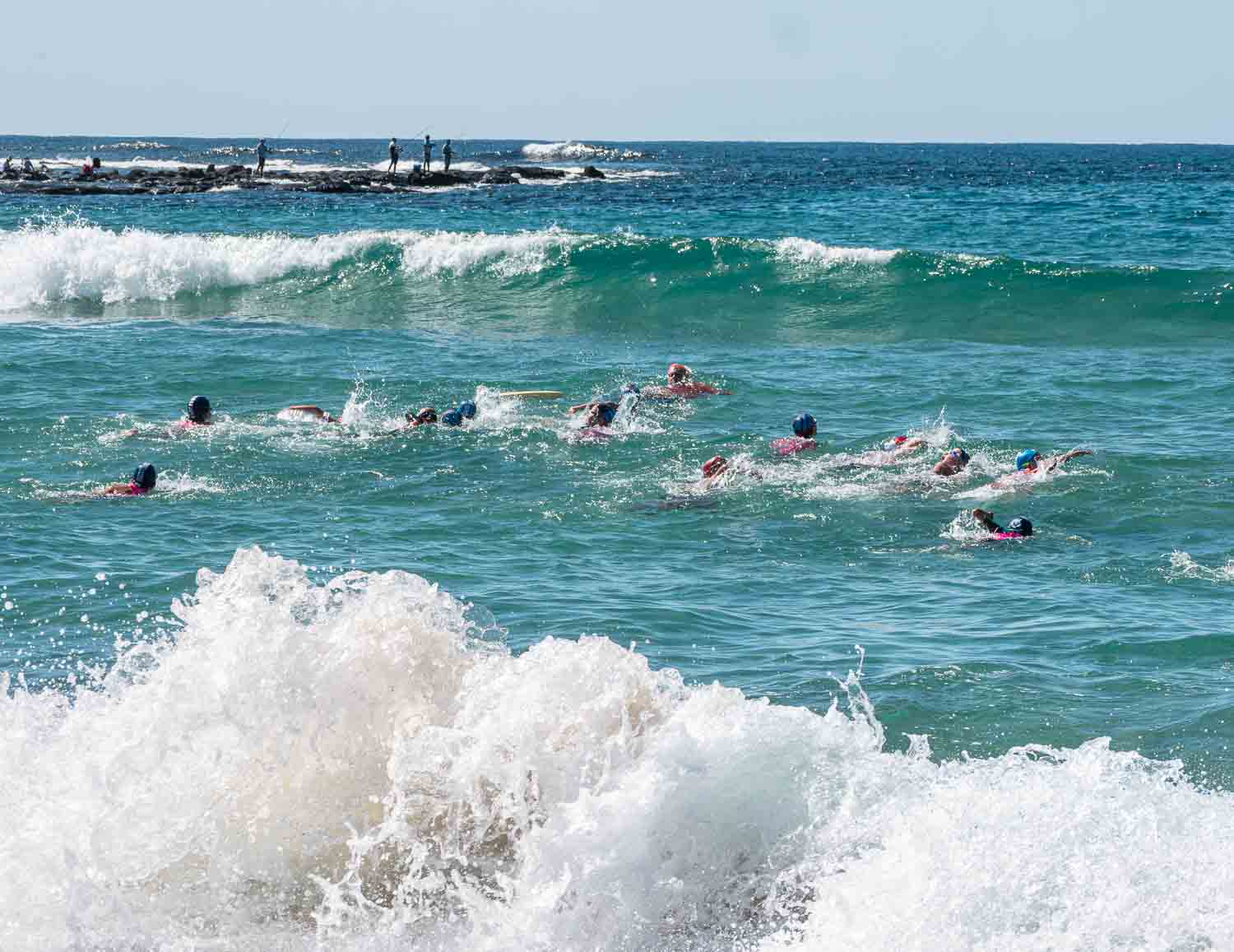
Of course there are swimming races. I’m in awe of the way the kids hurl themselves into the surf, dive through the waves and swim into deeper and deeper water. These are not short swims. Out to the buoys and back is several hundred metres. These kids below are all only nine years old; you can see the U10 on their legs. You know when they hurl themselves into the surf without hesitation that they’ve been doing it since they could walk, and probably started learning to swim before they could walk.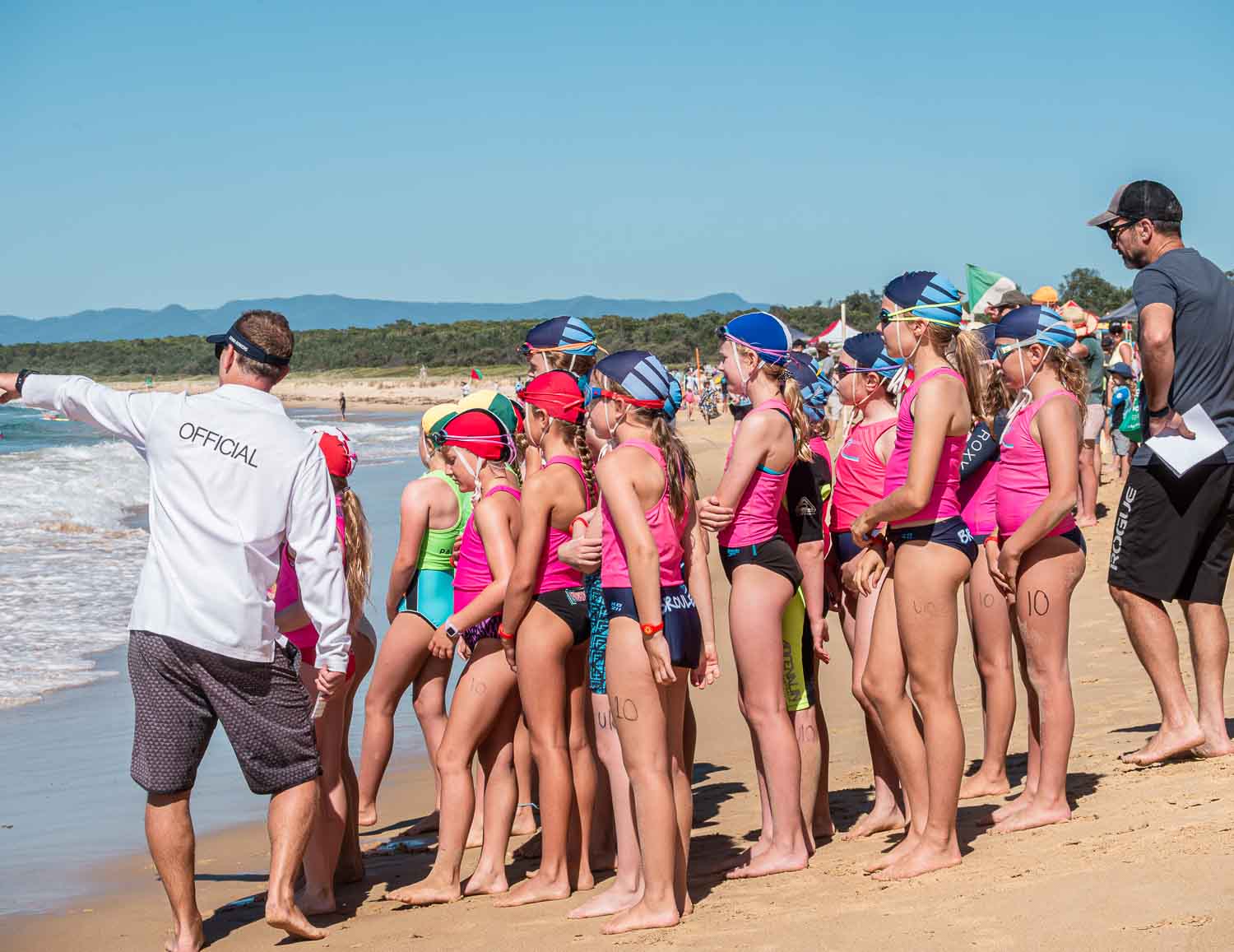

And naturally there’s a lot of hanging out with your mates, playing in the sand.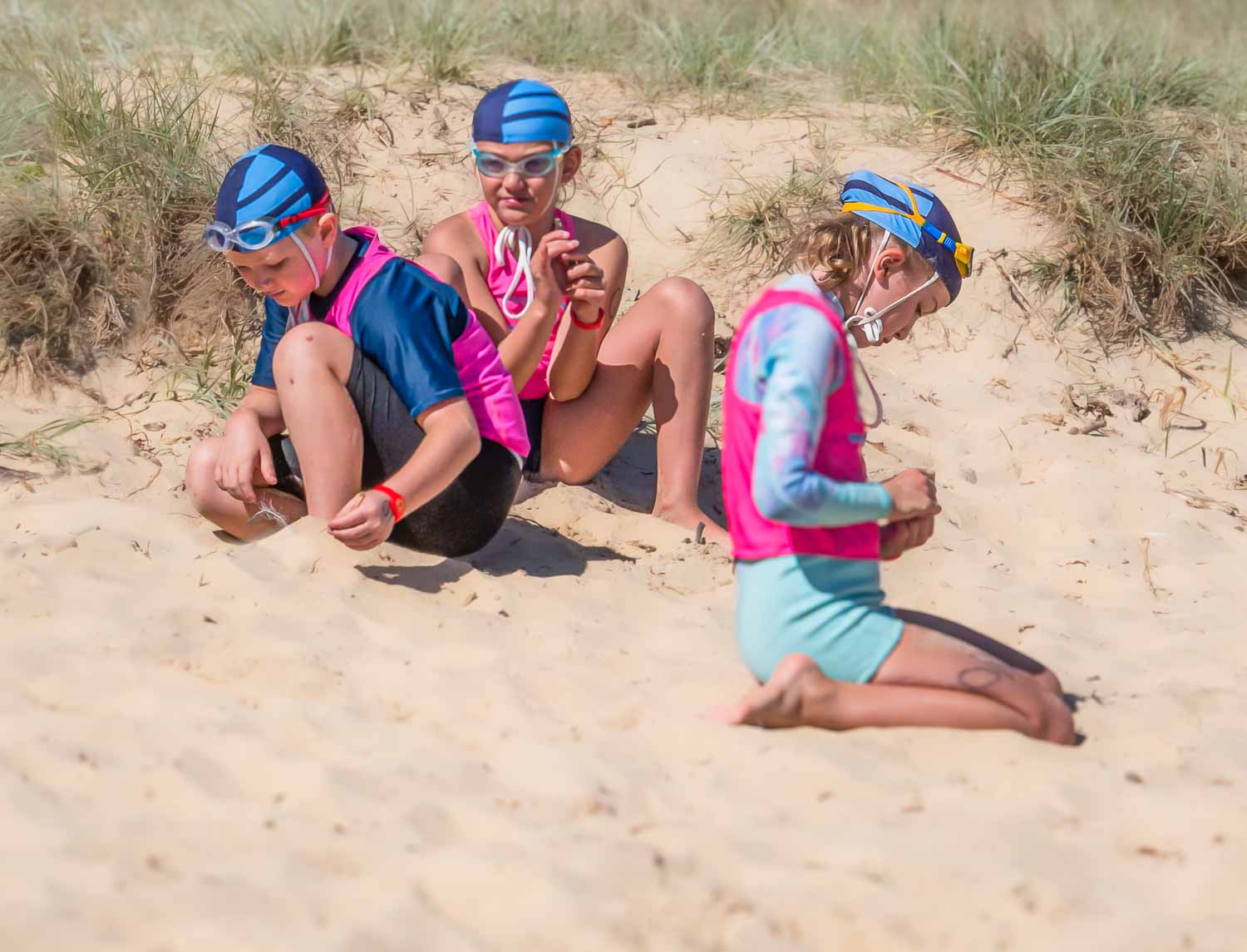
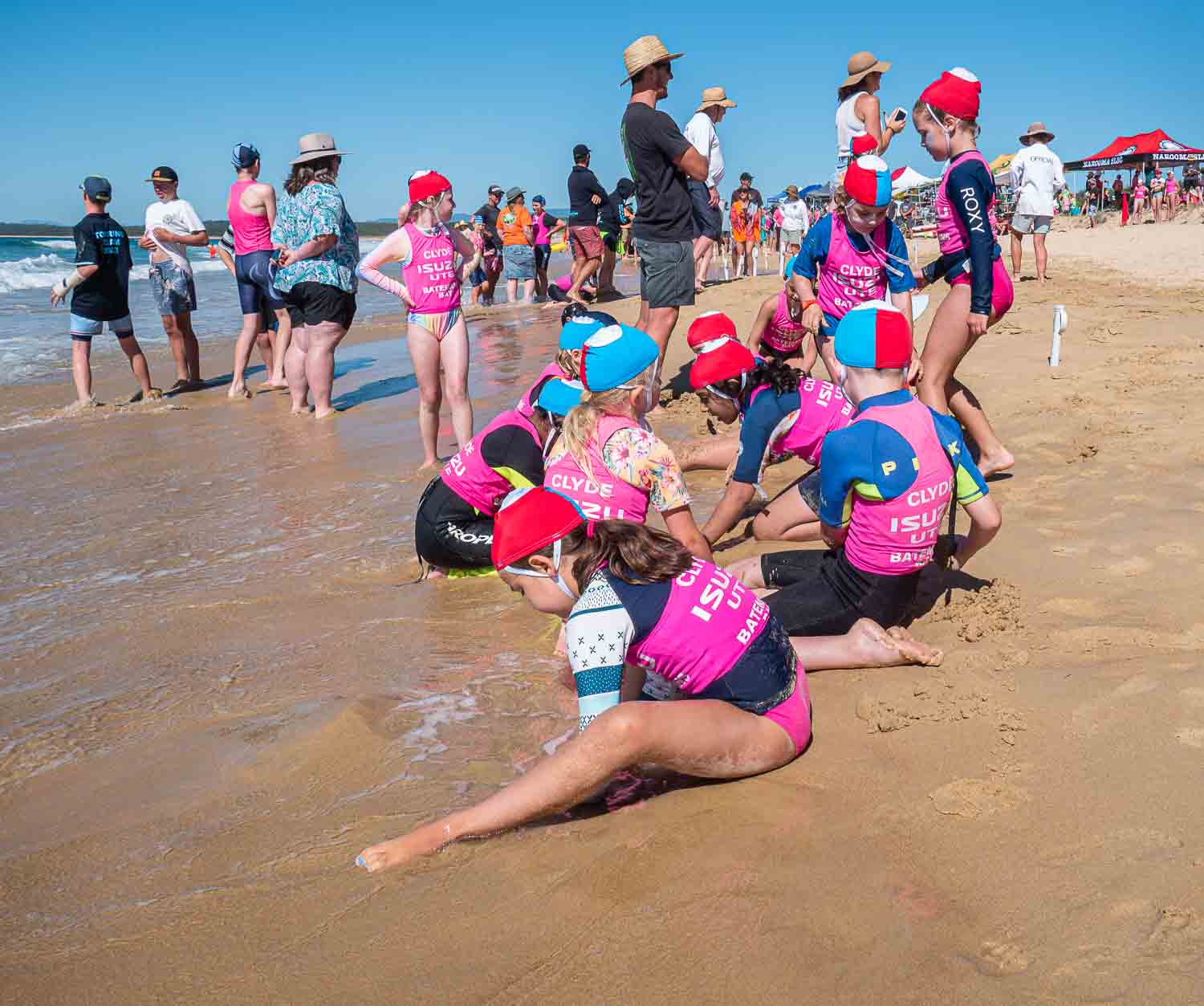
And those caps? They’re for visibility, a clear form of in-water identification. At carnivals the cap colours indicate the club. On beaches that are patrolled by SLSA they are worn by lifesavers while on active duty. The red and yellow quartered patrol cap has been an iconic symbol of the surf lifesaving movement for almost a century and makes lifesavers instantly recognizable.
The difference between lifesavers and lifeguards is lifesavers are volunteers who are part of surf lifesaving clubs. Lifeguards are paid professionals who work for the Australian Lifeguard Service, local council, or an alternate service provider. Where possible, lifeguards are recruited through the volunteer base provided by SLSA. Apart from first aid and resuscitation certificates, lifeguards must pass the following fitness tests: A minimum 400m swim, 800m run, 400m rescue board paddle and 800m run in the surf, all in under 25 minutes, plus an 800 metre pool swim in under 14 minutes, and rescue scenarios utilising a Rescue Board and Rescue Tube. They are clearly serious athletes.
Of course I knew there was surf lifesaving volunteers on Aussie beaches, and I knew that they were always recognizable by their bright red and yellow colours, but I had no idea the organisation had gotten so big. And so necessary. Last year sadly 125 people drowned at Australian beaches, but nearly 10,000 were rescued.
I wish I could have stayed longer, talked with some people there, asked some questions, but the others were waiting and it was time to get Sylvie the greyhound to the off-leash area so she could have some fun too. So with one last look back I join the others and we go watch the frolicking dogs.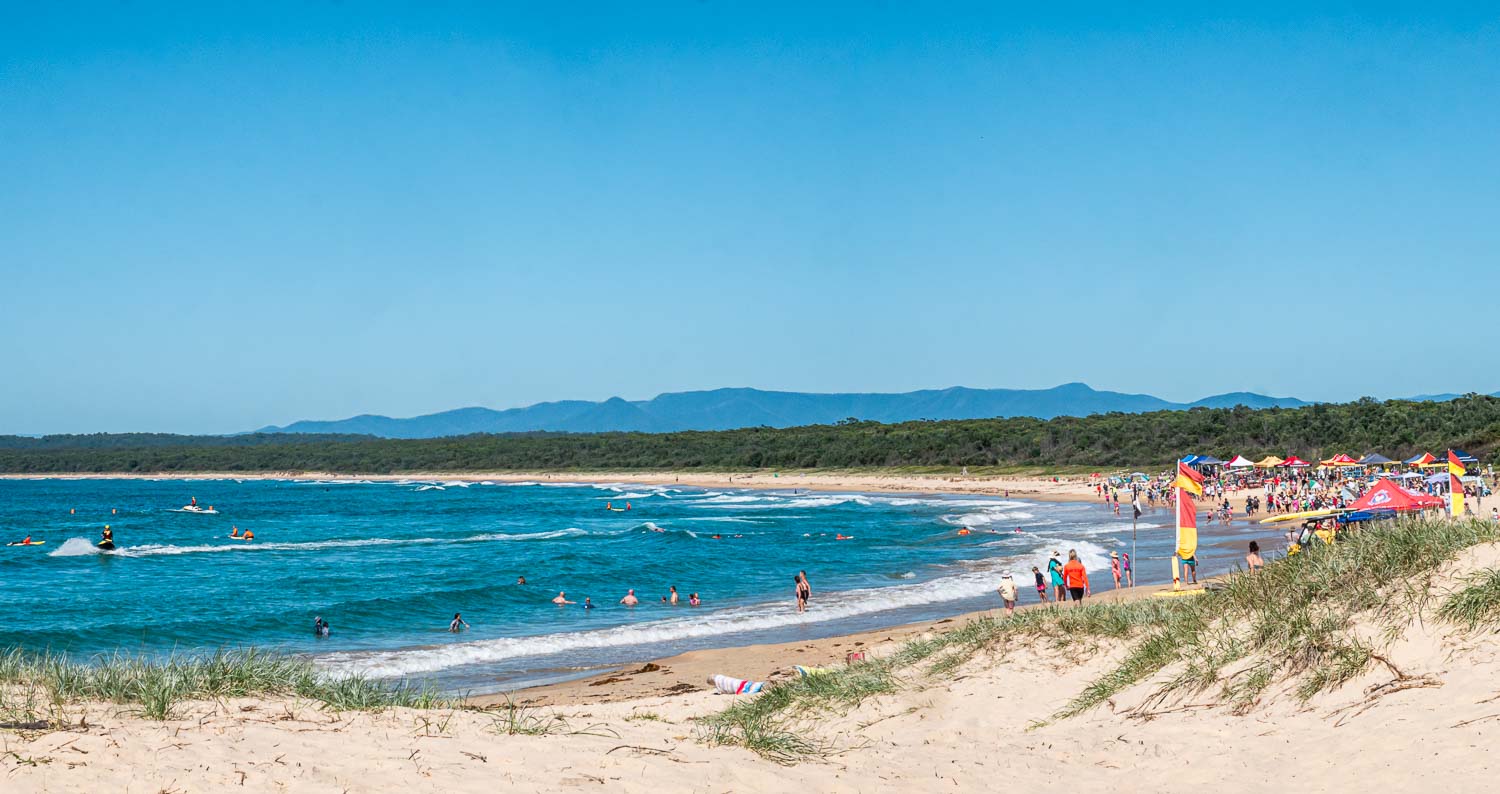
If you want to see some surf lifesavers at work on one of the busiest beaches in the world, watch a couple of episodes of Bondi Rescue. They’re paid professionals, rather than SLSA trained volunteers, but it will still give you a good idea of what beach safety entails and how they manage it.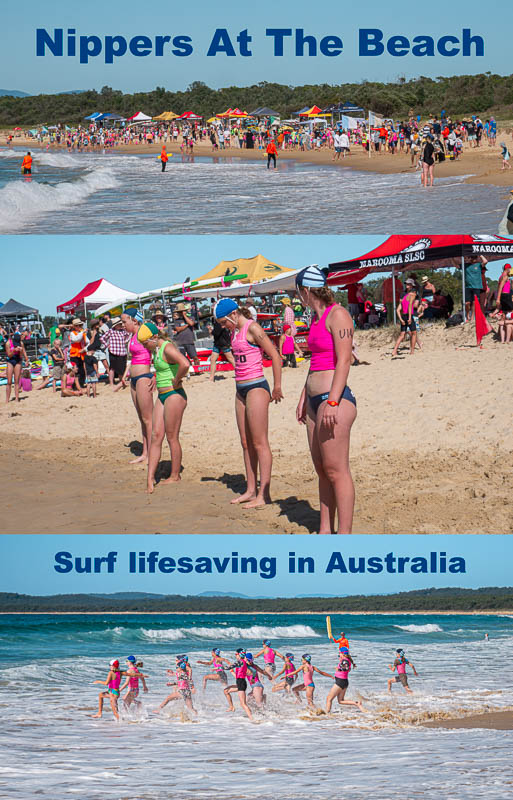
Broulee Beach is situated on what was and always will be Aboriginal land; the land of the Yuin Nation.
Next post: What? You thought I wouldn’t have any photos of surfers? A photo essay of surfer shenanigans coming up.
All words and images by Alison Louise Armstrong unless otherwise noted
© Alison Louise Armstrong and Adventures in Wonderland – a pilgrimage of the heart, 2010-2024.

 Adventures in Wonderland
Great post. We often see Nippers. ‘Bondi Rescue’ sure shows how important lifesaving and lifeguarding are in Australia.
LikeLiked by 1 person
Thanks Peggy. I’ve lived in Canada for too long I guess – I didn’t even know about the nippers, but am not remotely surprised. And I only just found out about Bondi Rescue. 40,000 people on the beach!! 😳 Madness.
Alison
LikeLiked by 1 person
Great! My twin grandsons will be doing this soon…..
LikeLike
Thanks Cindy. Putting this post together was such an education for me. I’m so glad we stumbled on the nippers carnival. And of course such things are happening in Cali too. I bet your grandsons will love it.
Alison
LikeLike
So great to have so many kids involved, learning valuable skills. And lucky for you to happen upon it! Maggie
LikeLiked by 1 person
Yes to all of that. It was fun to watch the kids, even if only briefly.
Alison
LikeLiked by 1 person
The sea and the beach still play a big part in life in Australia
LikeLiked by 1 person
It’s a huge part of life there. With so many fabulous beaches it’s an endless form of free entertainment.
Alison
LikeLiked by 1 person
What a wonderful way to grow up!
LikeLiked by 1 person
It really is. Even living in Melbourne as a child, where the best beaches are a good long drive away, we still spent all our summer hols at the beach. We never joined any SLS clubs though, not like in Sydney or the NSW/Qld coast where there’s dozens of them and the kids get so fit.
Alison
LikeLiked by 1 person
Alison, I enjoyed learning about this important aspect of Aussie beach life. Your photos are excellent and tell a great story. I was mesmerized by the swimmers and surfers on the beaches in Australia, especially Bondi. The waves were a bit too scary for me and I can imagine how dangerous they can be. Thanks for enlightening me! 🙂
LikeLiked by 1 person
Thanks so much Jane, I’m glad you enjoyed it. Beach life is so huge there that it’s no wonder surf lifesaving has become such a big part of the culture. And so necessary.
Alison
LikeLiked by 1 person
Amazing photos. You really feel like you are on that beach.
LikeLiked by 1 person
Thanks so much rabirius. That’s a great compliment!
Alison
LikeLike
Wow, that’s a massive operation, Alison. It really speaks to how seriously Australians take their beach life.
LikeLiked by 1 person
It *is* a massive operation! I had no idea. And yes, very much indicative of the importance of beach life in Oz.
The more I researched it the more overwhelmed I got, but think I managed to distil the essence of it. Beach culture rules!
Alison
LikeLike
And may it rule on! 🙂
LikeLiked by 1 person
With a country surrounded by water and with so many wonderful beaches, it’s not surprising they have a large volunteer organization like this. The caps are amusing.
LikeLiked by 1 person
Probably because I’ve not lived in Australia for so long I was not aware of how big the whole organization had become. As I researched into it I was amazed. But it’s not surprising really because it’s so necessary. The caps are kinda amusing aren’t they, but also necessary – especially for the SLSA lifesavers on duty.
Alison
LikeLiked by 1 person
I love that the children’s division is called “nippers.” That’s a word we don’t use often enough, at least in America!
I saw a couple episodes of the British volunteer force (I forget the name now) and remember being shocked that the entire country of Britain owed its sea rescue to a volunteer organization. I saw some of them a few years later at a summer festival when I was on a house-sit in Weston-Super-Mare, which is on the coast.
So I was not as surprised as you to learn that the Australian organization is as large as it is, though I am *still* shocked that people “volunteer” (it’s a lifestyle choice, I expect).
The caps are absolutely ridiculous on land, but I can see the value in having something easily recognizable in the water. It’s the same reason medieval knights and troops had banners – how else do you identify them on the battlefield?
LikeLiked by 1 person
Nippers is such a Brit word, where much of the Aussie colloquial language comes from. And it’s so Australian to use it in this way.
I admit I hadn’t even ever thought of sea rescue in the UK since I never think of it as a beach place. But It’s obvious really. I mean any island has to have something in place for water rescue.
People volunteering – the beach culture is so ingrained and so huge that it’s not surprising. There’s kudos in it for sure, but also a love of being at the beach, and treating it as an athletic endeavour. Plus the numbers required make it pretty impossible to do it any other way – like the rural fire brigades in Oz and Canada (and the US?).
I did not know about the banners for medieval knights!
Alison
LikeLike
Pretty amazing numbers, Alison, and those kids look so fit! I like seeing that. As usual, you did a great job researching and explaining. The jolt of color is nice on another gray day, too. 😉
LikeLiked by 1 person
Thanks so much Lynn. The numbers come from how much time Aussies spend at the beach; the culture is ingrained. I too noticed how fit those kids are! The whole surf rescue thing is such an athletic endeavour. If someone’s in trouble you have to be fit enough to get to them. And get them back to shore. I hadn’t really thought about that until researching for this article.
Spring is coming . . . . .
Alison
LikeLiked by 1 person
As an ex-lifeguard (not in heavy surf, though), I found this so fun to read! Love the colorful photos, too.
LikeLiked by 1 person
Thanks so much Lexie. Glad you enjoyed it.
I really knew very little about it, and was completely gobsmacked that it’s grown so big over all the years I’ve been living in Canada.
Alison
LikeLike
At their age, I didn’t even dare to go too far into the sea. Well, my mom forbade me anyway. I think it wasn’t until I was in my 20s when I first waded through the waist-high water off one of the small islands to the north of Jakarta, and it felt great. It’s good to see how Australians have learned the basics of lifesaving since such early age, given the country’s beach culture.
LikeLiked by 1 person
I didn’t learn to swim until I was 8, which these days would be considered very late. They now have pool classes for mums and newborns, and actual swimming lessons by the time they’re toddlers.
I can imagine how wonderful it was for you to finally wade in to waist height. It’s an amazing experience to be immersed in water, to feel comfortable in it – I’m thinking of all the times I’ve been snorkelling and there’s something so magical about it. I hope you get to experience that one day. Get (rent) a good flotation life jacket and put on a mask and stick your face in the water. It’s amazing. There must be some really good snorkelling places in Indonesia.
Alison
LikeLiked by 1 person
The first time I snorkeled was in 2013, in the waters around the small islands off the eastern coast of Flores in Indonesia. The current was very strong, so in the first few minutes I panicked a bit and decided to swim closer to the shore. But once I calmed down, there was a magical underwater world I couldn’t take my eyes off. The best snorkeling I’ve had to date was in Banda, a chain of remote islands where nutmeg originally comes from. The coral reefs were so big and pristine. Where did you have the most unforgettable snorkeling experience so far?
LikeLiked by 1 person
Ah, so of course you learned to swim! What was I thinking?! My apologies. Somehow I thought you didn’t, and that up to your waist was all you went 😂
Even if you didn’t learn to swim until your 20s it sounds like you made up for lost time though. Isn’t snorkelling so special! It’s one of my fave things. Best experience by far was the GBR – just extraordinary. Then Bali would be 2nd best I think. Banda sounds amazing.
Alison
LikeLiked by 1 person
😂 My mom made sure I knew how to swim since I was little. But she never allowed me to go too close to the sea. It was only after I started living independently did I begin doing all those adventures, including climbing a volcano. She only shook her head in disbelief when I told her about all this. 😂
I really want to see the GBR.
LikeLiked by 1 person
Your mom was very special I think.
LikeLiked by 1 person
Great post with so many beautiful and colourful photos, Alsion. This reminds me of Surf Patrol, Australia’s Lifesavers an Australian reality television series I used to watch ages ago. I only wish we had a similar programme here in Ireland too which would provide the necessary skills and education to enable the youth of today to progress in lifesaving and surf sports as they grow older. Thanks for sharing, and have a great day 🙂 Aiva xx
LikeLiked by 1 person
Thanks so much Aiva. The SLSA is doing such a great job of teaching good lifesaving skills from a young age, but given Australia’s obsession with being at the beach it’s not surprising really. Even so, I think all island nations need something in place for coastal rescue. Glad you enjoyed the post. Have a great day yourself! 😁
Alison
LikeLiked by 1 person
🥰🥰🥰
LikeLiked by 1 person
I have never heard of surf lifesaving carnival, but it makes sense in a land that has so much coastline. That sounds, and looks, like a great sport for young people to participate in and learn water safety at the same time.
LikeLiked by 1 person
The carnivals are huge, as I’m sure you’ve gathered from my post. I just got to see a little of a junior carnival, but even the local adult ones are big events. I’d love to see one at Bondi one day.
I knew the carnivals existed but had no idea what they entailed, or how many events there were. This blog has me always learning, and yes I agree, it looks like a great sport, and totally suited to the Australian environment.
Alison
LikeLiked by 1 person
I agree that writing a blog always keeps one learning. It’s the research about the events and places (for a travel-related blog). This was a fun one to read.
LikeLiked by 1 person