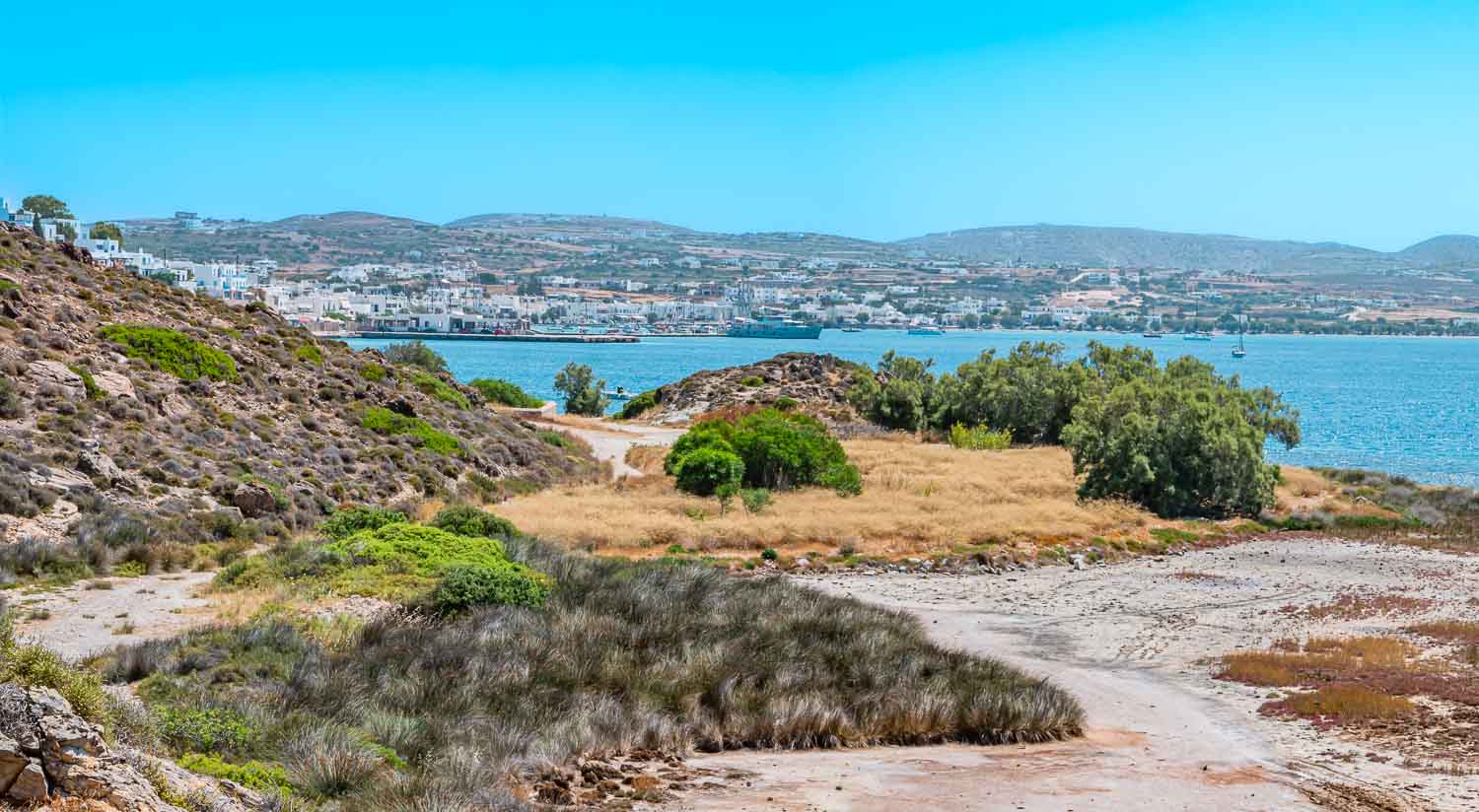
14 June 2022. We’re getting a bit concerned waiting for the ferry in Naxos. We wait and wait, wondering if we have the time wrong. Or the day. Where is it? We don’t know what else to do but to keep on waiting, watching as various vehicles arrive at the dock, conclude some business or other, and then leave. But where’s the ferry? At last other people arrive and join us. The ferry will be an hour late they tell us; they’d received a text. We had not, since we never had been able to chase down a local sim card in Greece. At least there’s shade. Even with our get-there-too-early travel style and then having to wait the extra hour, in the end the late departure is a blessing.
A few decades back Greek ferries had open decks as well as inside seating. Some still do, like the overnight ferry from Athens to Crete. But now the ferries on most of the shorter runs are all modern fast fully-enclosed water buses. So I have little idea what’s happening outside, especially as the sky darkens and night comes. On arrival at Adamantas on Milos Island I’m concerned with only two things – gathering all the luggage (two cases, two backpacks, and my camera bag), and finding a way to our hotel. As it turns out there are no taxis, and anyway our hotel is only 400 metres away, so walking it is. Normally this wouldn’t be a problem, but I’m dealing with all the luggage since Don’s hernia has clearly made its presence known so we’re trying to keep him in one piece until we get home; so no lugging luggage for him.
As I start hauling all our bags along the uneven pathway something makes me stop and look back towards the dock. It’s a heart-stopping moment. Right there rising over the water is the full moon, bright orange against an indigo sky.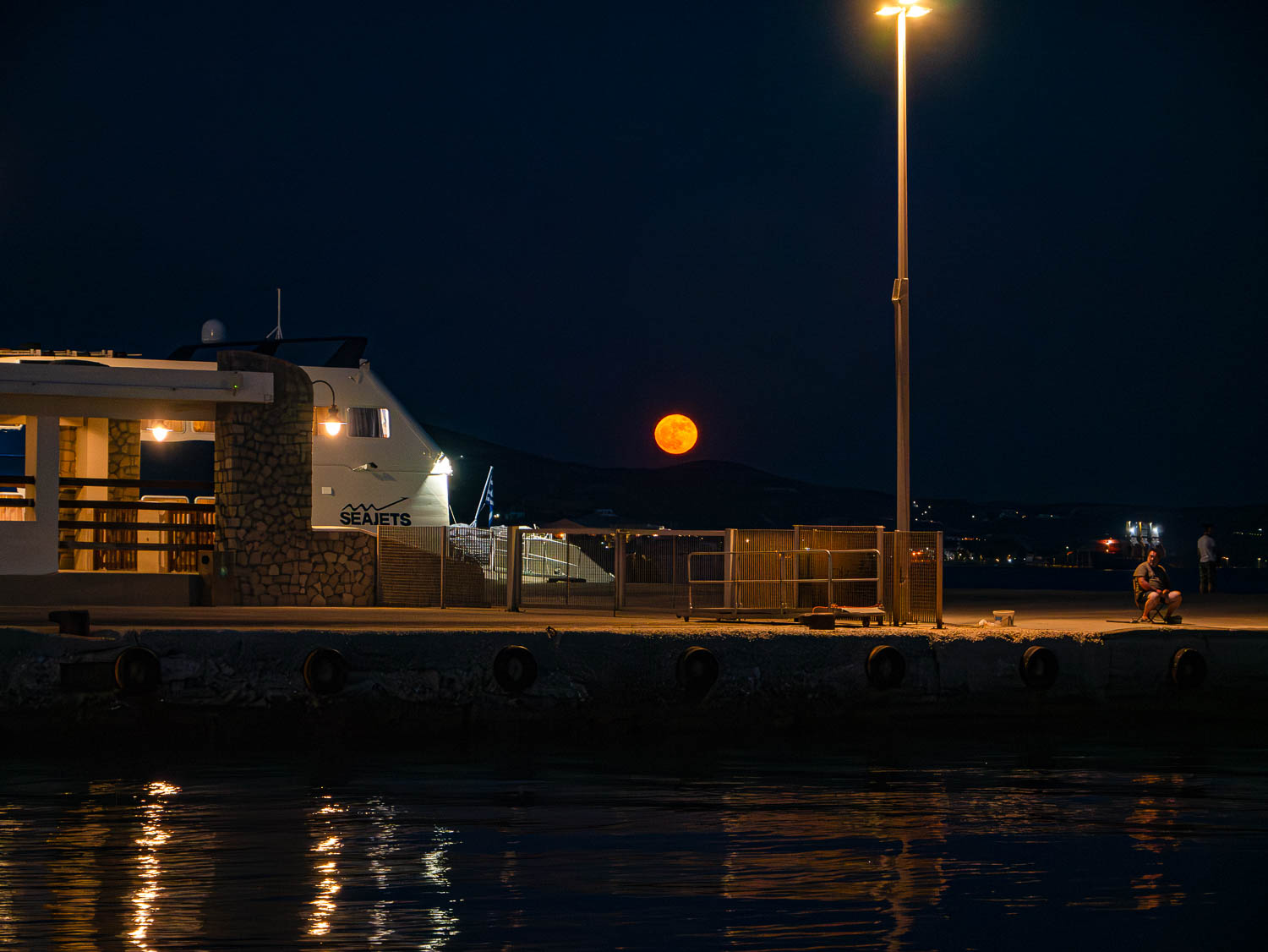
Stop. Breathe in. Breathe out. Beauty. Joy. A moment of gratitude and grace. A reminder that travelling, and moving from place to place, beyond schlepping luggage, and trying to find our accommodation for the night, there is still this, this! This eternal natural symbol that the world is turning as it should; this emblem of the rightness of things; a full moon rising.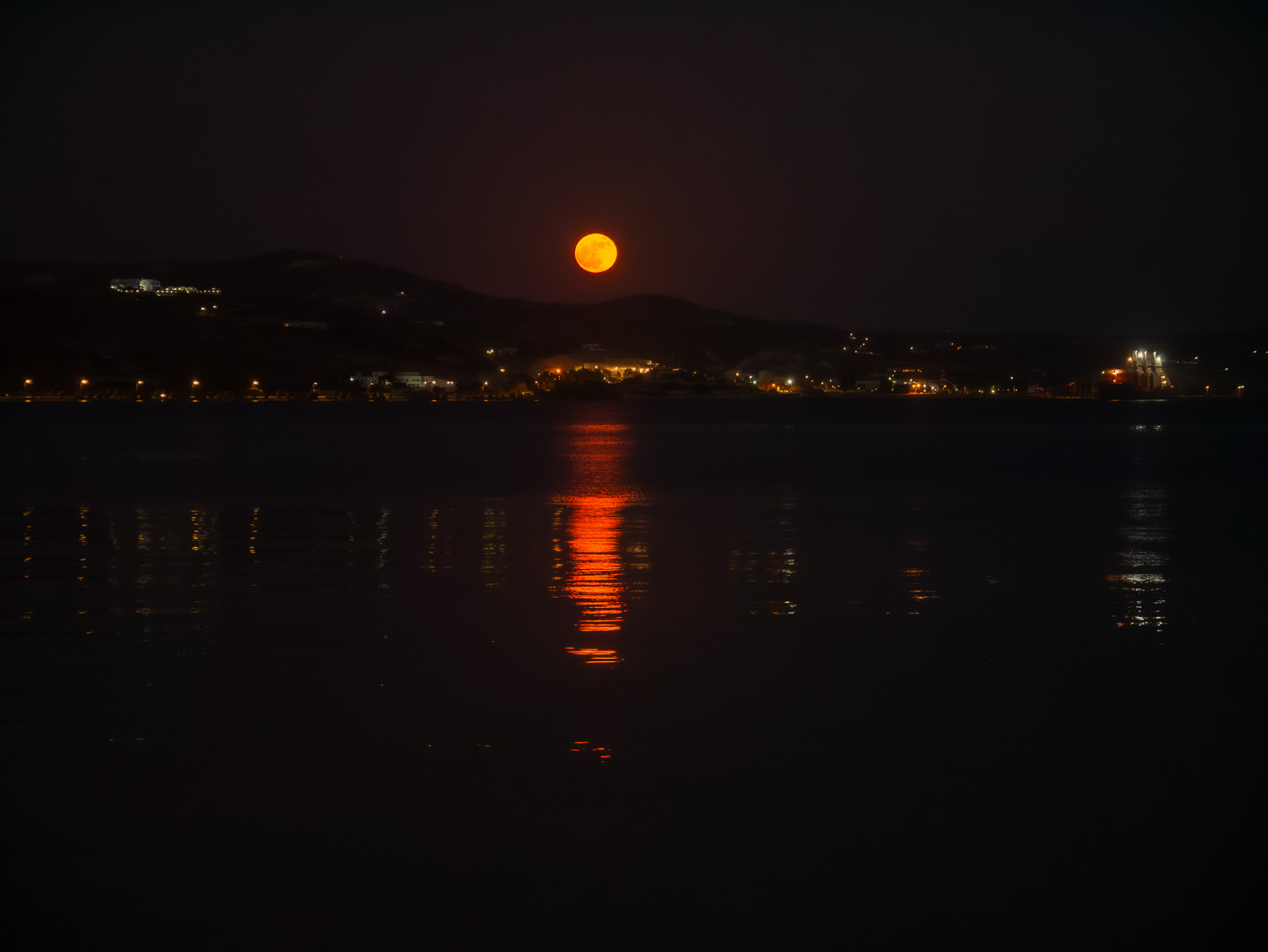
We hadn’t been paying attention to the weather. We’re in Greece in June, so of course it’s hot and dry, every day. Much less have we been paying attention to the phases of the moon. And here it is – this lucky moment, to remind us of our place in the universe, and that all is well, and that everything is magic.
Thus, a charmed arrival time and incandescent welcome to the island of Milos.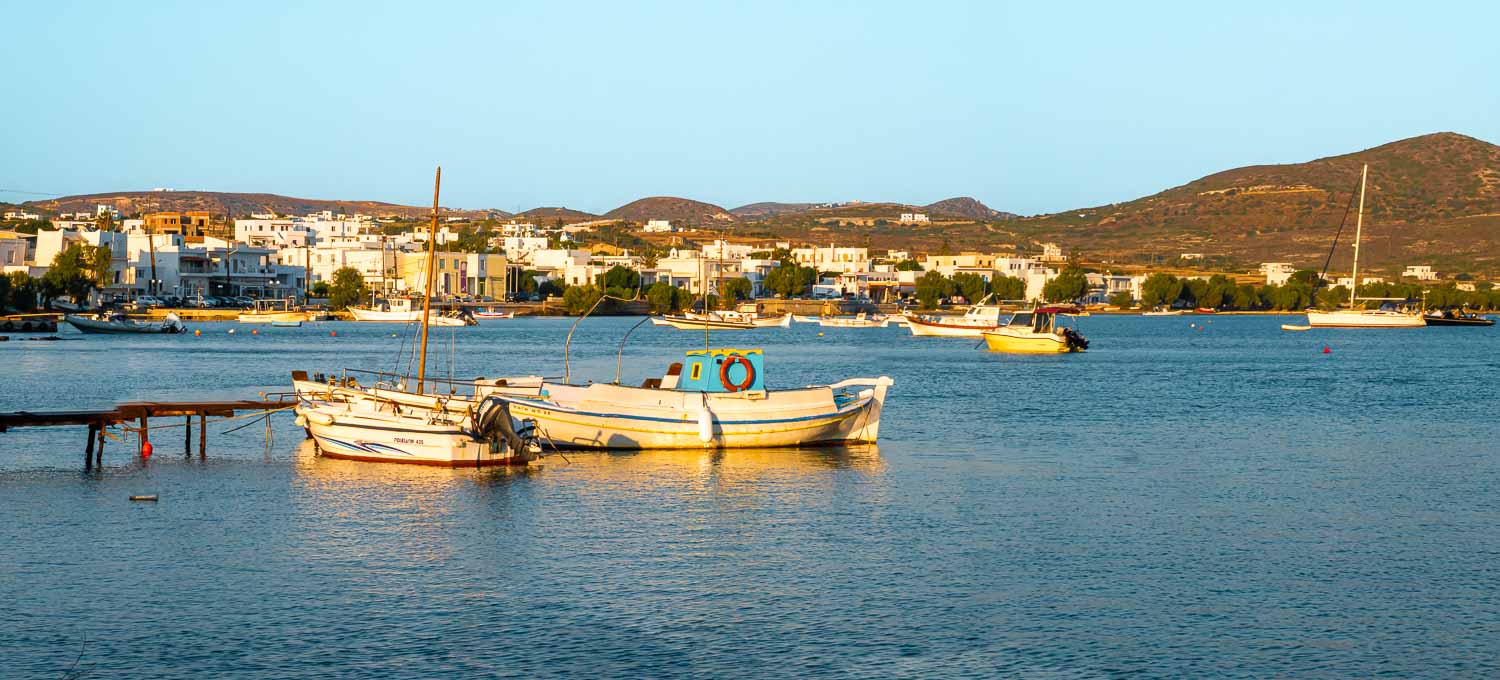
Milos is not like Santorini with its tourist vibes, conspicuous consumption, and stunning scenery that can lull you almost to sweet oblivion, or like family-friendly Naxos with it’s world-class beaches that go on forever. Milos apparently has more than forty beaches, though I’d hardly call any of them a beach so much as a meeting of land and water. This is not to disparage them; far from it. The Milos shoreline is an endless parade of extraordinary rock formations, of bright colours, of tiny bays and grottos notched into multi-coloured cliffs. There is nothing common about the beaches of Milos, but they are mostly difficult to access; some look to have very rough sand, let’s call it gravel; they’re small and have few or no facilities; and anyway I don’t think anyone should go to Milos for the beaches. That’s not what this island is about. If you want beaches go to Naxos (and probably plenty of other Greek islands), but if you want something really unique, something really special, go to Milos.
Milos is about this,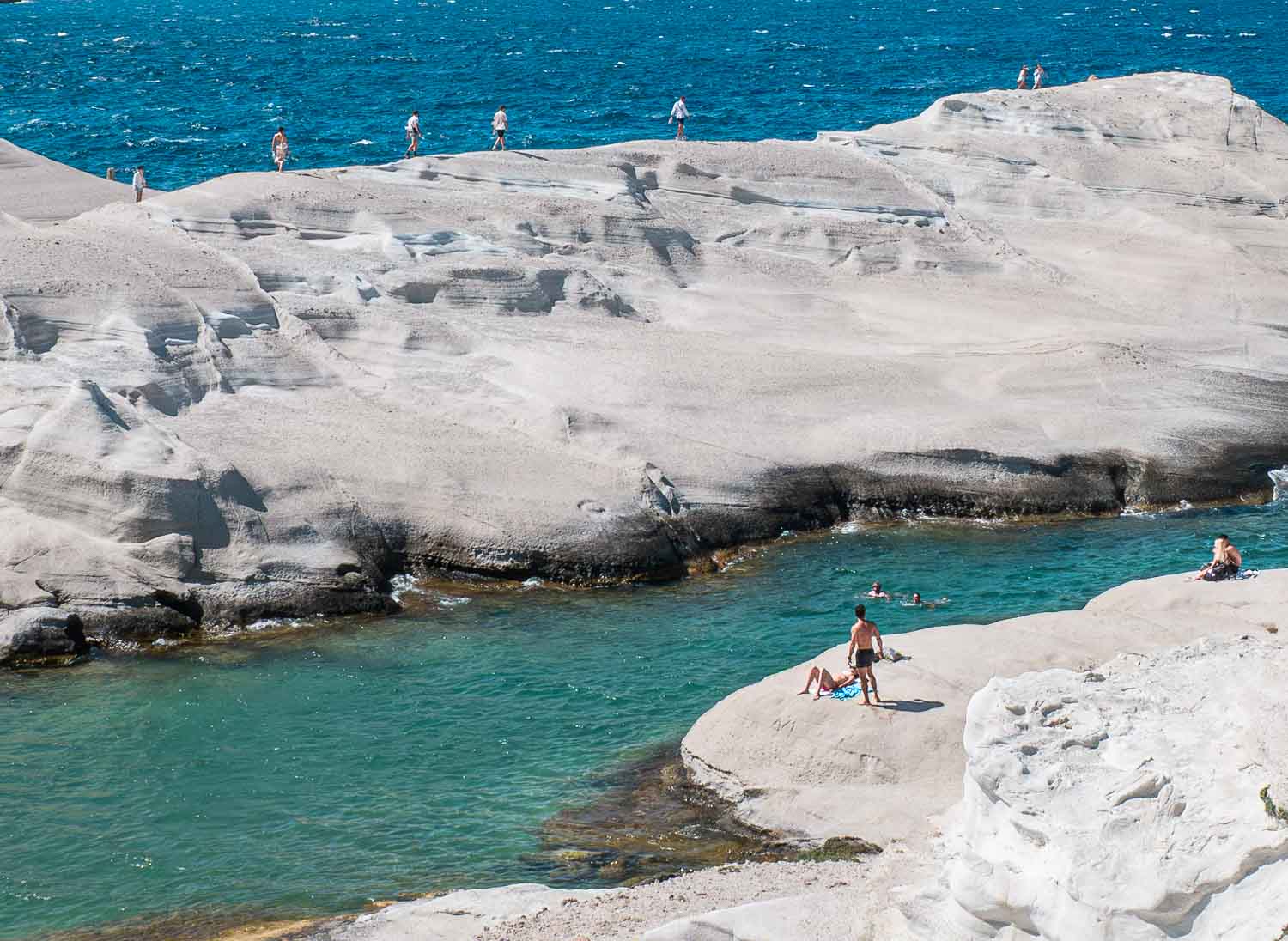
and this.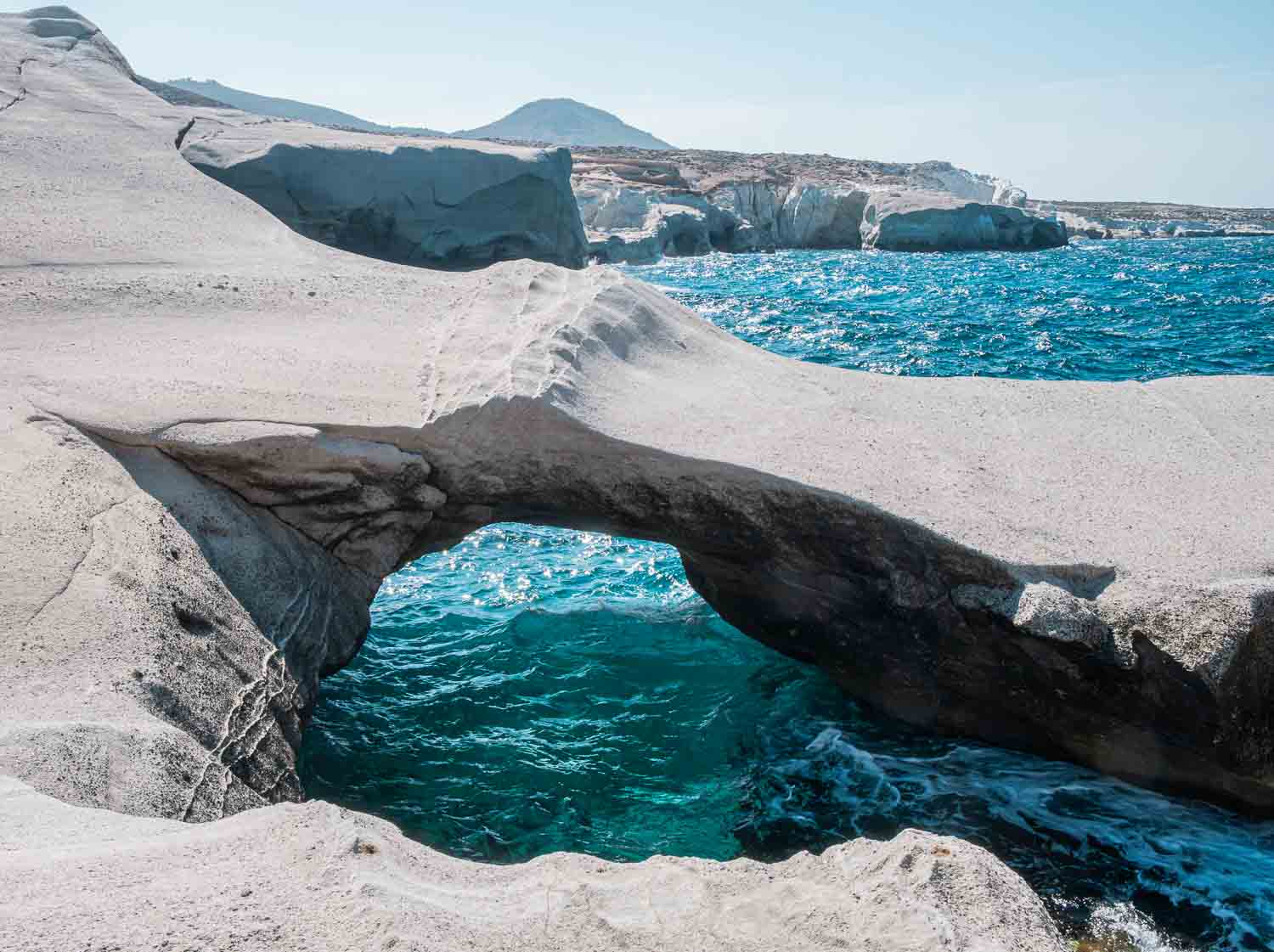
On a cruise that circumnavigated the island I see some of the beaches of Milos, and I’ve looked at plenty of pictures online, but this is the only beach we actually go to. This is Sarakiniko.
We take the bus from Adamantas and arrive here: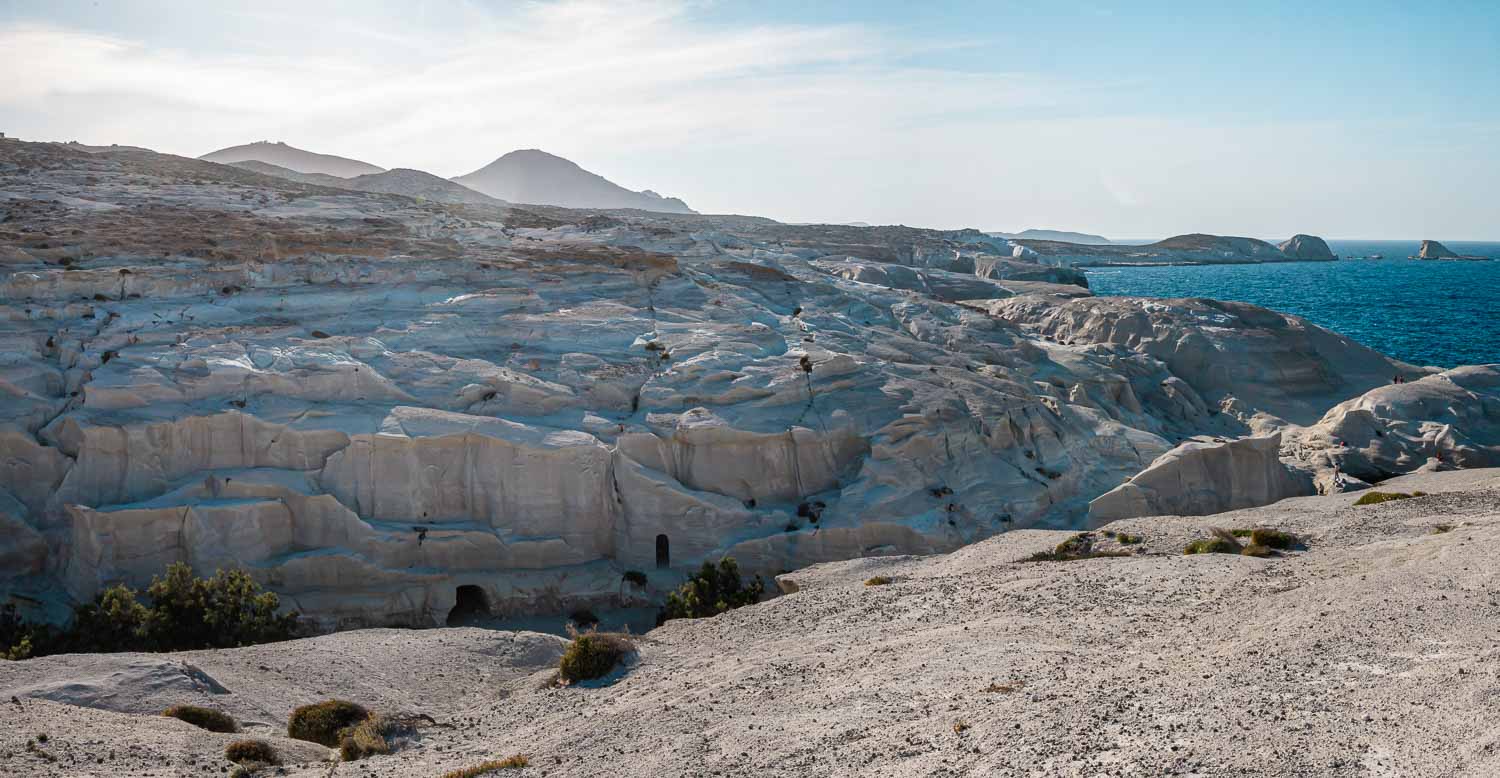
And then we walk.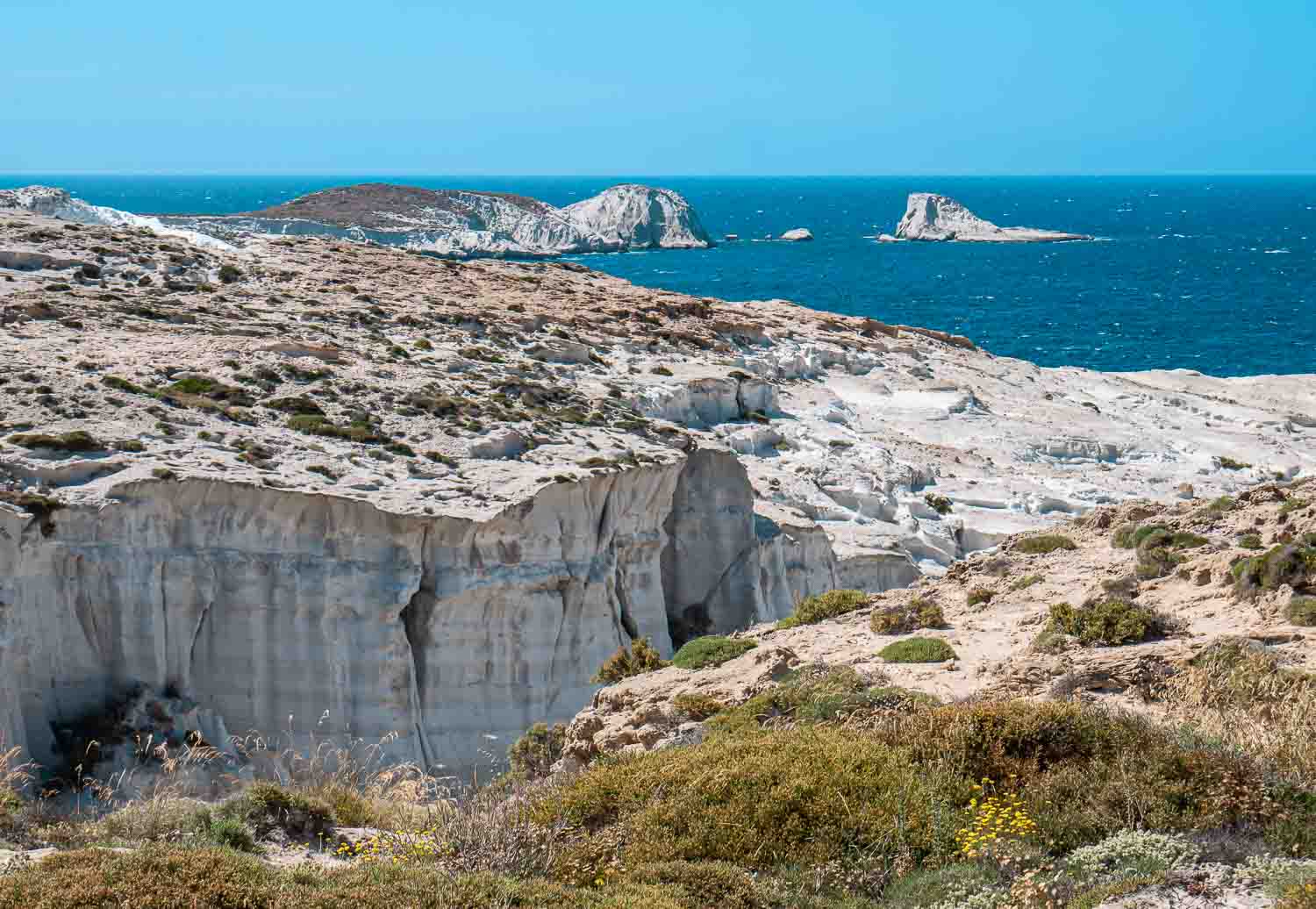
Across and down, across and down, over an unearthly bright bone-white landscape of wind-sculpted ledges and valleys,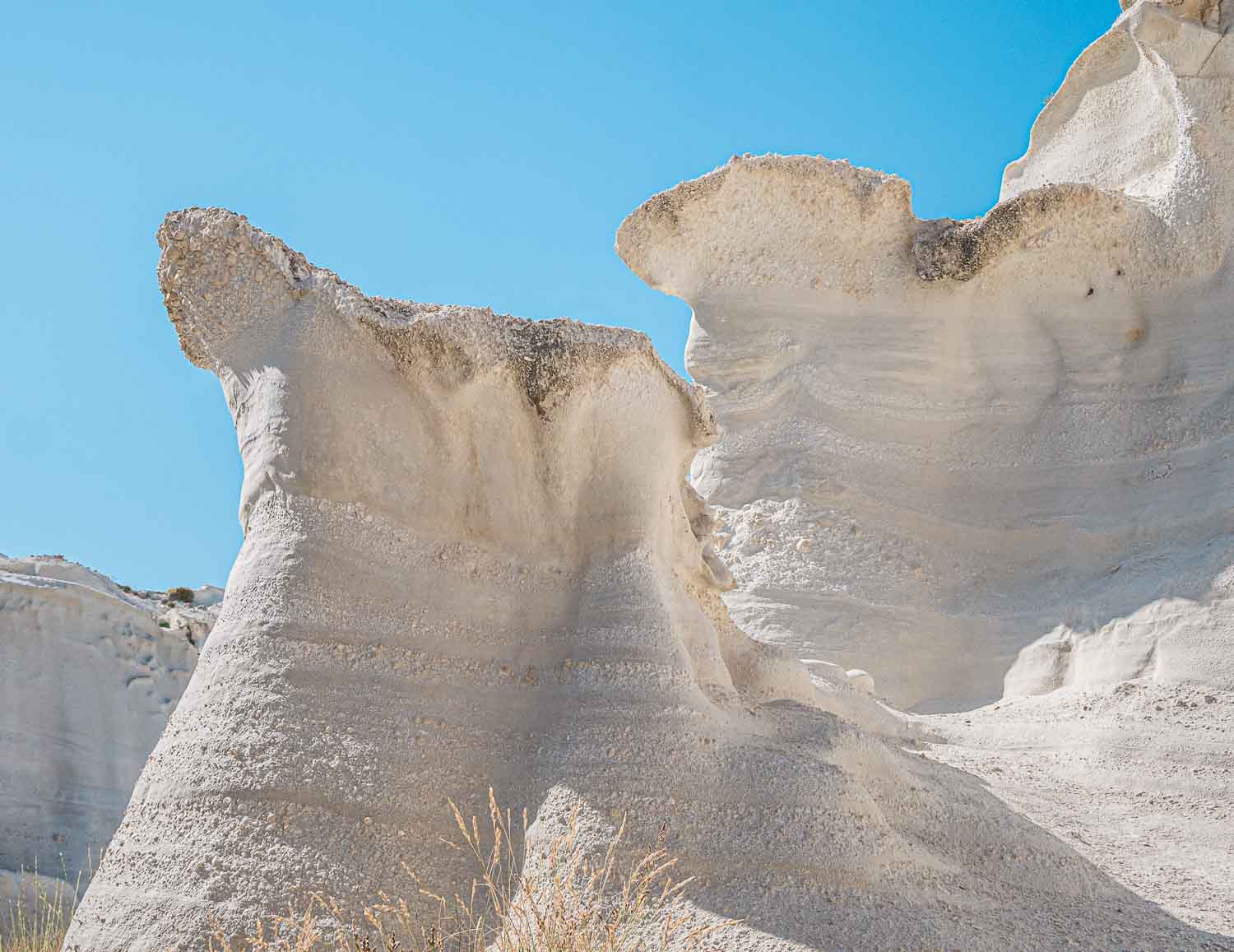
crevasses, crevices and cliffs,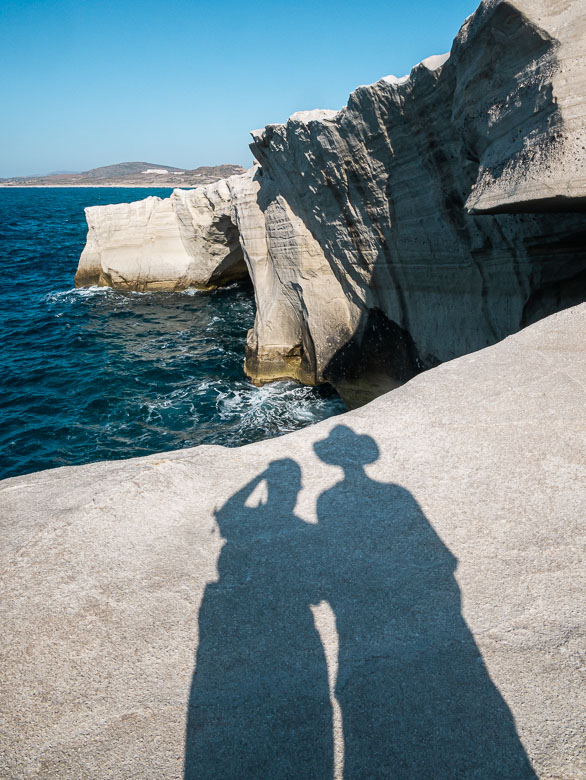
until we arrive at last at the small beach.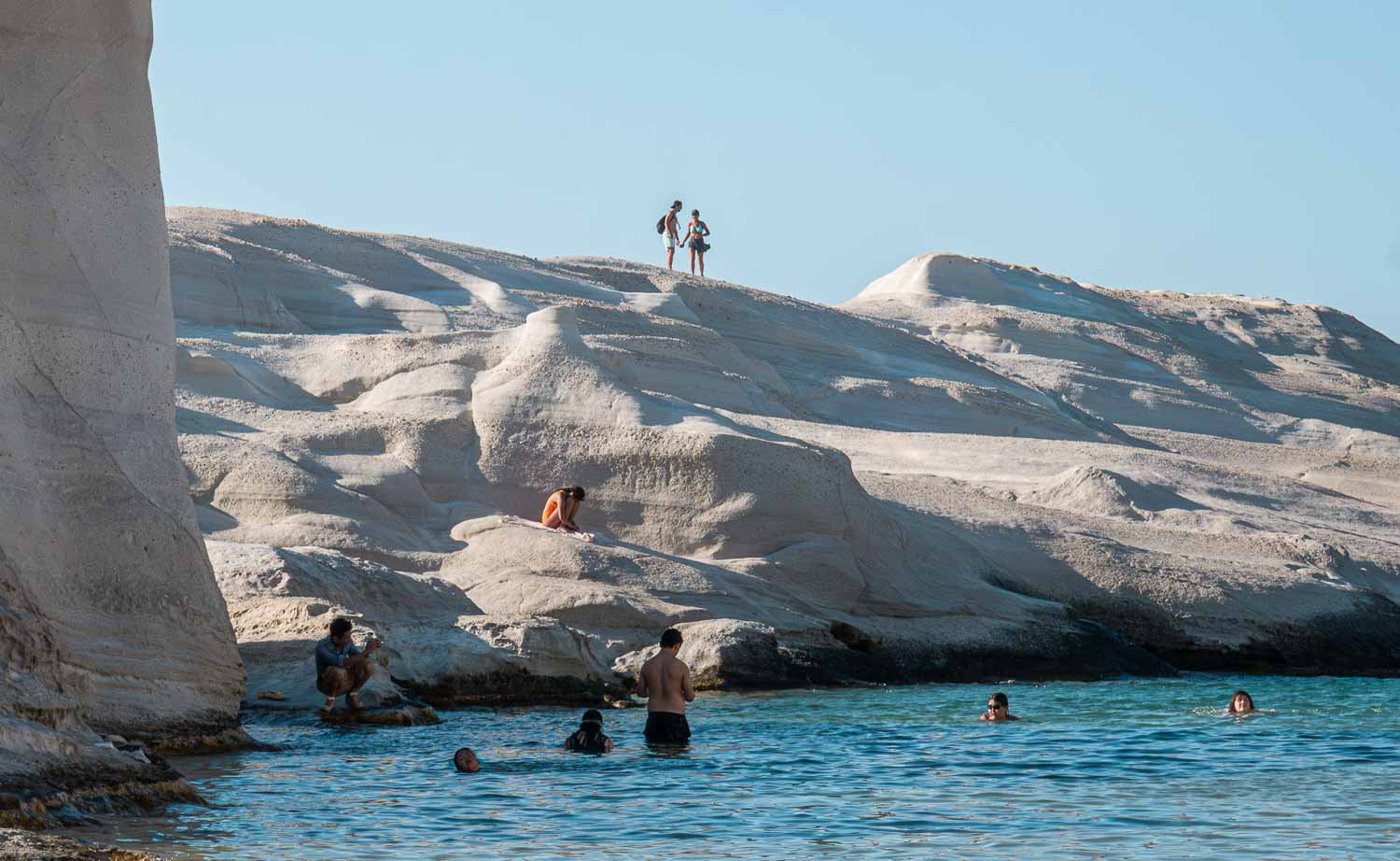
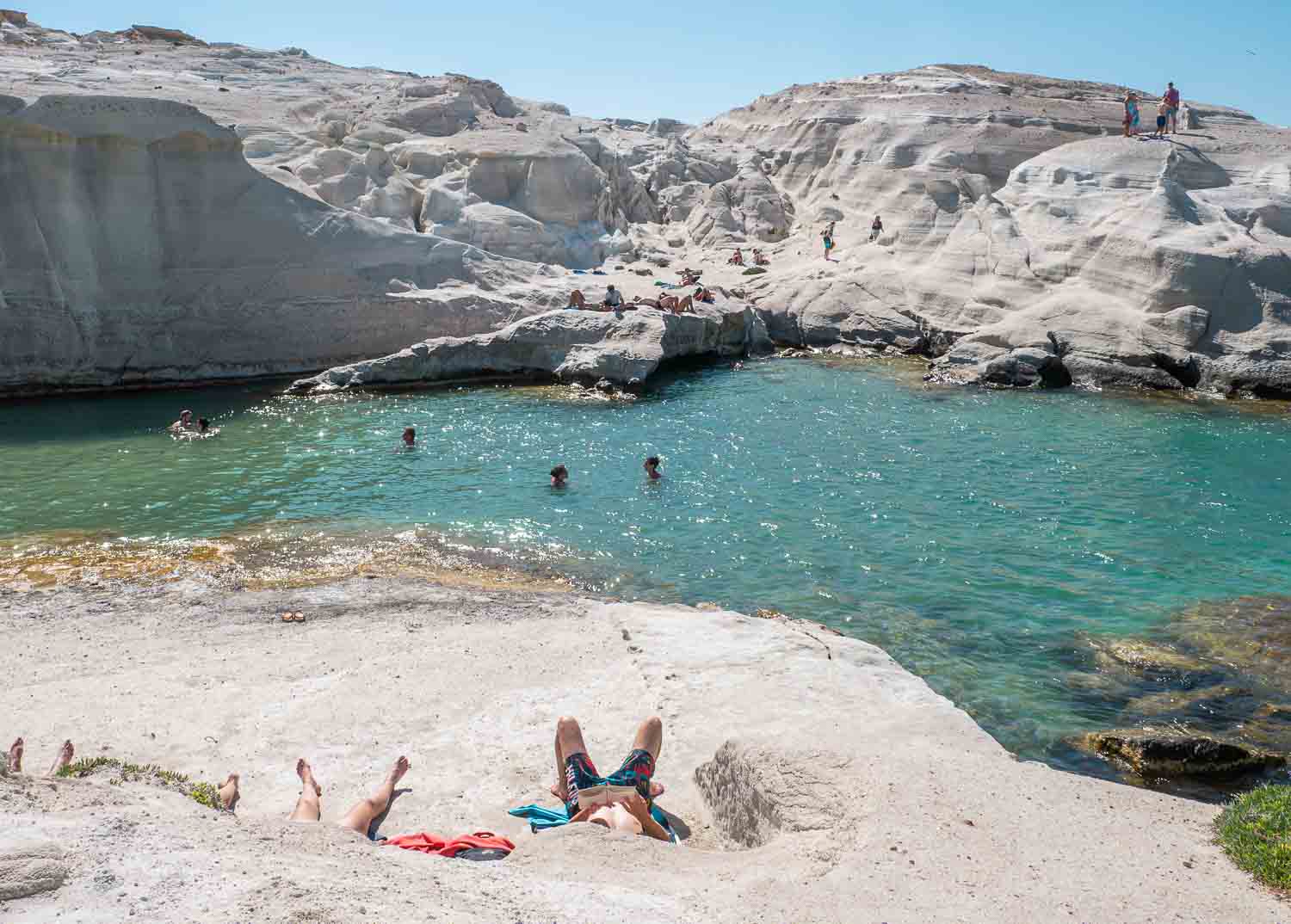
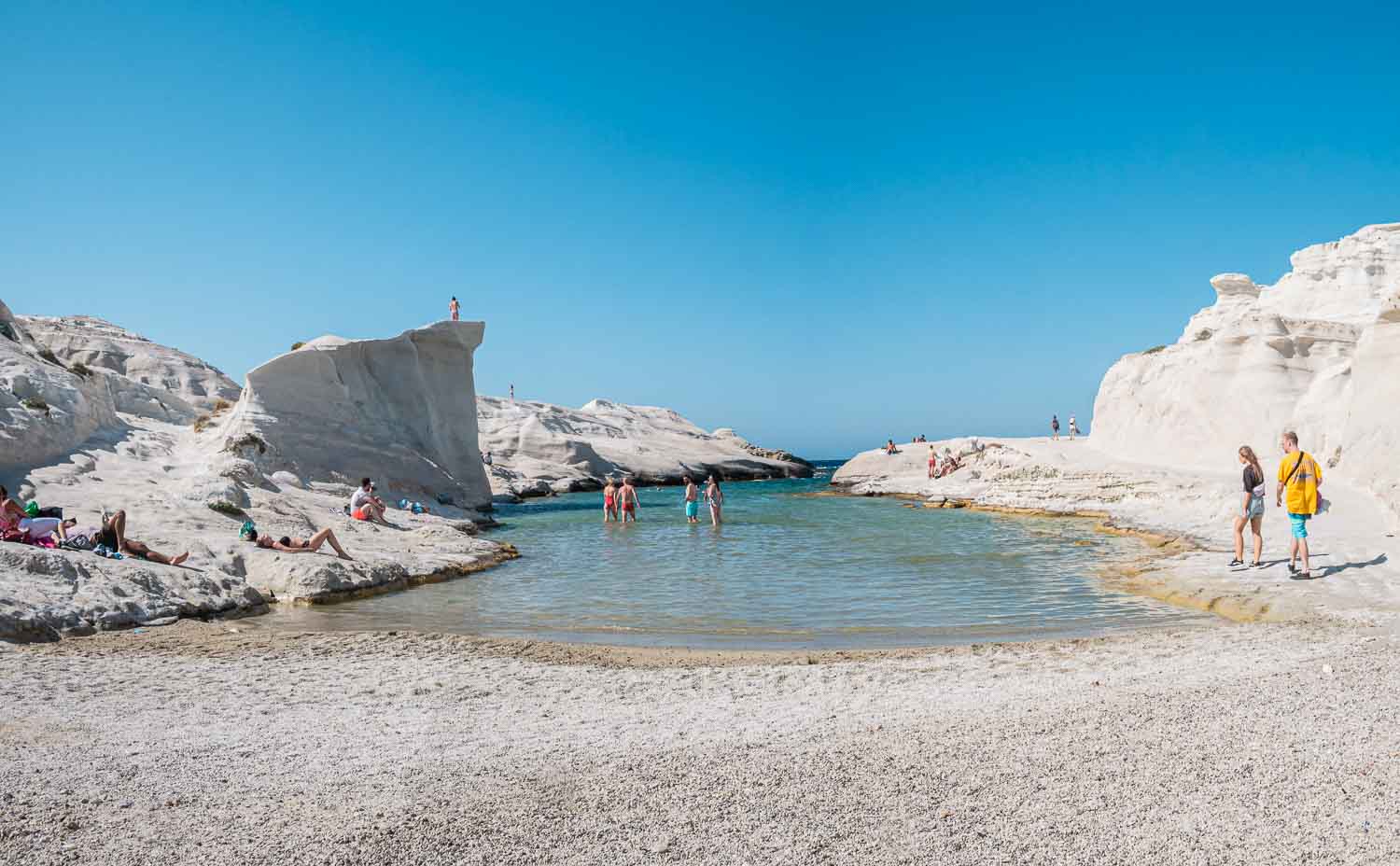
This other-worldly stretch of coast is named for buccaneers. The rocky shore, filled with coves and caves eroded by the sea, is steeped in the stories of pirates. The name comes from the Saracen (Sarakinós in Greek) pirates who sheltered here before heading out again into the Mediterranean. This Saracen hideout was also used by other marauding groups; Sicilian, Ottoman, and Barber pirates also took safe haven here. For several centuries Sarakiniko was the headquarters of the Aegean pirates. With a convoluted volcanic landscape such as this to hide in it was the perfect place.
But we are several centuries removed from this ruthless band and have no reason to fear marauders hiding in the caves below. It’s time to go exploring.
Almost every mention of Sarakiniko I find online warns that there is no shade. It is all lies. We stroll a short distance inland from the beach to this: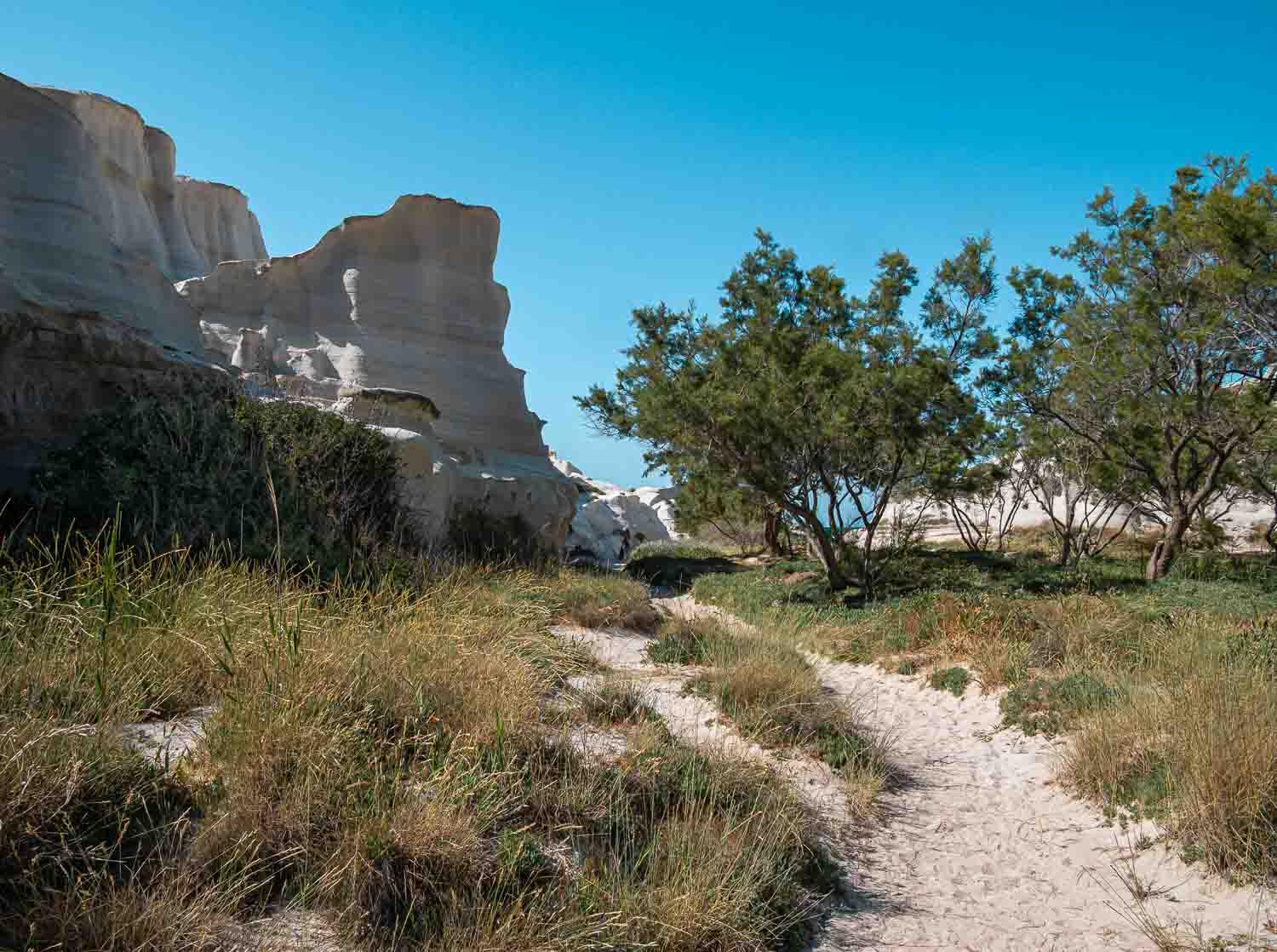
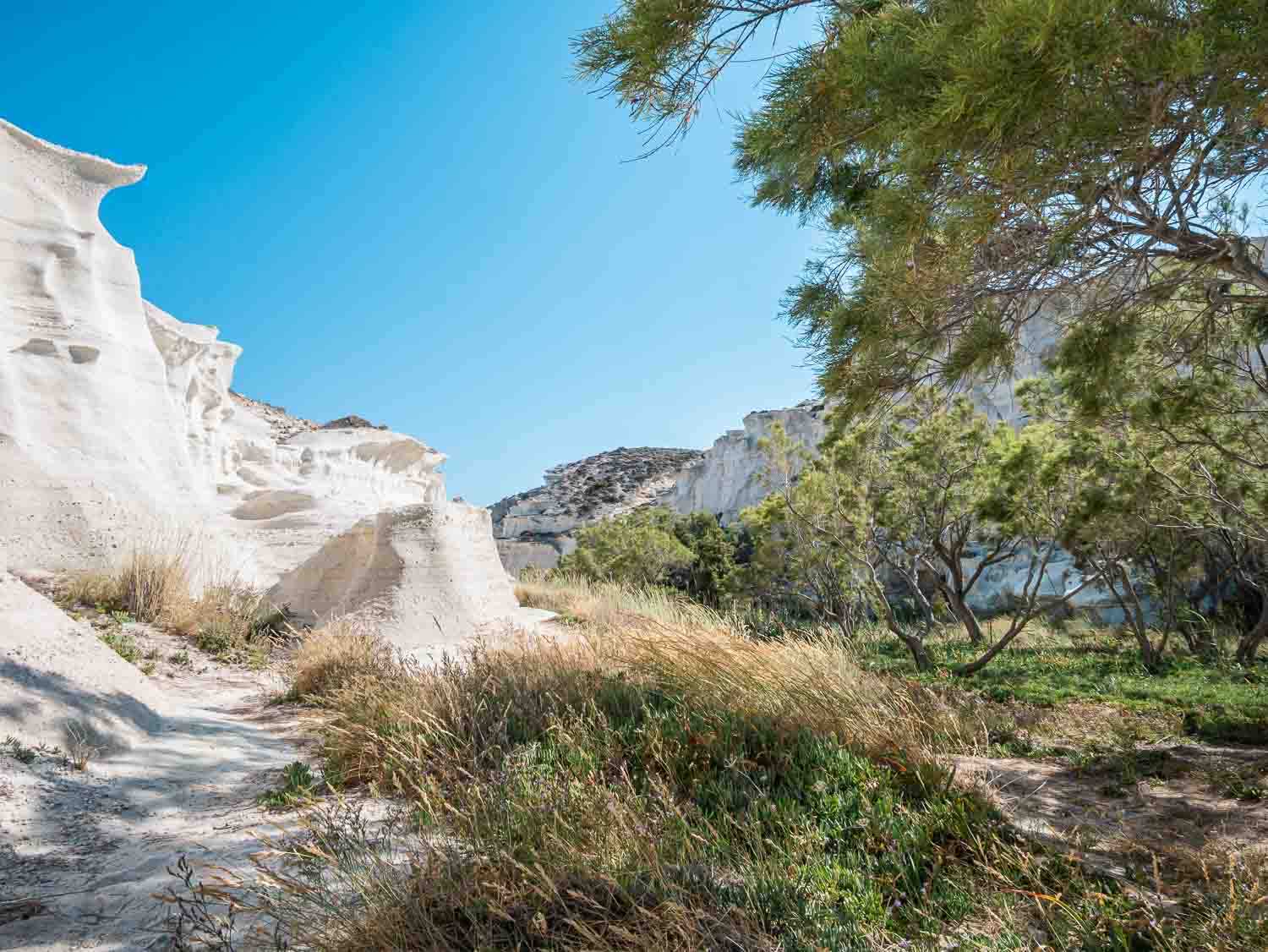
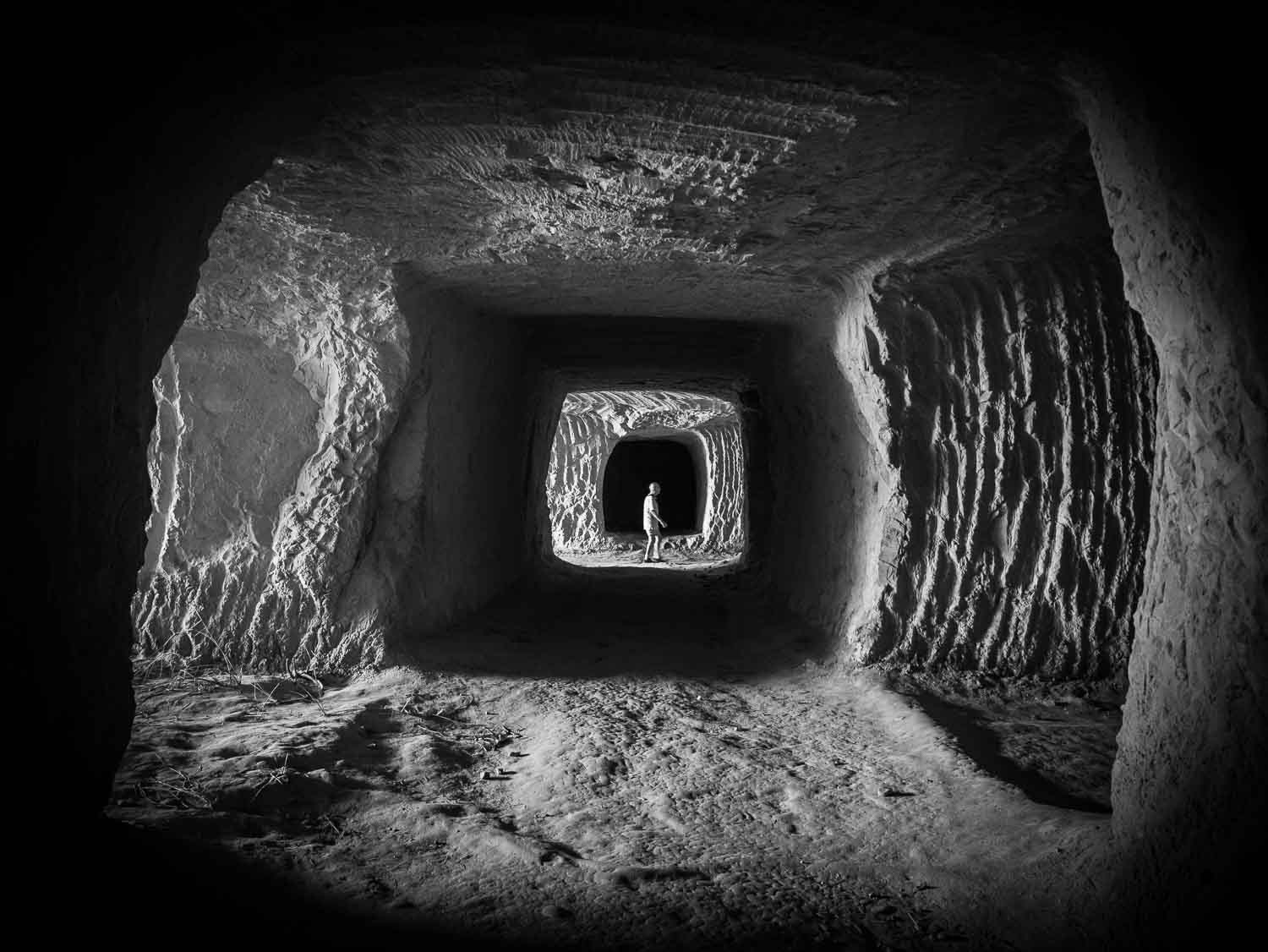
And then discover the old mining shafts; plenty of shade here.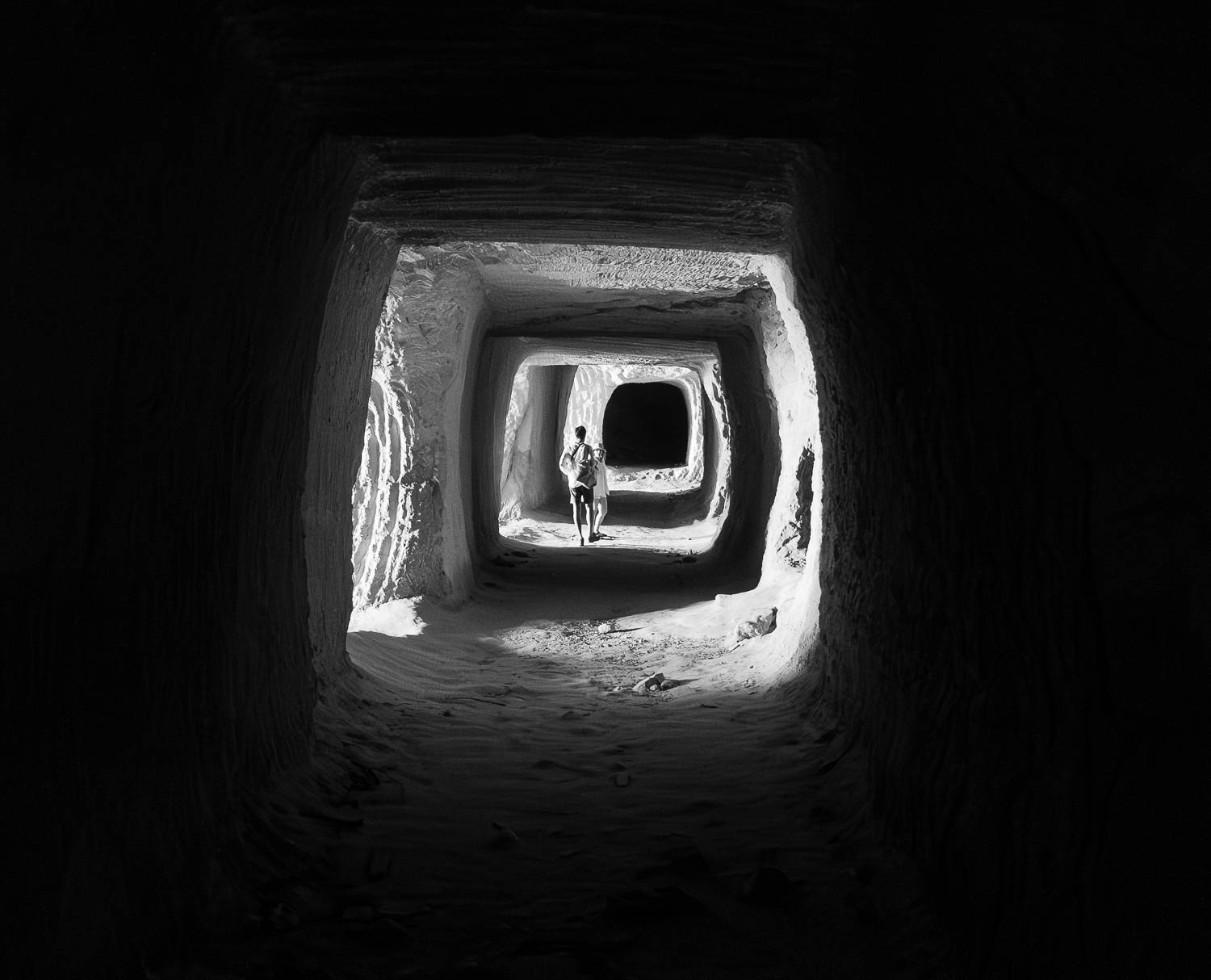
I do not understand how this next photo came to be. Those are not my legs. Nor Don’s,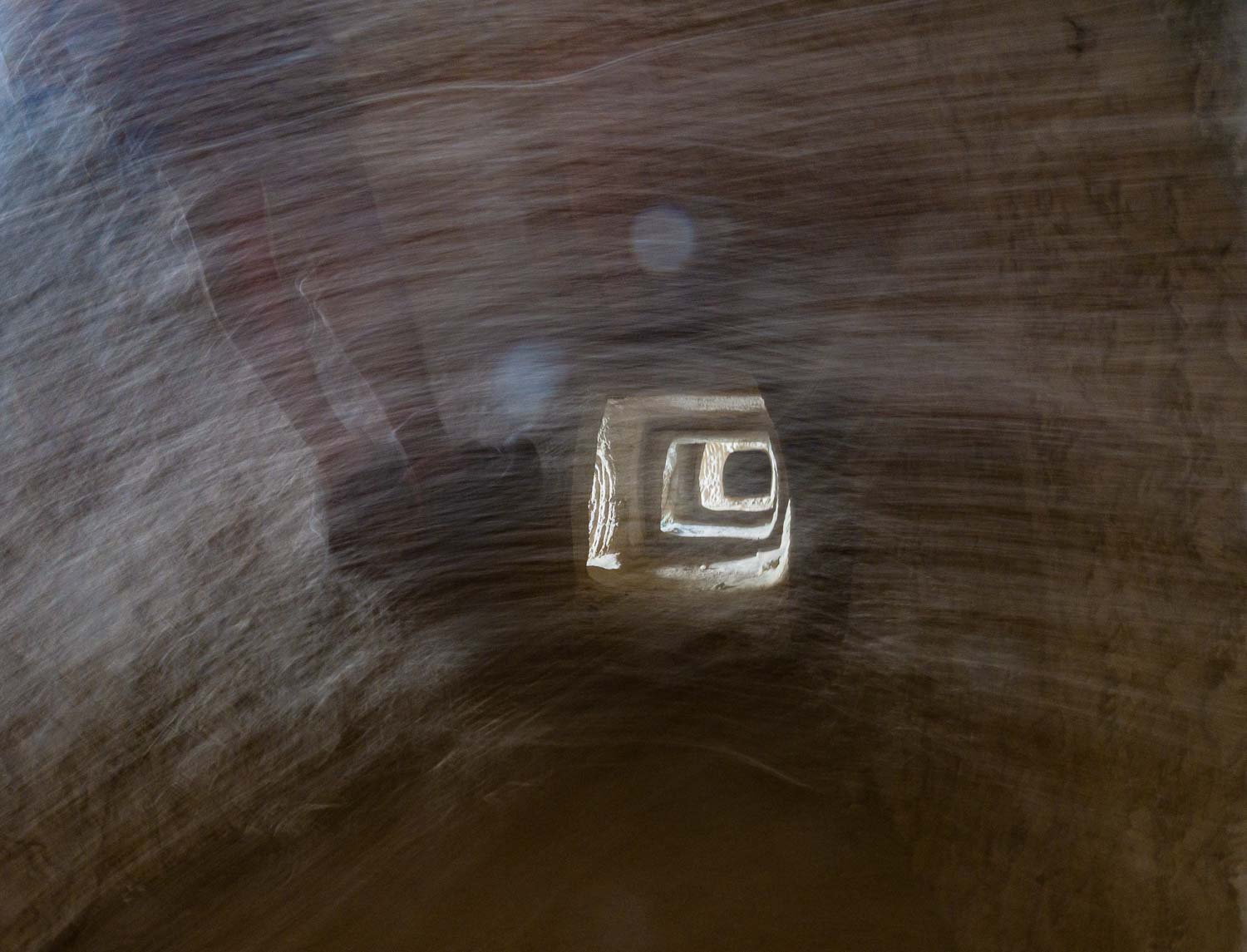
though the photo does give a hint of the eeriness of the mine shafts, and perhaps the ghosts of pirates past are messing with us.
We head back out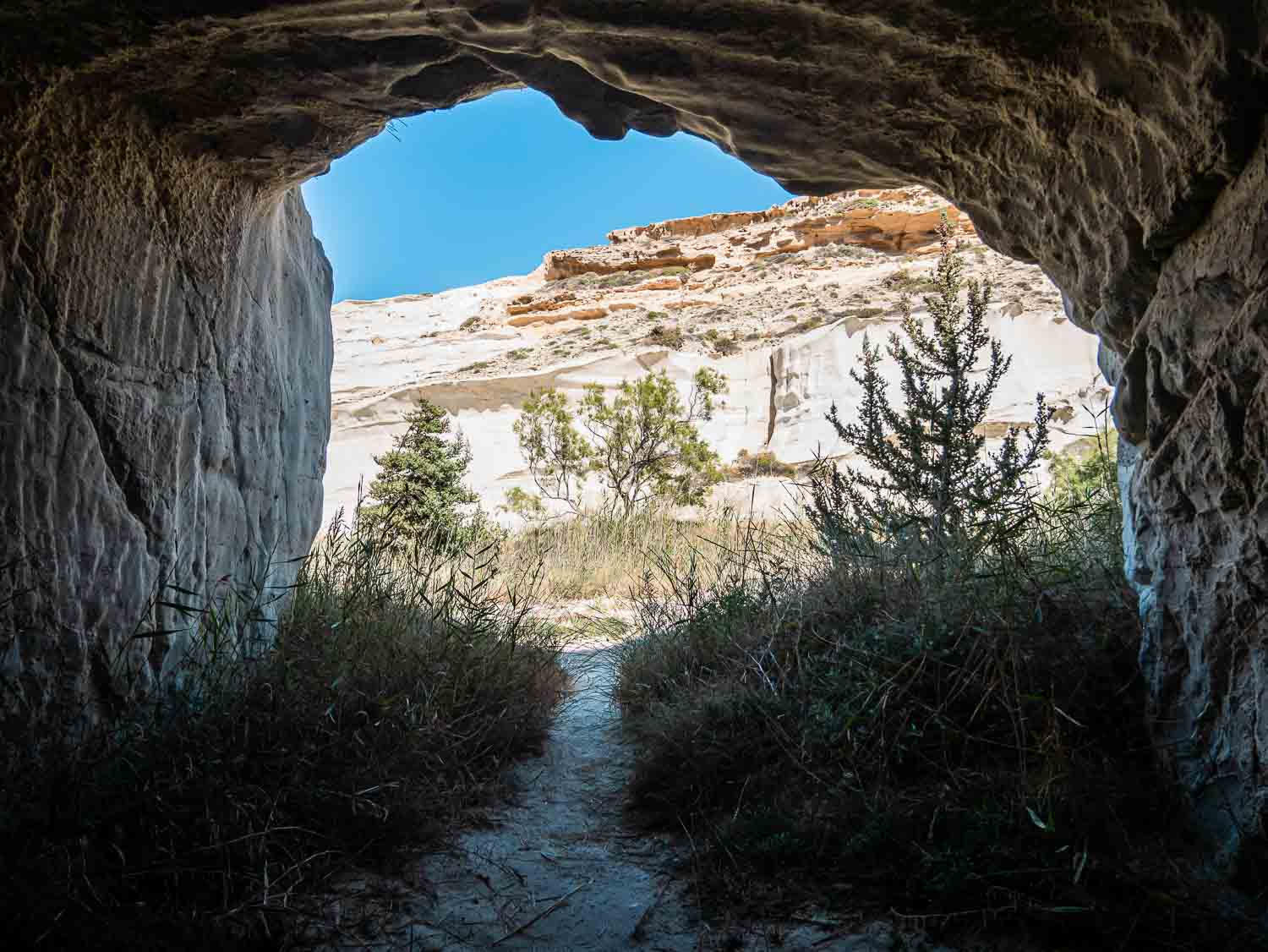
to go climb a cliff to two, along with the relatively few other people here; in June, rather than July and August, Sarakiniko is still comparatively quiet.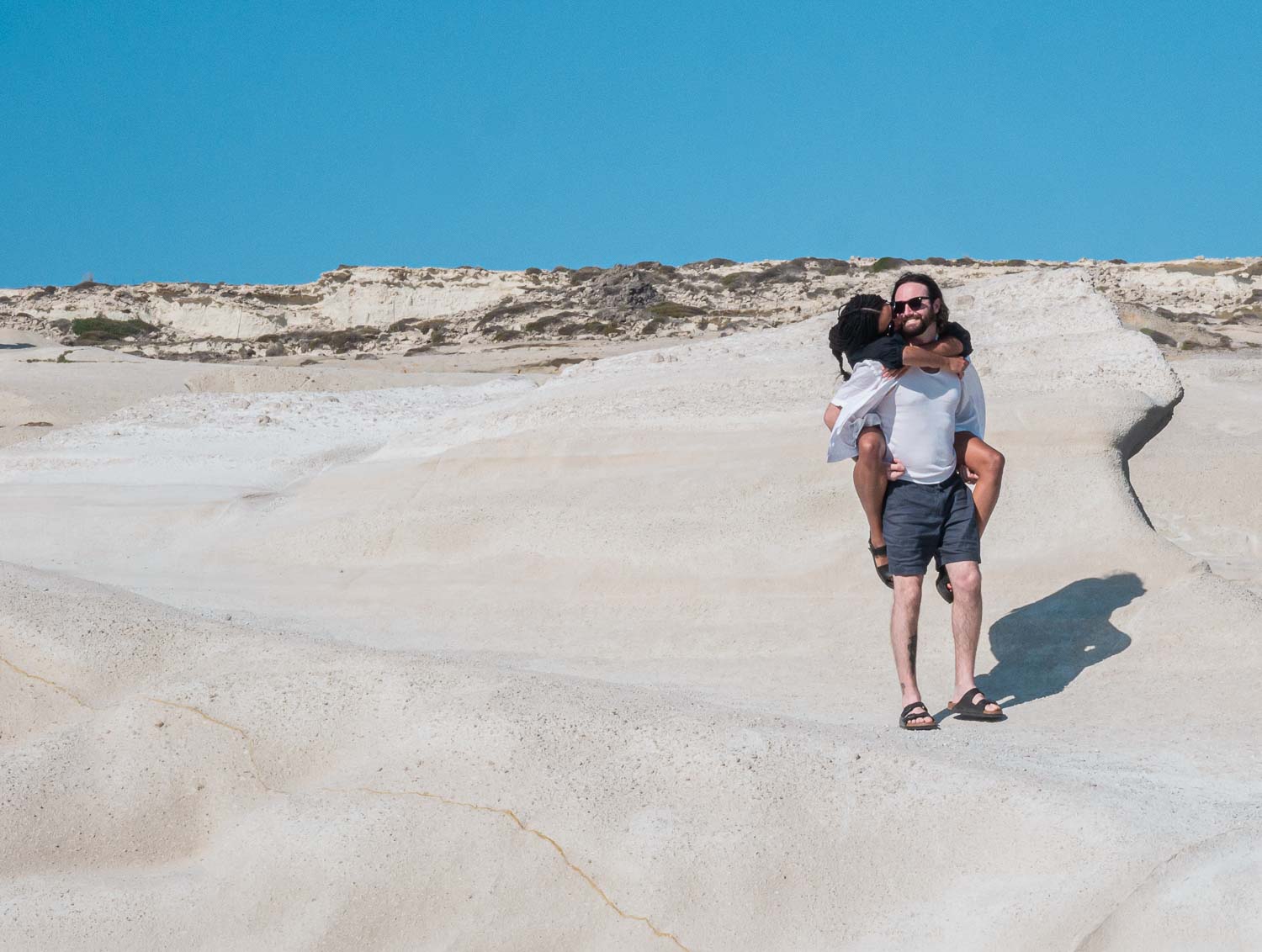
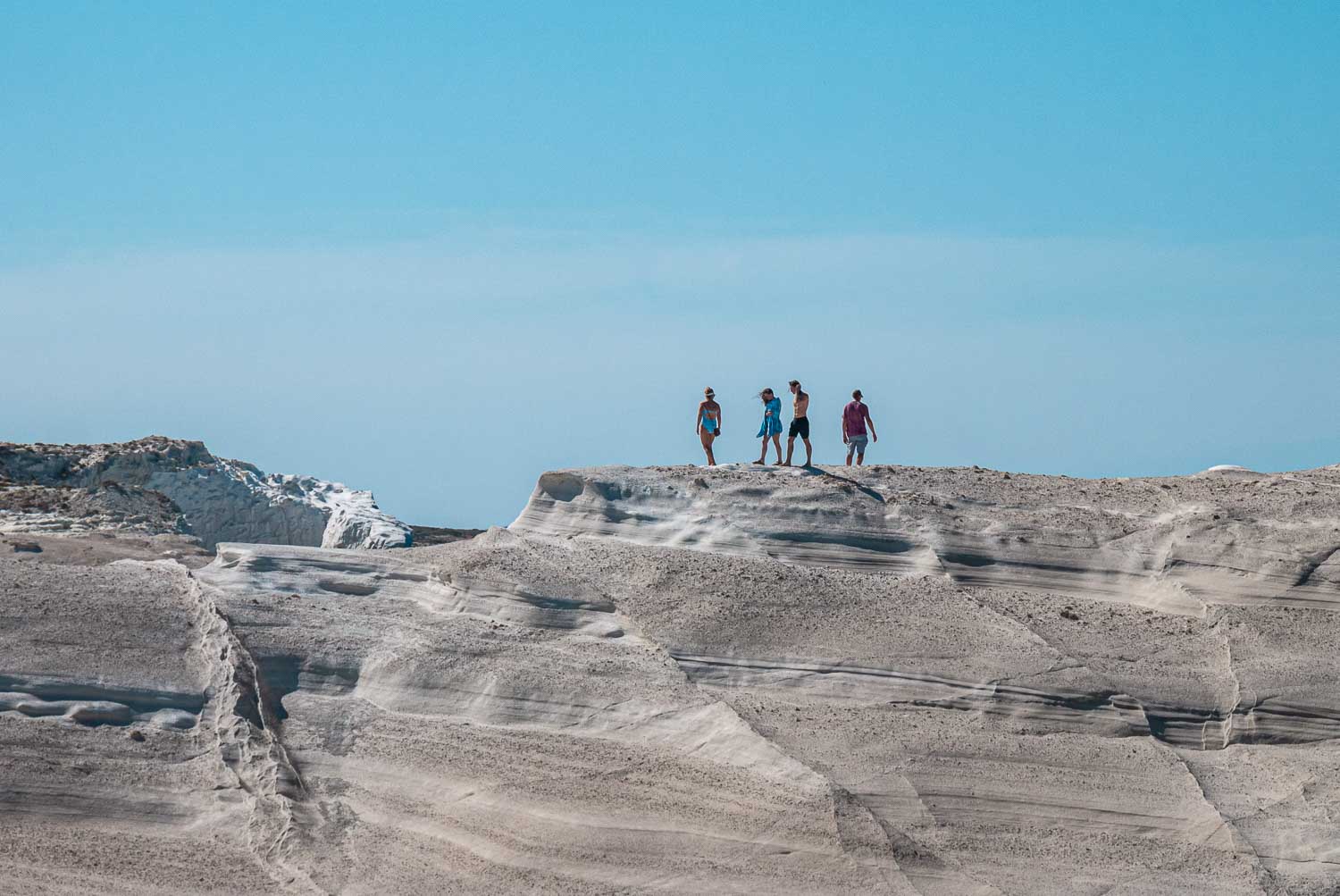
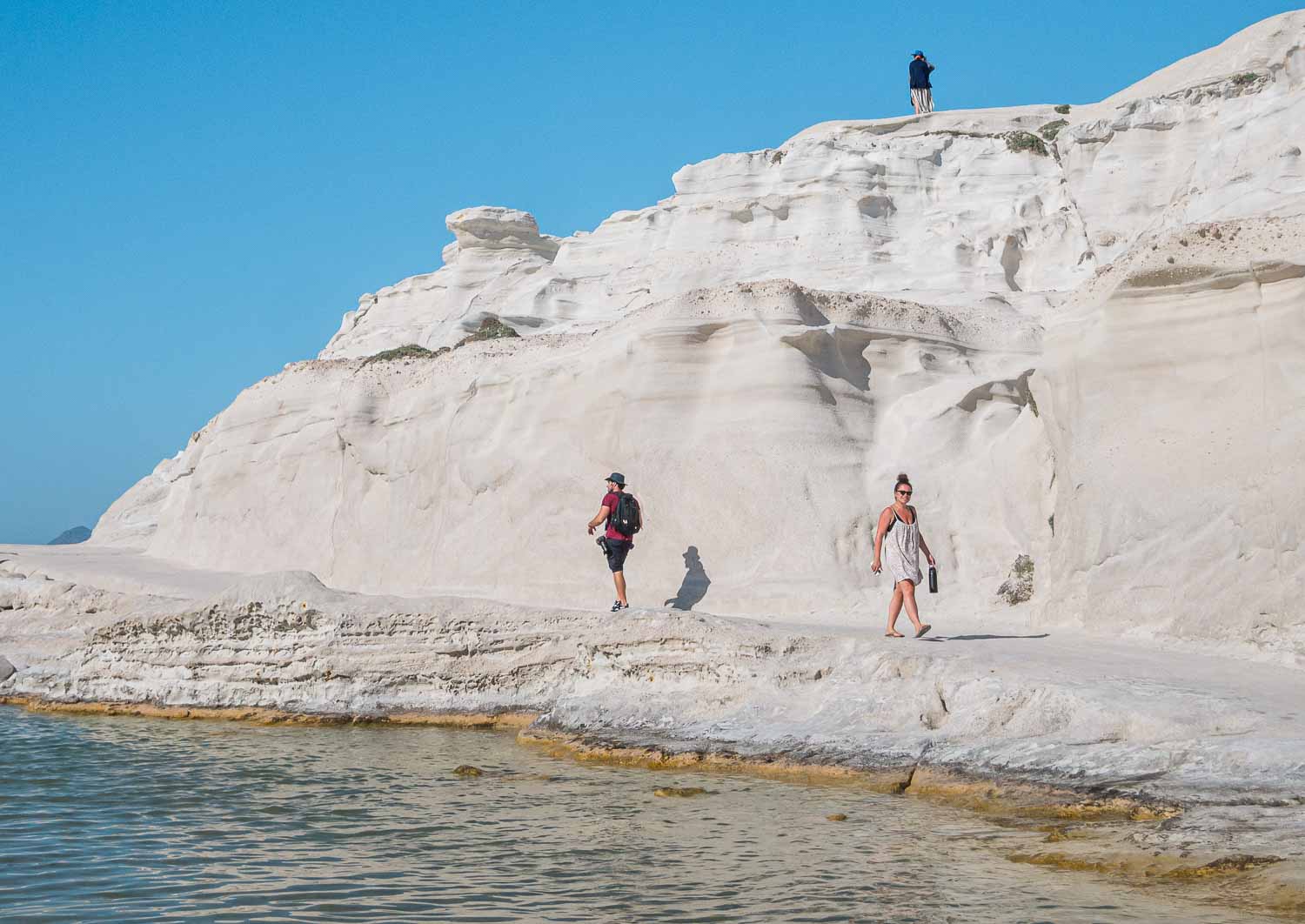
Milos is a volcanic island, a semi-circle surounding a central caldera, the result of many eruptions millions of years ago. Sarakiniko’s white rock is pumice, a light porous rock formed when frothy lava cools rapidly, trapping gas bubbles within it; and then sculpted by wind and the sea over millennia into smooth undulating curves and intricate patterns. The landscape also includes tuff, and lava flows caught in place as if snap-frozen. Isn’t nature a marvel?!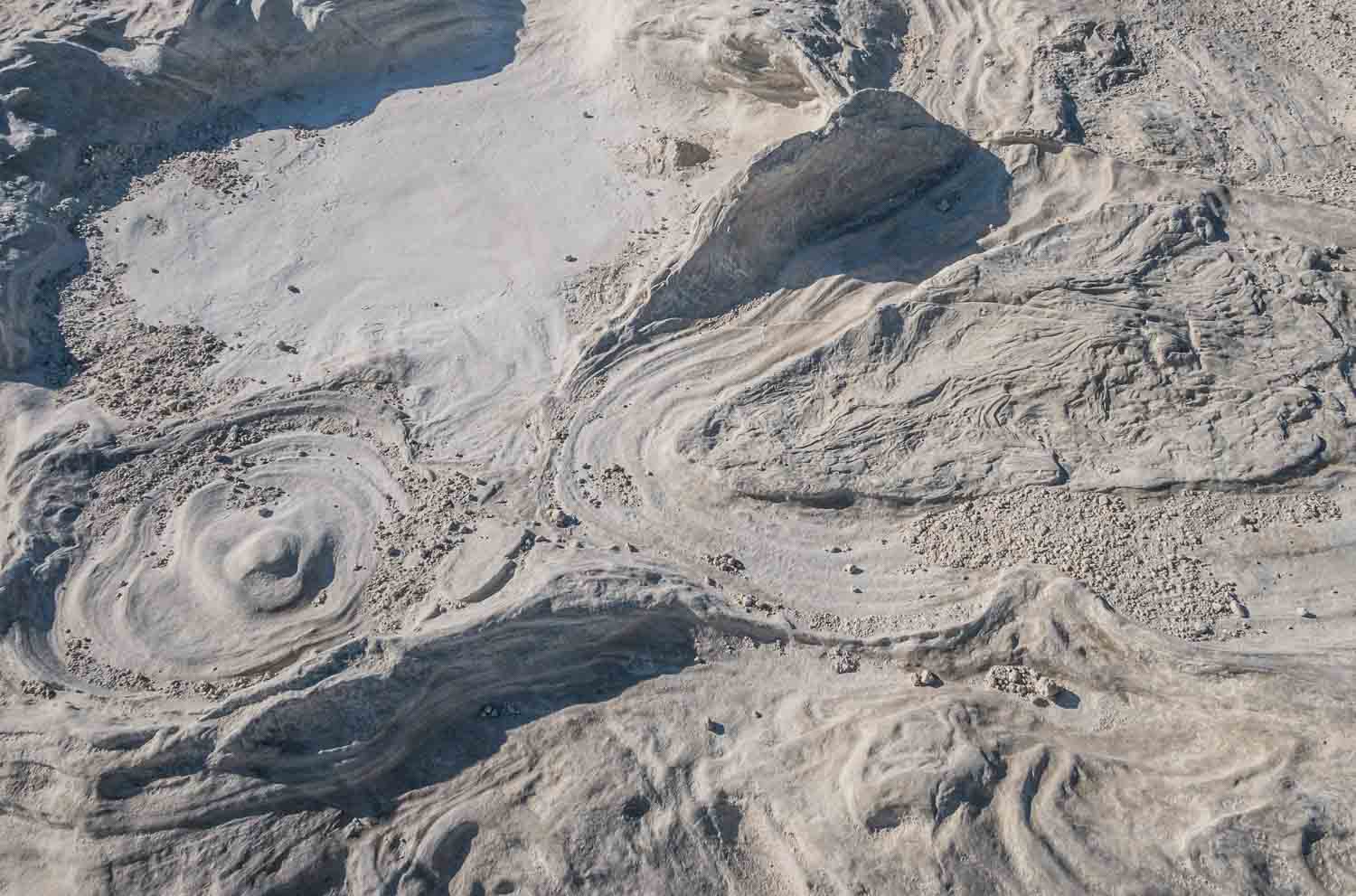
Sarakiniko is a holiday beach in an alien landscape, and the landscape alone warrants its place at the top of any list of the best beaches of Milos. It’s much more impressive than Don expects, but not me. I’d seen the photos, and this time the place lives up to the pictures.
Not a soap opera: Aphrodite, the goddess of love and beauty, fell in love with Adonis. Adonis’ best friend was Milos, who was married to Pelia. Milos and Pelia’s son was named Milos after his father. When Ares, the husband of Aphrodite and the god of war, discovered Aphrodite had had an affair with Adonis, he of course killed Adonis. When Milos found out that his best friend had died, he killed himself. Pelia, madly in love with her husband, killed herself, too. Aphrodite, moved by these demonstrations of love, decided to protect the young Milos and sent him to colonise a new island. The island became one of her homes, and she gifted her beauty to the land. Thus, despite all the killing, Milos became the island of love and beauty, and since it has been inhabited for some 12,000 years perhaps it’s all true, with only the names changed to protect the innocent. Until a few years ago this luminous place was shared secretively within the Greek community. Now it has been discovered and rightly recognized as one of the most exotic islands in the Aegean.
Like most visitors we arrive on Milos at the port town of Adamantas, also called Adamas, a bright and pretty town of some 5000 souls. It’s the largest village on the island though Plaka, up on top of the cliff, is the capital. There’s a small sandy beach just west of the ferry dock;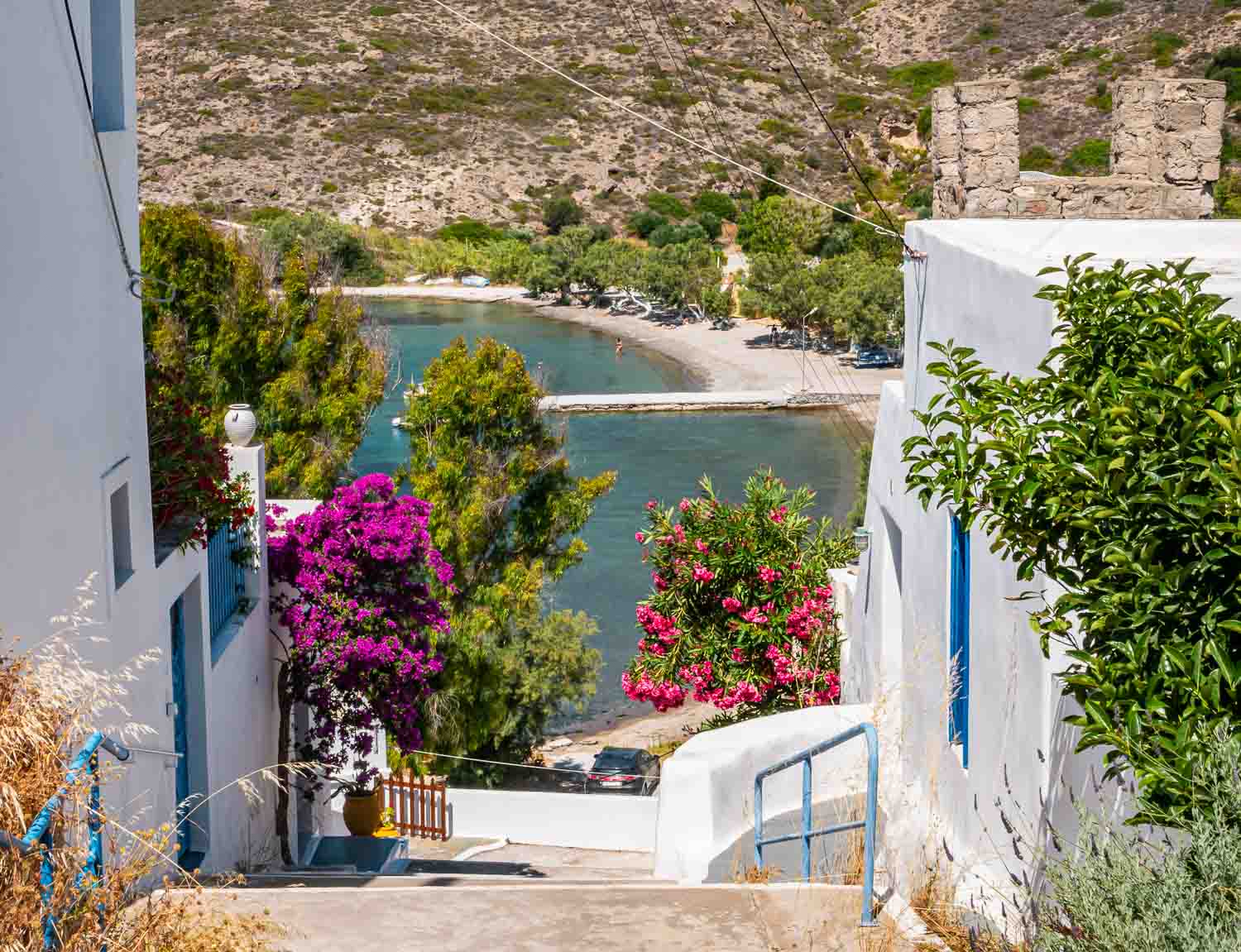
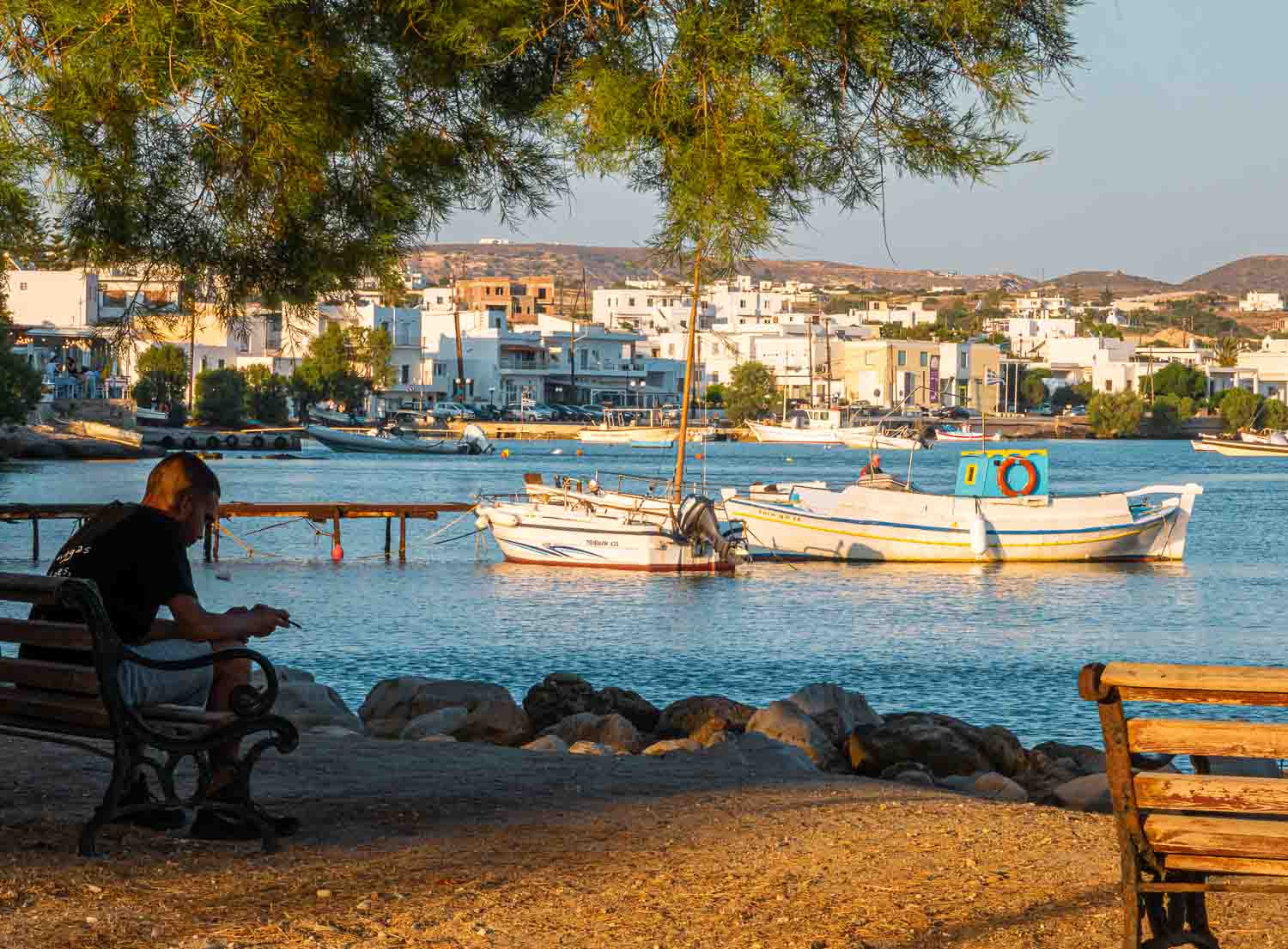
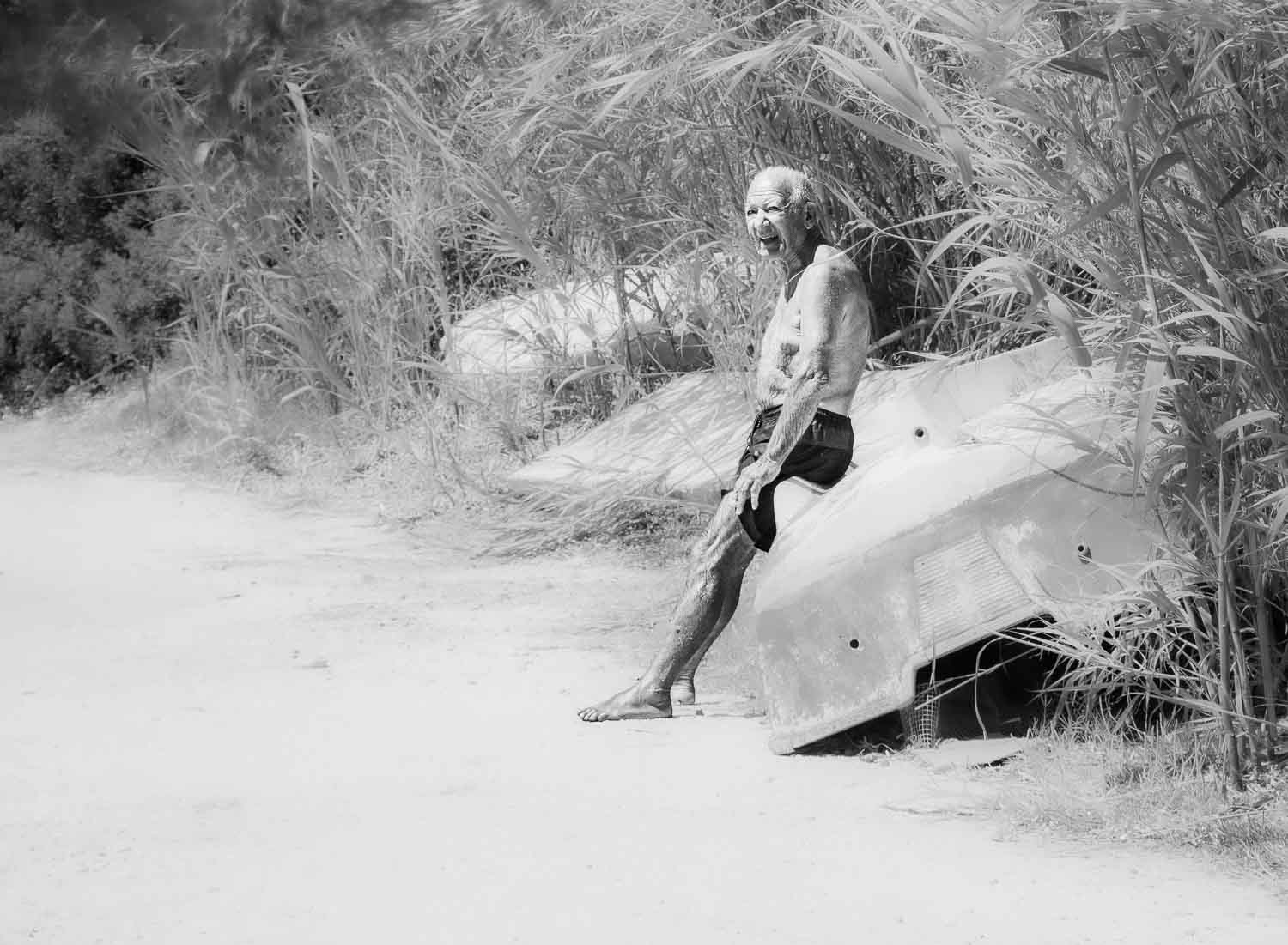
the inevitable local fishing fleet;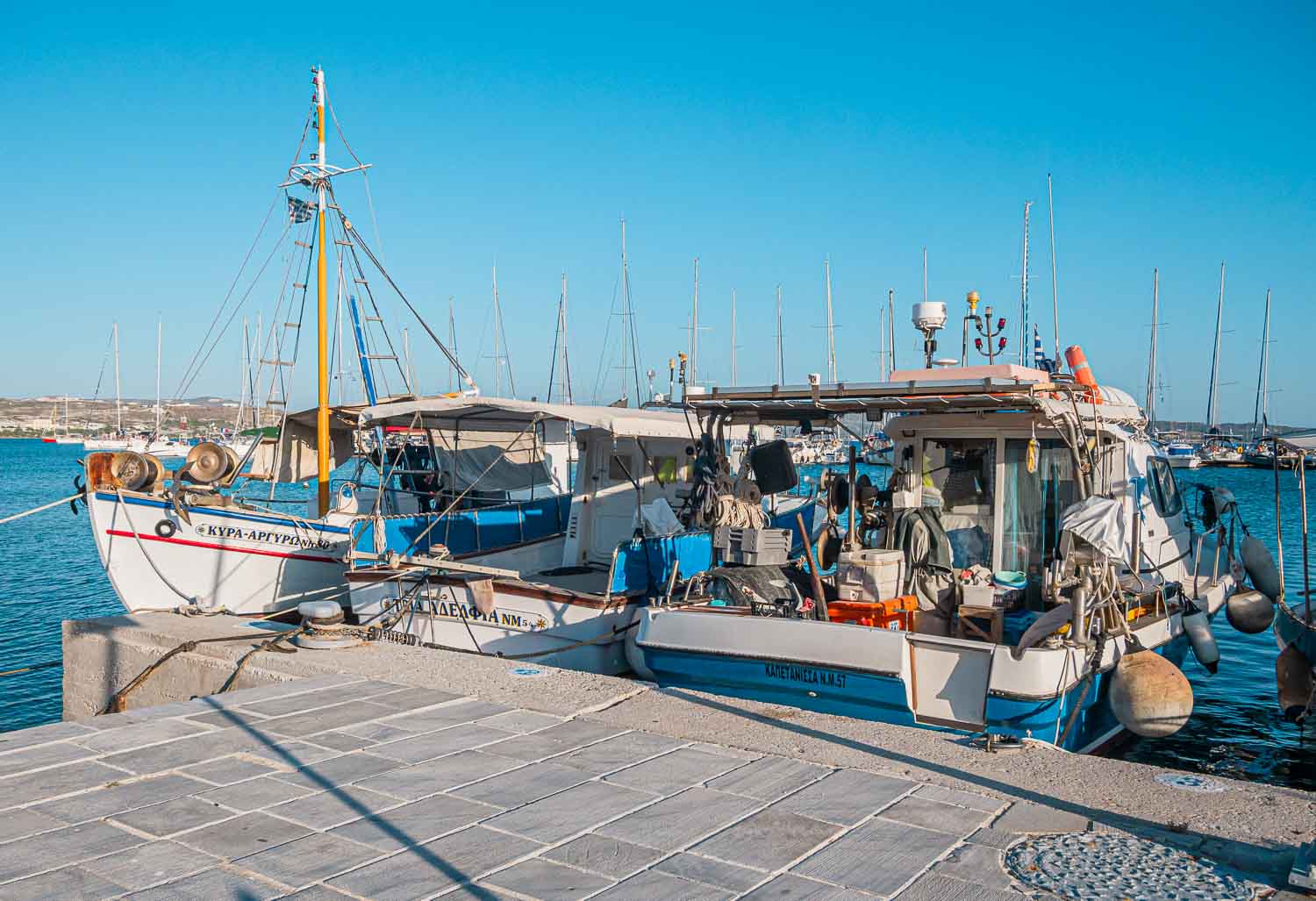
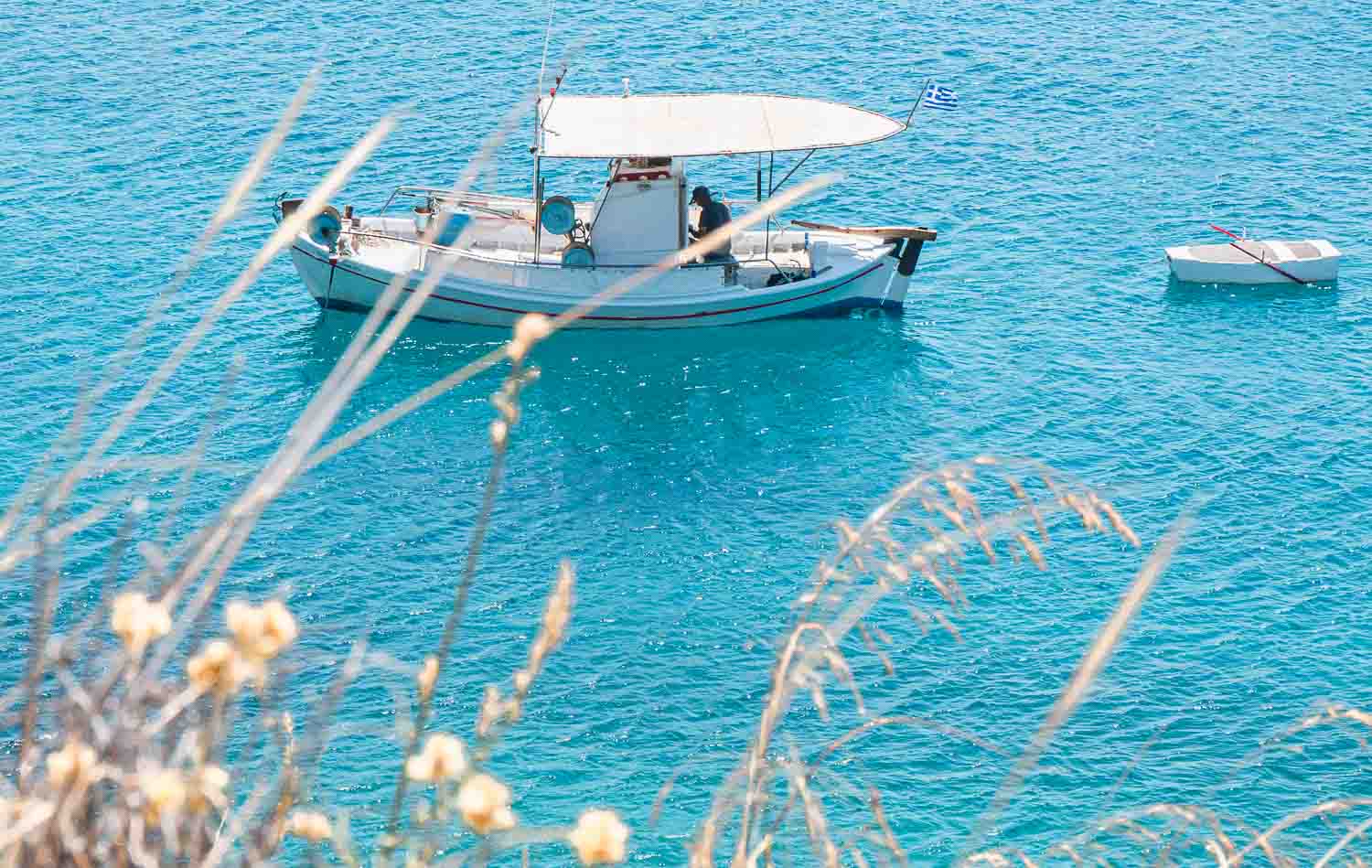
a shiny modern waterside pedestrian boulevard with a string of tavernas and restaurants;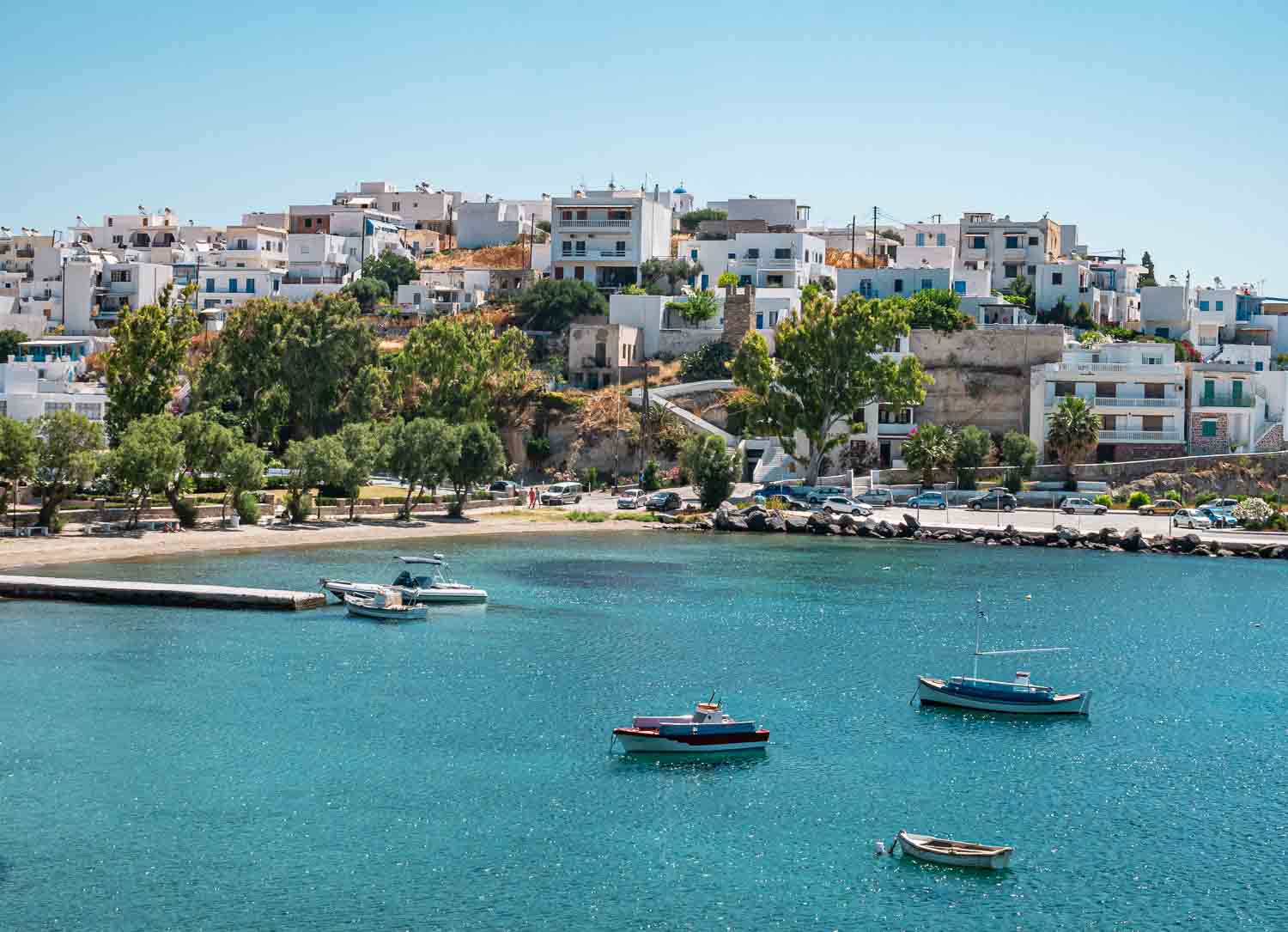
and beyond the beach an area called the wetlands, though at this time of year it’s pretty much bone dry.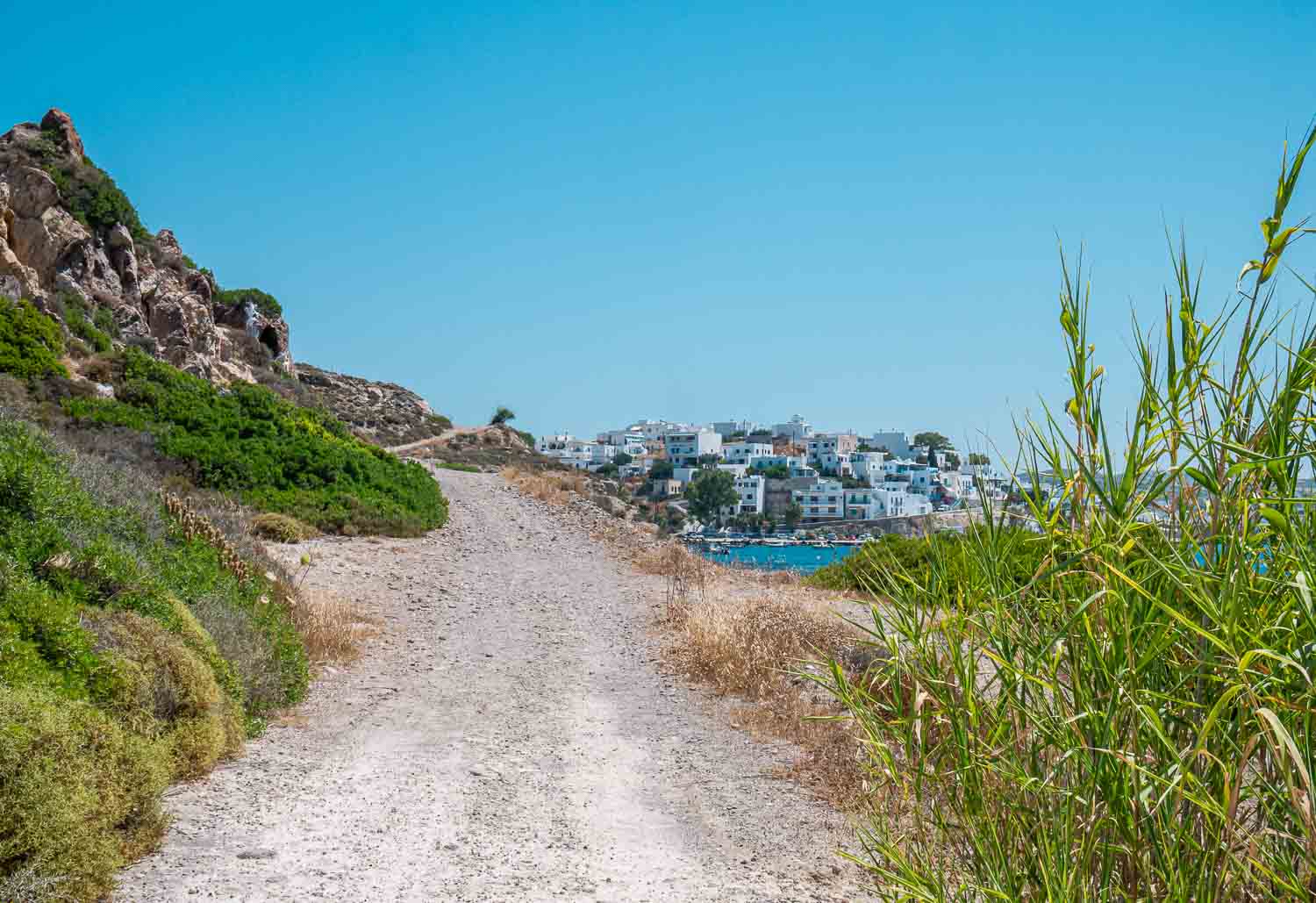
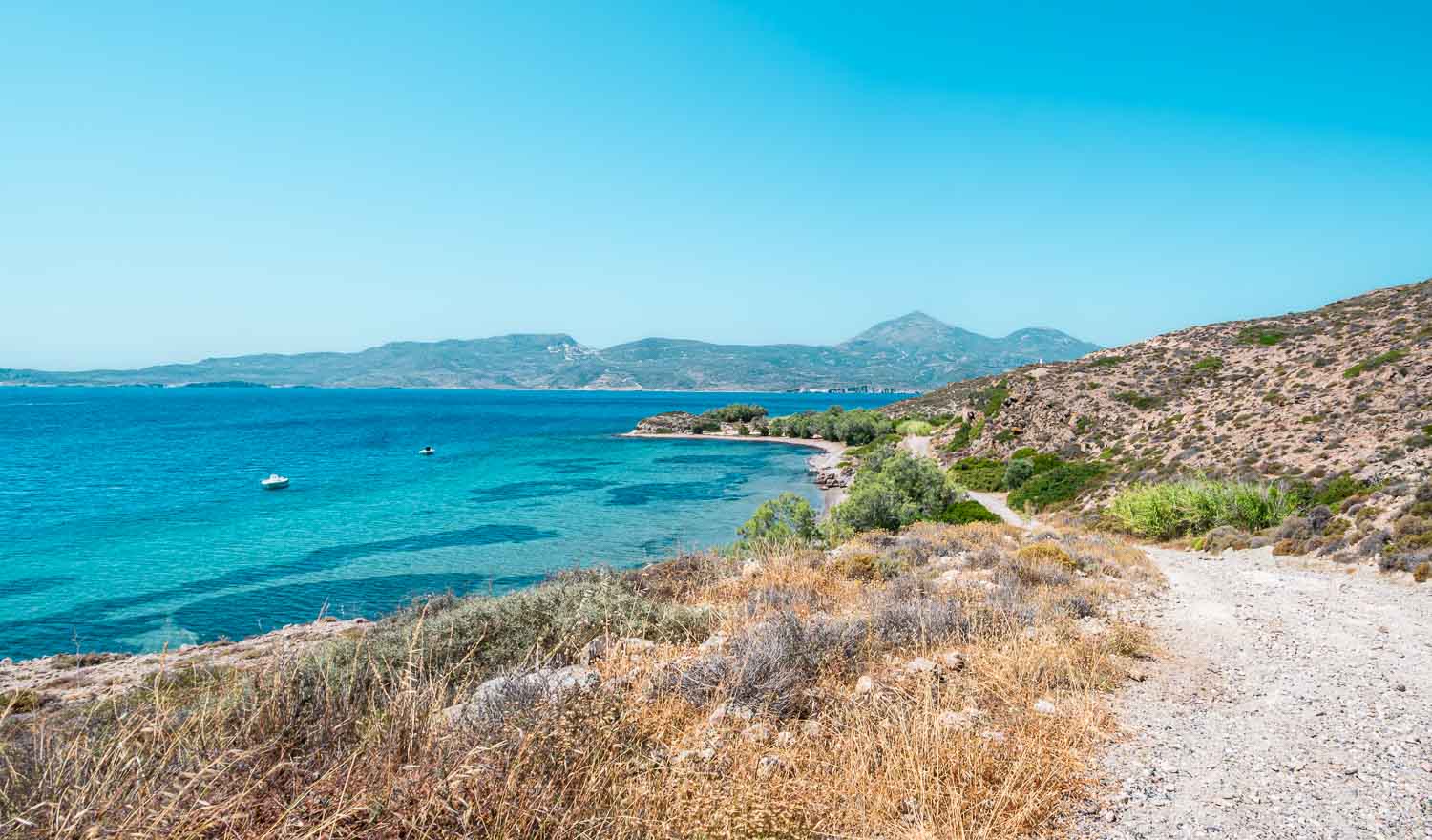
We’re not exactly coddiwompling since we have a destination in mind. Don wants to find a restaurant called Milor, and we follow directions all over the place without success. We’re up to the top of the hill and down again, arriving at a place that’s completely different from what Don’s expecting, but we’re discovering the town along the way.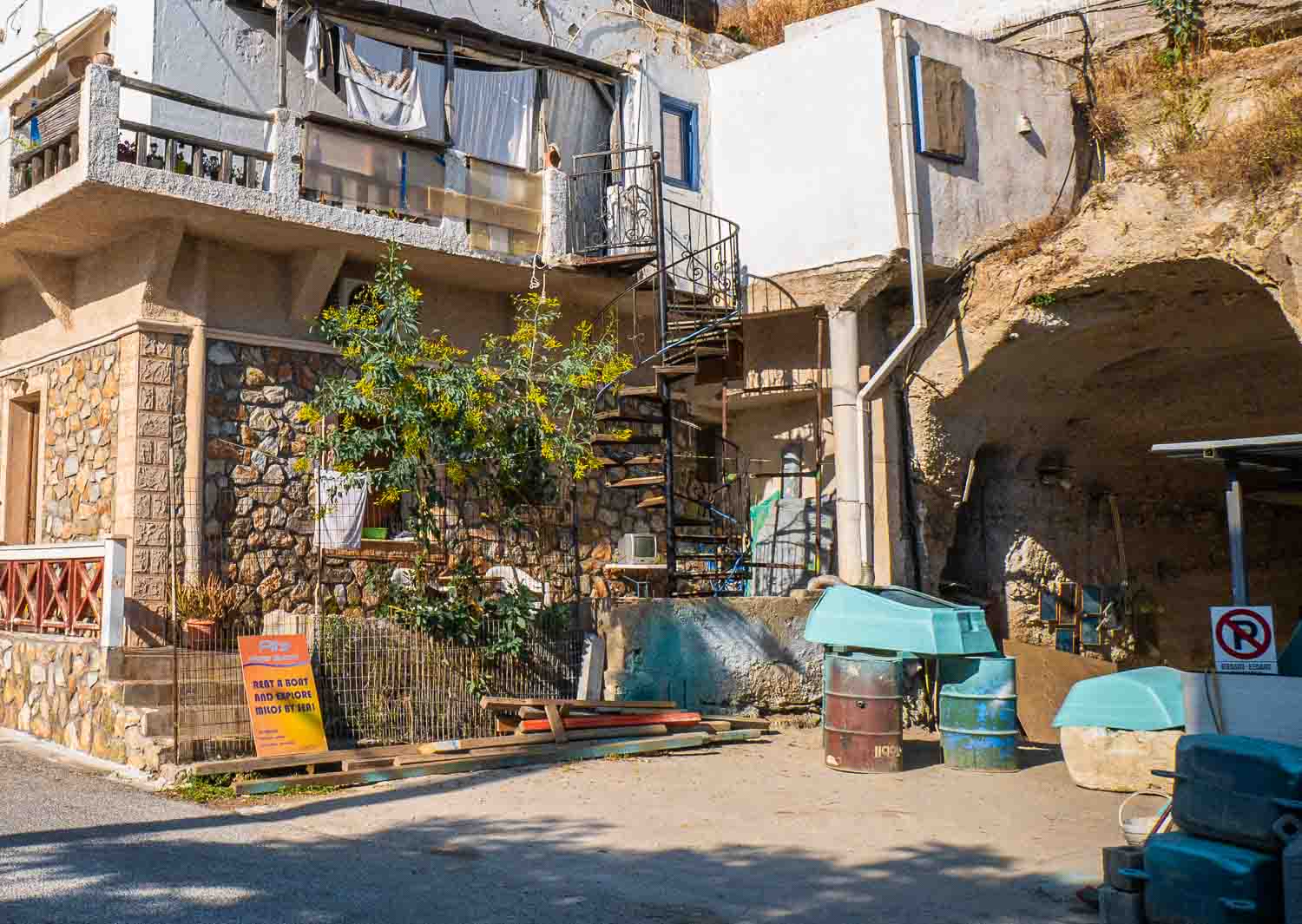
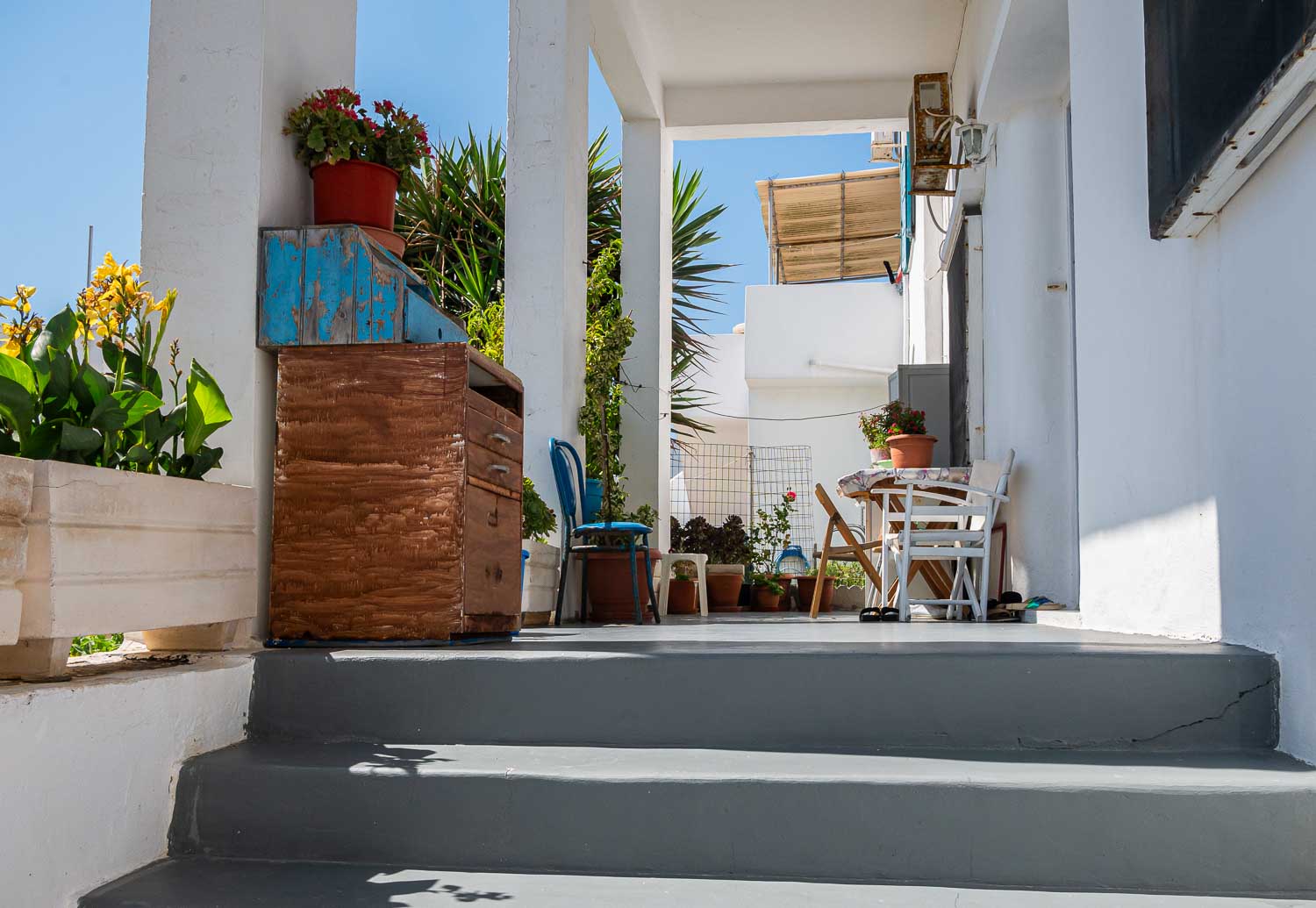
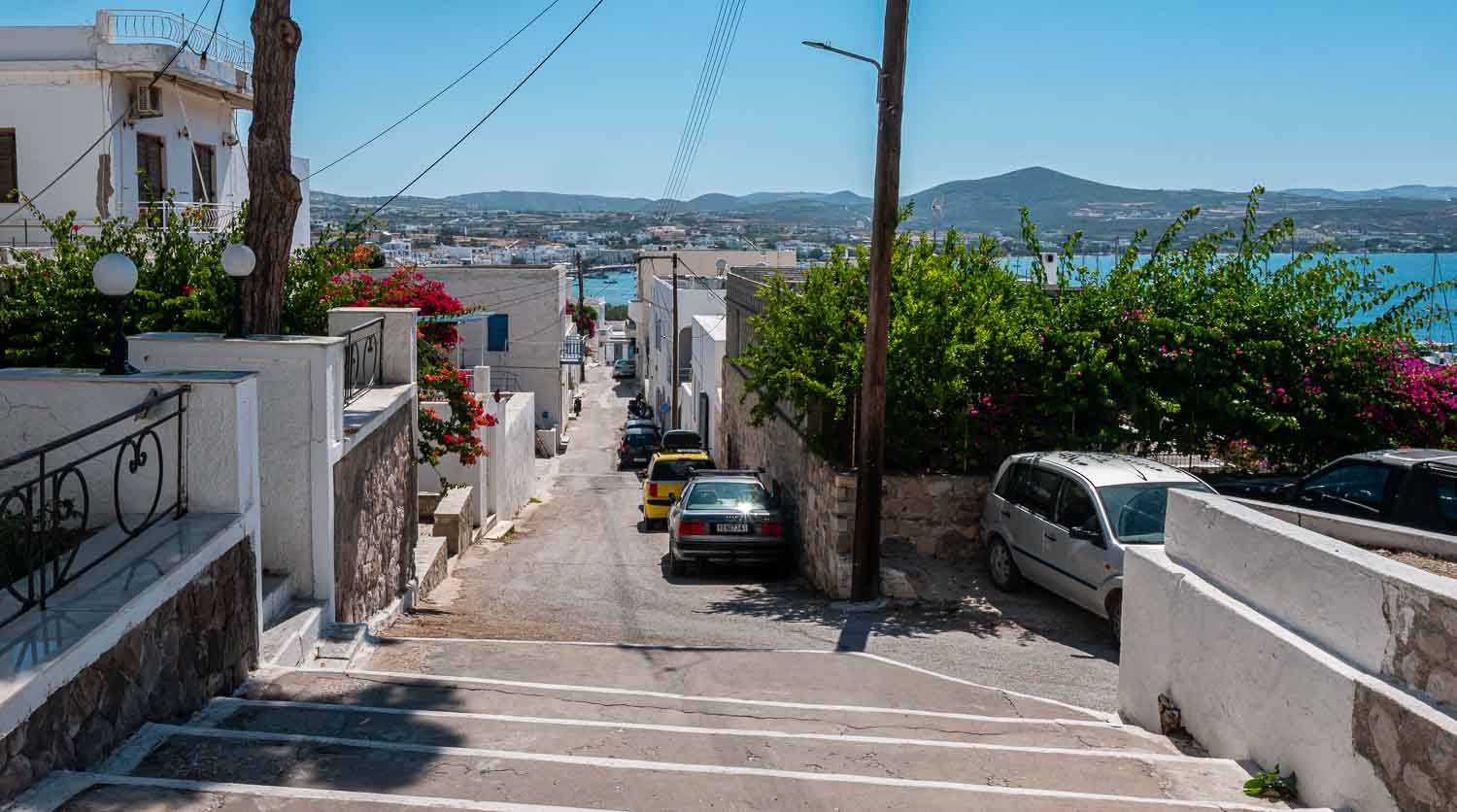
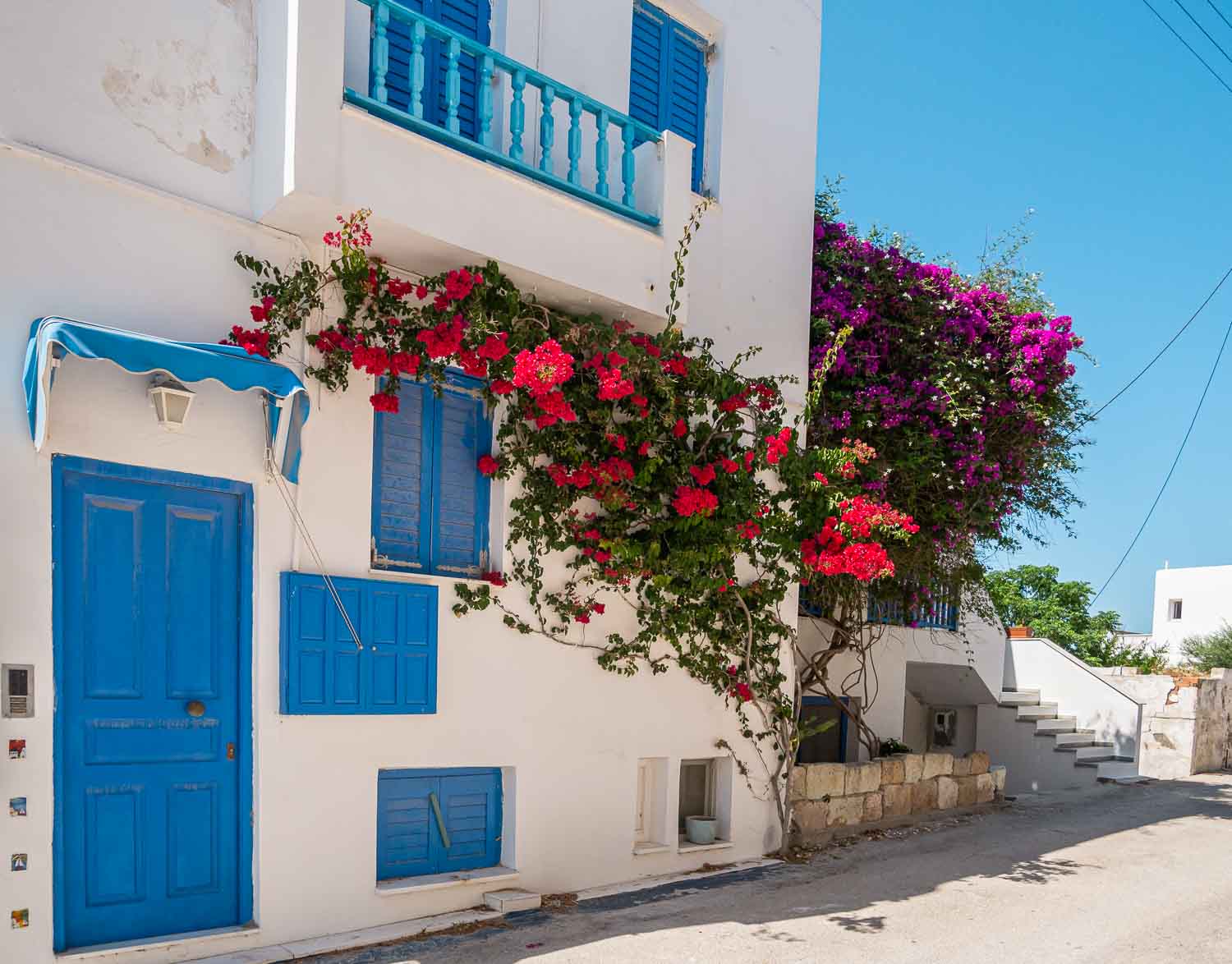
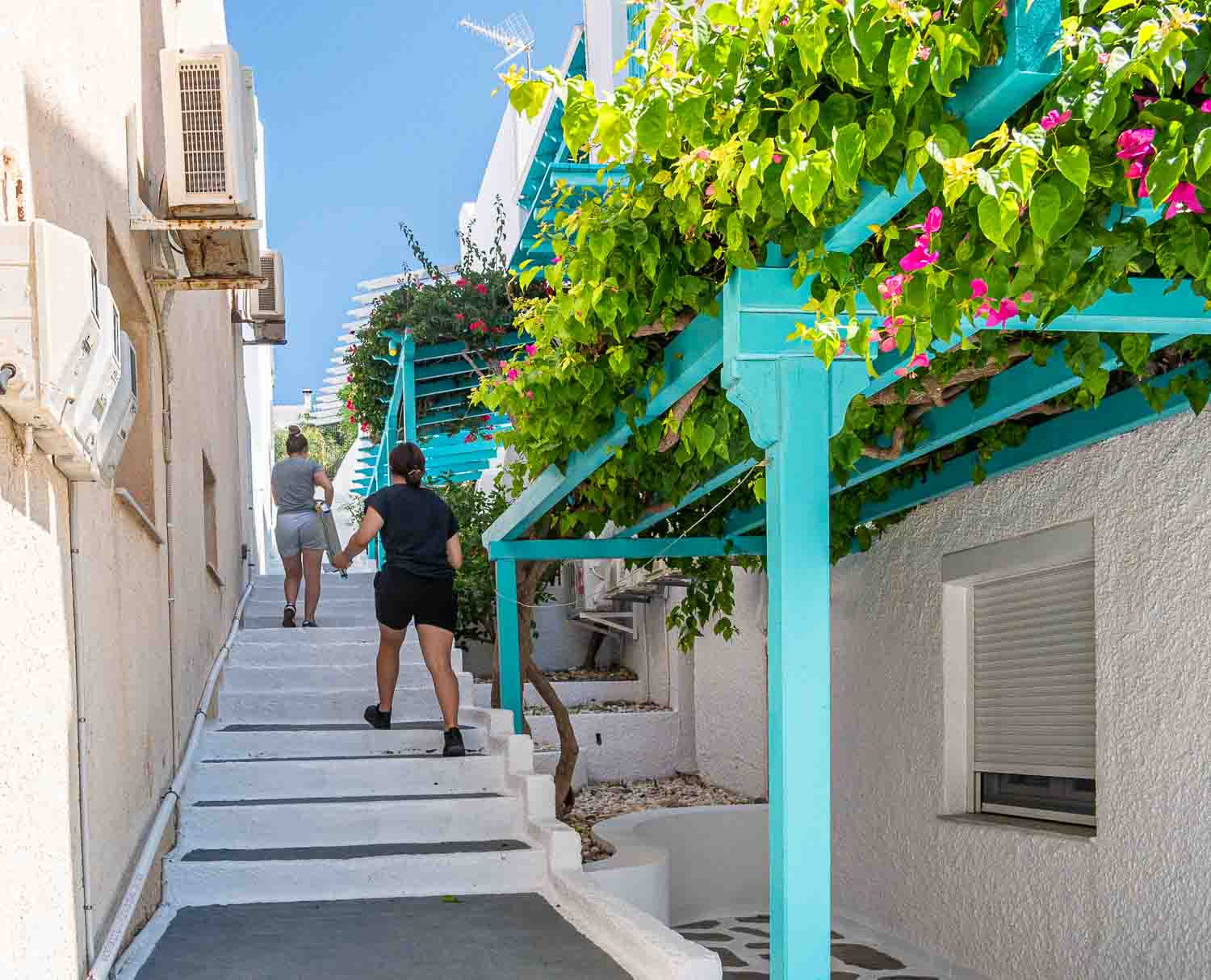
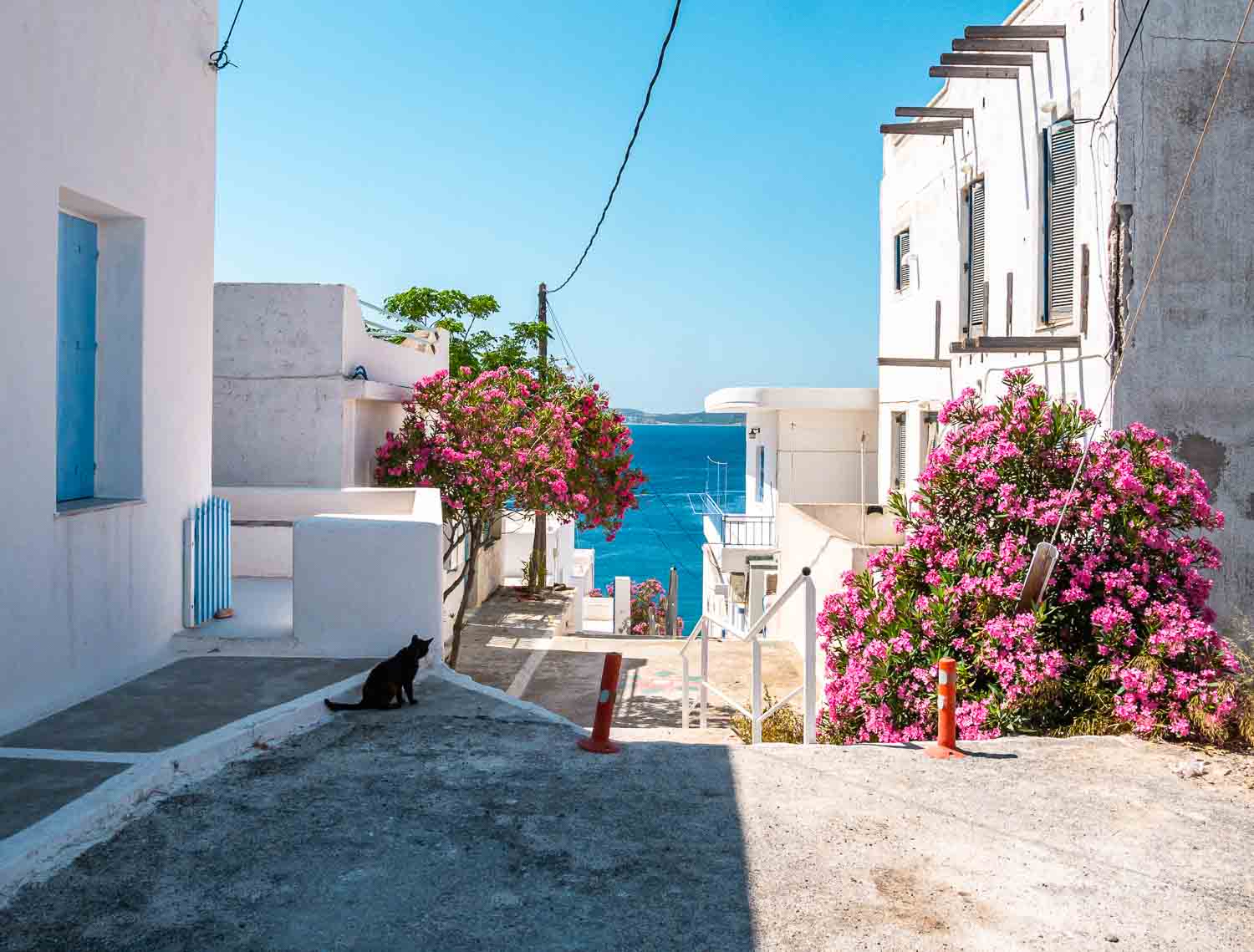
Then we try finding it using maps.me and it takes us to another place and there’s nothing there. Finally we head down the stairs to the waterfront and sit down at the first place we come to, one of the seaside tavernas. Don goes to the bathroom; I peruse the menu; idly I turn it over to find the name of the restaurant. Milors! Having done all that searching, sadly our meal there is not very wonderful; a traditional Greek breakfast of dakos – crunchy bread a bit like croutons but bigger, with stewed tomato, sliced olives, and feta, followed by yogurt with honey. Ah, I’m generally not very good at trying the local dishes, and for breakfast I’d rather have toast and jam and a cup of tea. Having said that, Greek lunch and dinner food makes me very happy.
It’s a 25 minute walk from our hotel, but O! Hamos! has been recommended by a friend and we really want to eat dinner there. We walk and walk and walk, having this day already walked all over the town, out to the wetlands and back, and all over Sarakiniko. We arrive finally to be told there’s a 45 minute wait! I guess the whole world wants to eat at O! Hamos! Disappointed, we walk back to town and eat at Zorbas by the water.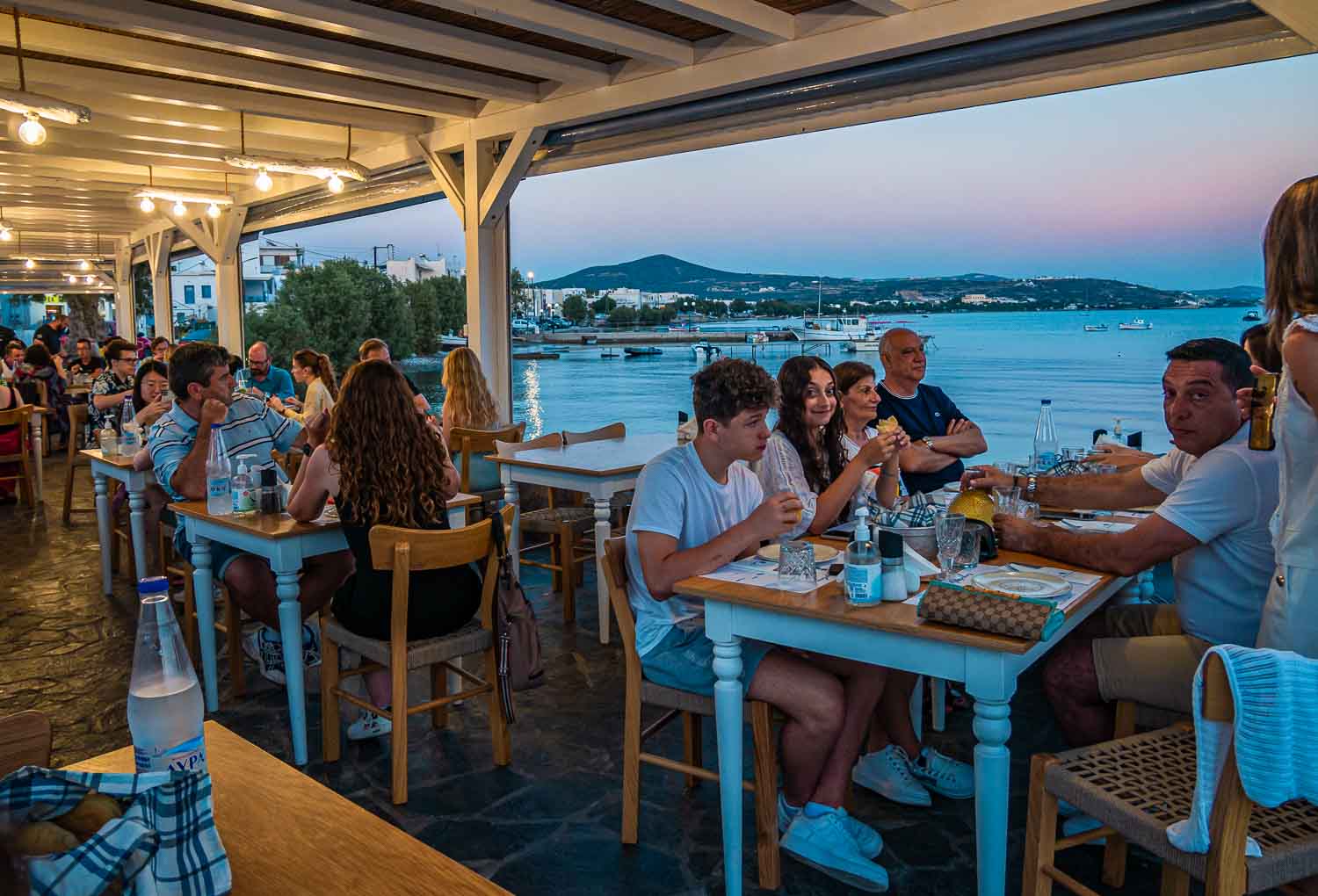
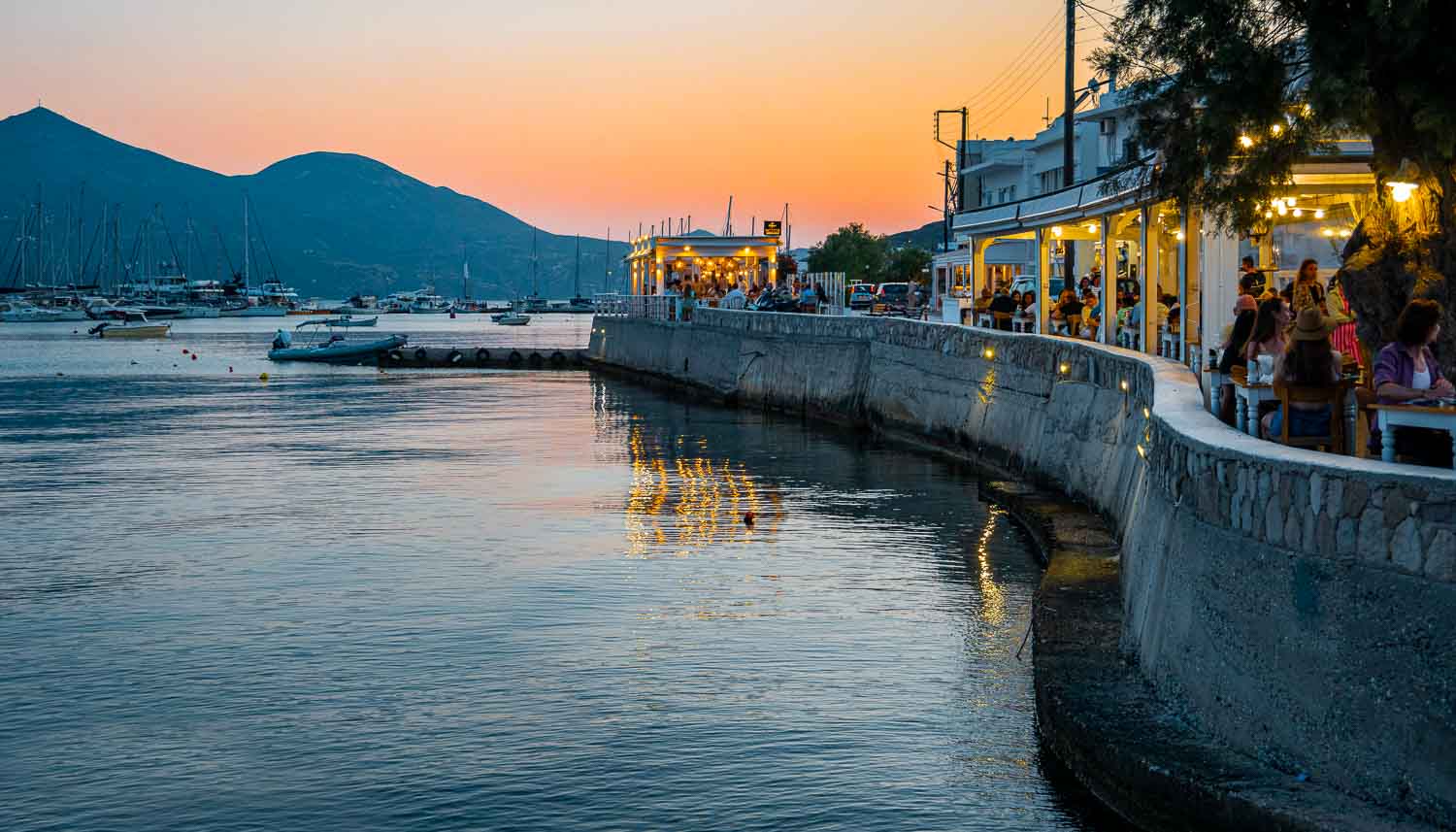
It’s a fifteen kilometre day by the time we get back to the hotel. Exhausted. Milos is lovely, and Sarakiniko truly extraordinary, but we know the best is yet to come – a hike from Plaka by ancient local footpaths down to the brightly coloured fishing village of Klima, and a sailing cruise that circumnavigates the island – all in the next couple of posts.
All words and images by Alison Louise Armstrong unless otherwise noted
© Alison Louise Armstrong and Adventures in Wonderland – a pilgrimage of the heart, 2010-2023.

 Adventures in Wonderland
I struggle to believe it will get better, Alison. I’m already in love with Milos. The land formations and tufa are mesmerising. I’ve seen that mine shot, or one very like it, on a long ago post of Andrew Petcher’s, so the ghost has been around a while 🤣🩵. He always recommended we go to Milos and I regret now that we haven’t. Love the moon shots and I don’t think I’d have looked for a lovelier waterside restaurant than Zorba’s.
Meanwhile, here I am in Leeds, on my 34th wedding anniversary 🩷
LikeLiked by 1 person
Isn’t it a beautiful island! Wait til you see what’s coming in the next couple of posts about it. Milos was by far our fave of the 3 we went to. Extraordinary landscape, and we really got to see it when we did the cruise.
I had a quick look at Andrew’s blog but couldn’t find the photo – It’s been a long time I guess; anyway I have no idea how my photo turned out like that. A little bit eerie! 😂
I hope you get to Milos one day.
Zorbas was lovely, but we got a quick glimpse into O! Hamos! – a garden rather than a waterside restaurant. Next time! 😂
Alison
LikeLike
🤣💙
LikeLiked by 1 person
I love that you include the mythology behind this island, Alison. I try to remember if I’ve ever seen any bone-white landscape like this in my past travels, but I guess I haven’t. And what is more incredible is how it is set against those unbelievably blue Aegean waters! Speaking of your photos of the full moon, they remind me of Wadi Rum in Jordan because during our stay the moon was shining so brightly it made me realize why some ancient civilizations worshipped it.
LikeLiked by 1 person
Thanks Bama – it was writing the post about Santorini that I knew I needed to include the mythology of these islands. Santorini just oozed something mythical so I needed to find out what.
Ah the blue waters and the white landscape! So stunning. And so very unique.
A full moon in Wadi Rum – that must have been an amazing experience!
Alison
LikeLiked by 1 person
that moon was waiting for your arrival, and I absolutely love learning about Milos
LikeLiked by 1 person
Thanks so much Beth. I’m glad you enjoyed it; Milos is so magical.
And the full moon to welcome us was really special.
Alison
LikeLiked by 1 person
The landforms are extraordinary. What a fabulous trip you are having.
LikeLiked by 1 person
Aren’t they amazing! The landforms of Milos are so unique; more to come in the post circumnavigating the island.
It was a fabulous trip. Greece makes a very short list of places we’d like to return to.
Alison
LikeLiked by 1 person
What a lovely surprise to have the full moon greeting you and what a miraculous landscape. Your photos of the mining shafts can fit into any art gallery!
Thanks for reminding me of Aphrodite’s story; hard to beat.
LikeLiked by 1 person
Thanks so much Astrid. The full moon was such a gift – such serendipity to arrive when we did, and for me to suddenly stop and look back.
Those mining shafts were amazing to explore – and yes, very photogenic. I had a lot of fun playing with editing them. I’m glad you like them.
The whole mythology involving Aphrodite is so wide-ranging and complex. She had her fingers in a lot of pies. I’m glad Milos was one of the pies! 😂
Alison
LikeLike
I learned a new vocab word – Coddiwompling . That beach looks so intense with the stark white rocks and blue ocean. Did you snorkel there? It looks a little like the beaches in the Red Sea where the land is stark but under the water is a garden corral and tons of life. Your posts are really making me want to go to Greece again.
LikeLiked by 1 person
Isn’t coddiwompling a wonderful word! I only recently learned it myself, and it’s so perfect for what Don and I do when we’re travelling.
We didn’t snorkel at Sarakiniko (and didn’t see anyone else snorkelling there), nor anywhere else in Greece, though I swam in a couple of different places when we did the sailing trip around Milos. Such crystal clear water! We snorkelled in Jordan in the Red Sea and there was lots of underwater life there, though having snorkelled the GBR in Oz I’m a bit spoiled – no where else has lived up to that.
My posts are making *me* want to go to Greece again! Greece makes a very short list of countries we’d like to return to.
Alison
LikeLike
Those unexpected moments when you’re dealing with life and you look up and see something extraordinary – like a full moon setting over the water – and everything stops for a moment so you can be fully present and just marvel at nature — those are the best moments. And they do happen a lot more often while traveling, I think!
Milos’ sculpted artwork is stunning indeed. Even in pictures on a computer screen, the white is quite stark! Maybe the laws of normal light don’t quite apply on Milos – that would explain your pirate legs in the mines. 😉
My favorite pictures are the 2nd one of the full moon rising (my phone sucks at night photography, so I’m doubly impressed by this one) and the very last one.
LikeLiked by 1 person
Seeing that full moon was such a beautiful moment; what a lovely gift it was. And I agree – moments like that seem to happen more often when traveling.
I too wonder about the normal laws of light on Milos 😁 – it’s a pretty magical place. We went there on the advice of a friend, and are so glad we did. It was really special.
Being a photography snob 😂 I never take photos with my phone (except on the very rare occasions that I’ve drained all my batteries, or not brought my camera). All this to say that the moon shots (and all the rest of them) were taken with my regular camera and edited for clarity in Lightroom.
Thanks Felicity, you always give such thoughtful and observant comments.
Alison
LikeLike
Those shoreline rock formations are so unique! Just when I was lulled by this very different view of a Greek island, you hit us with the quintessential combo of blue seas and pink/red/purple flowers, whitewashed buildings, and outdoor eateries, all of which make my heart flutter anew!
LikeLiked by 1 person
All these quintessential Cycladic villages made my heart flutter too. Would love to go back to Greece. As for the rock formations this was just one place on Milos that was unique. The next post of the sailing trip around the island shows many places of amazing rock formations, all different. It really is a quite unique place.
Alison
LikeLiked by 1 person
What a strange and fascinating beach along with those mines. You must’ve been so inspired making these excellent images, Alison. And your charming photos of the architecture and streets are making me wonder why we’ve never been! I love the monochrome portrait of the man on the beach. 🙂
LikeLiked by 1 person
Thanks so much Jane. Sarakiniko was fabulous for photography; I had so much fun there with the landscape, and the people. I’m so glad it wasn’t crowded.
All the towns we went to on the Cycladic Islands were charming. Get thee to Greece! It’s wonderful; one of few countries we’d like to return to.
I’m glad you like the man on the beach – I kinda suspect it may be the kind of photo only another photographer would like.
Alison
LikeLiked by 1 person
☺️
LikeLiked by 1 person
Oh Alison, this is something else – I think you and Don may be the first people I know to have gone to Milos! Its dramatically sculpted landscape is just surreal… combined with the sight of the Aegean, everything seems white and blue, but in such a different way from Santorini. I had to look *very* hard to see the beach at Sarakiniko, especially in the second shot with the swimmers. And of course I loved how you recounted the moment of serendipity at the dock – thank you for sharing those photos of the full moon! I had a similar experience in Kaohsiung when I arrived at my hotel room to see the fiery red sun setting over the harbor.
LikeLiked by 1 person
Thanks so much James. It sounds like you had the same kind of magical arrival in Kaohsiung as we had in Milos.
Milos was definitely our favourite of the 3 Cycladic islands we visited, though both Naxos and Santorini were special in their own way.
The Milos landscape is truly extraordinary and very varied; next post will show it off, though this is not to diminish in any way Sarakiniko, which pretty much had me slack-jawed.
Milos is not so developed as the other two islands which adds to its charm a little. You should go!
Alison
LikeLike
Those amazing sculpted white rocks… perhaps the inspiration for the white and blue Greek landscape colors originated here? The huge moon hanging over the silhouetted land is stunning, as is your description of that moment.
LikeLiked by 1 person
Thanks so much Ruth. Suddenly turning to look back and see the moon was really one of those special moments.
Isn’t the Sarakiniko landscape amazing! Of course I have no idea if it was inspiration for the Greek colours. It’s a good theory.
Alison
LikeLiked by 1 person
Sarakiniko looks like heaven and maybe it’s pirates heaven that you found! The white rocky shores are phenomenal! Maggie
LikeLiked by 1 person
Thanks Maggie. We were blown away by Sarakiniko. We didn’t really know what to expect, but the place definitely lived up to the pics we’d seen. It’s really amazing.
Alison
LikeLiked by 1 person
Captivating glimpse into Milos, Greece! Your post captures the charm and beauty of the island wonderfully. Thanks for sharing your experience!
LikeLiked by 1 person
Thank you so much Carl. I’m glad you enjoyed it. Of all our travels Greece easily falls within our top ten destinations. We loved it.
Alison
LikeLike
Milos, the island of love and beauty! Your post captures its essence perfectly. Thanks for sharing!
LikeLiked by 1 person
Thank you so much. I’m glad you enjoyed it. We loved our time in the Cyclades.
Alison
LikeLike