
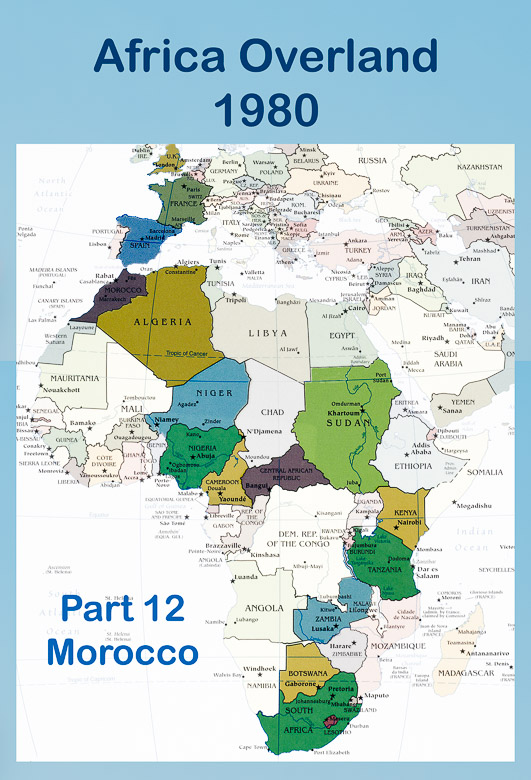
This is the twelfth instalment of a four-month trans-Africa trip from Johannesburg to London that I did with Exodus Expeditions in 1980, travelling by ex-army truck and camping. We were not sightseeing, though we did see some incredible sights. Our goal was to see and experience Africa from south to north by whatever route was open. Four months. Twelve people. One truck. Fifteen countries. 18,000 kilometres. Links to the earlier posts are listed at the end of this one.
*********************************
Wouldn’t you know we’re riding on the Marrakesh Express
Wouldn’t you know we’re riding on the Marrakesh Express
They’re taking me to Marrakesh
I finally made it! I finally got to Marrakesh, that great hippie mecca, second only to Haight-Ashbury in San Francisco! It’s a dream come true, and so what if I’m a few years late to the party, or that I was plagued by imposter syndrome during all my hippie years; I longed with all my heart to be a real hippie without knowing exactly how to go about achieving that. Surely being in Morocco would give me some credibility, a bona fide entrance into the club. And at last I’m here! In Marrakesh!
It began in Sydney in 1968 when I saw a production of Hair: The American Tribal Love-Rock Musical about the hippie counterculture and sexual revolution of the late 1960s. I fell in love with it, the whole idea of it, but being still young enough to want to please my parents I became a librarian, that most staid of professions, and the polar opposite of anything counterculture or unconventional. Then in 1974 I went to North America and Europe for 18 months. It was Canada that did it. I blame Canada: living in a dilapidated old farmhouse on the outskirts of Vancouver with six other people, smoking a little hash, trying a little LSD, turning on, tuning in, dropping out. When I got back to Australia I was irrevocably changed, and promptly went to art school, then dropped out after seven months because I knew that what I wanted to do more than anything was travel.
I was in search of whatever it was most of us were searching for: self discovery, freedom, free love, a little hash, freedom, a life of authenticity, freedom. I’d started my transformation from librarian to hippie with clothing, most of it thrift store finds, and was jealous of those women who had exquisite, authentic, hand-woven, hand-made, hand-embroidered garments from Asia or South America. Or Morocco. On a later trip back to Australia: a conversation about the hippie culture with my mother, myself, and a spinster aunt. Mentioning a friend, the aunt asked: and is he one of the dirty ones? I wish I’d had the presence of mind at the time to say I don’t know any dirty ones. Boom! Though after four months on the road across Africa I’d certainly qualify.
I don’t remember why I chose South America over the hippie trail, that overland route popular from the mid 1950s to the late 1970s from London across Asia to Kathmandu, but I always expected I’d do it eventually. But first South America, and then Africa. By 1980 the hippie trail was no longer possible due to the Iranian Revolution and Russia’s invasion of Afghanistan.
Meanwhile a hippie trail, centred in Marrakesh, had developed in Morocco, largely due, I suspect, to the easy availability of good hash. And finally here I was, and it was everything I’d hoped it would be.
Crossing the border from Algeria into Morocco at Zellidja Boubker we head west through the foothills of the Atlas Mountains.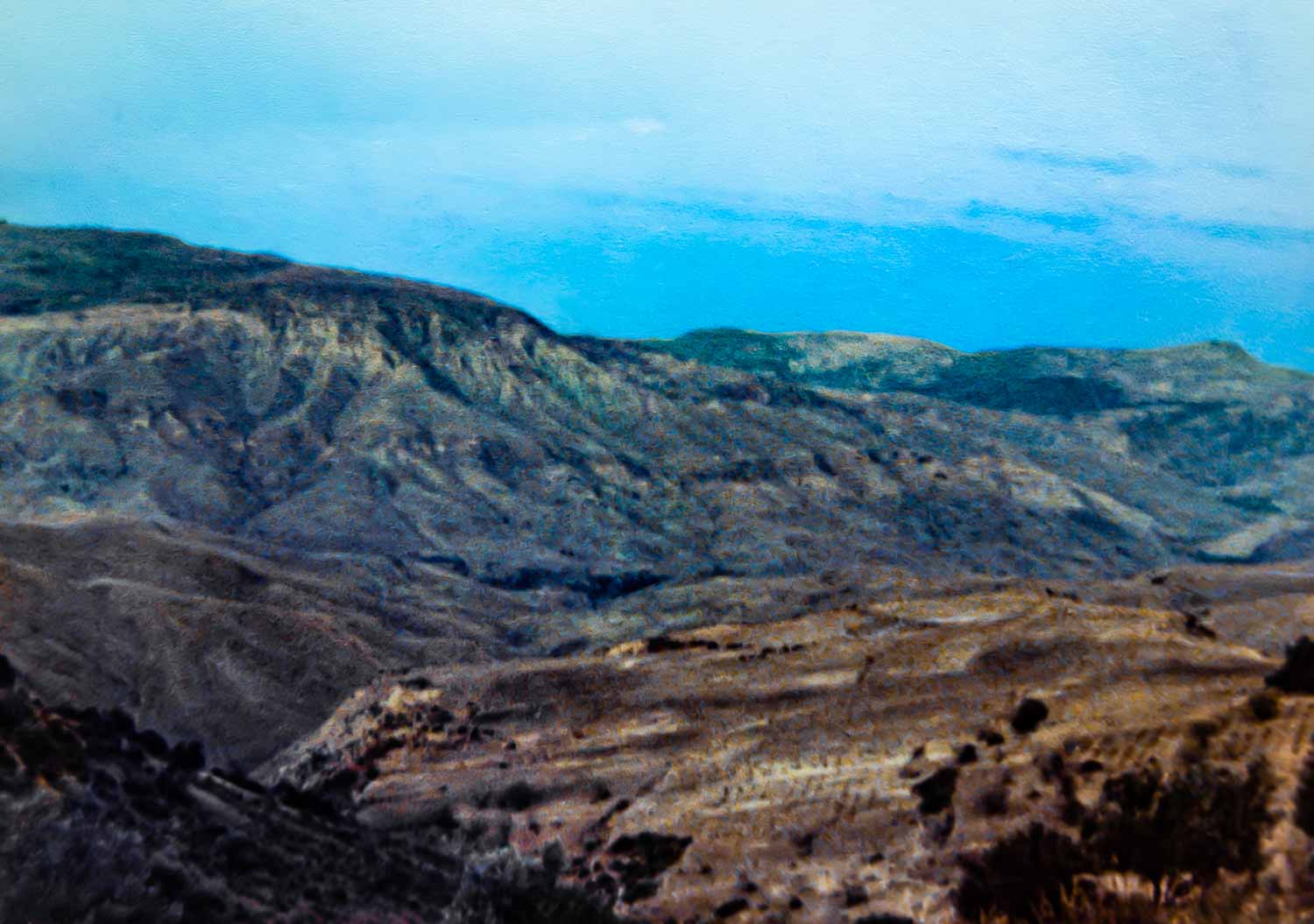

There’s a palpable relief to finally being out of the desert. Without realizing it at the time, the challenge of the Sahara has affected us all, and the ease of being in a mild climate on paved roads brings a joyous lightness. And soon we’re overlooking the city of Fès.
Separated from Spain by the Strait of Gibraltar with its famous “rock”, Morocco is a mountainous country with the Rif Mountains in the north and the Atlas Mountains spread throughout from north-east to south-west. Its indigenous people are collectively known as Berbers, and their influence can still be felt even though over the centuries Morocco has seen extensive migration from other cultures. The Arab conquest of the late 7th century led to most people accepting Islam. The 19th century saw Great Power politics leading to the country becoming a French Protectorate in 1912. Independence was regained in 1956, and to this day the country is one of only three monarchies in all Africa. The Medieval traveller, Ibn Baṭṭūṭah, a native of Morocco wrote: it is the best of countries, for in it fruits are plentiful, and running water and nourishing food are never exhausted.
Morocco is still an extravagantly exotic place, and in 1980 it was even more so. I was in hippie heaven.
Fès is surrounded by low hills carpeted with olive groves and orchards. We are unused to such abundance after weeks in the Sahel and the Sahara! The old town, or medina, is a labyrinth of narrow alleys, a tangle of adjoining buildings centuries old; it is known as Fès el-Bali. Fès el-Jedid, dating from the 1200s and founded as an extension of the medina and as a royal citadel, is the “new” old town. It chiefly contains the historic Jedid Gate
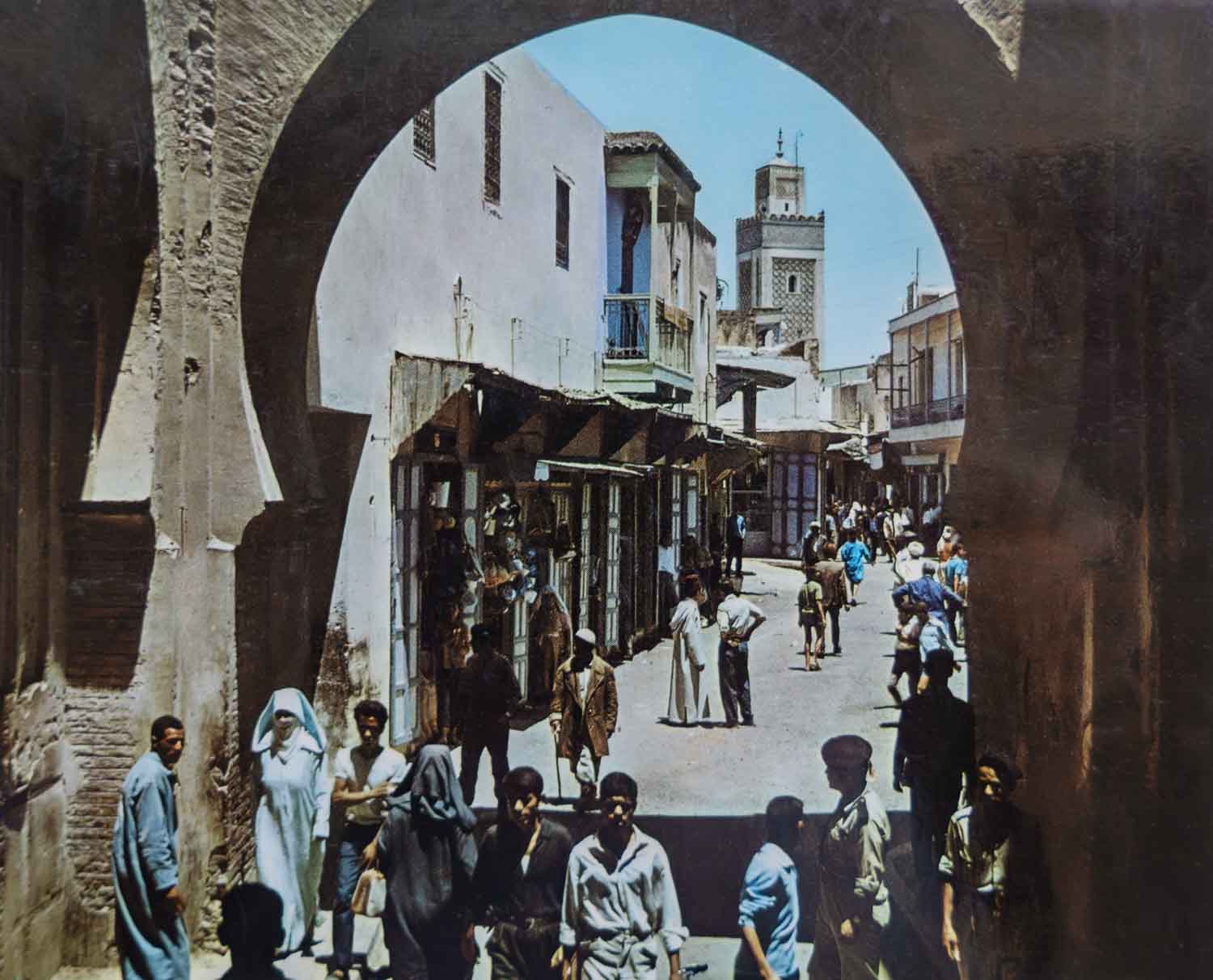
and Fès Royal Palace, which was once the Moroccan centre of government, and on occasion is still used by the royal family today.
With a local guide we plunge into the medina, Fès el-Bali,

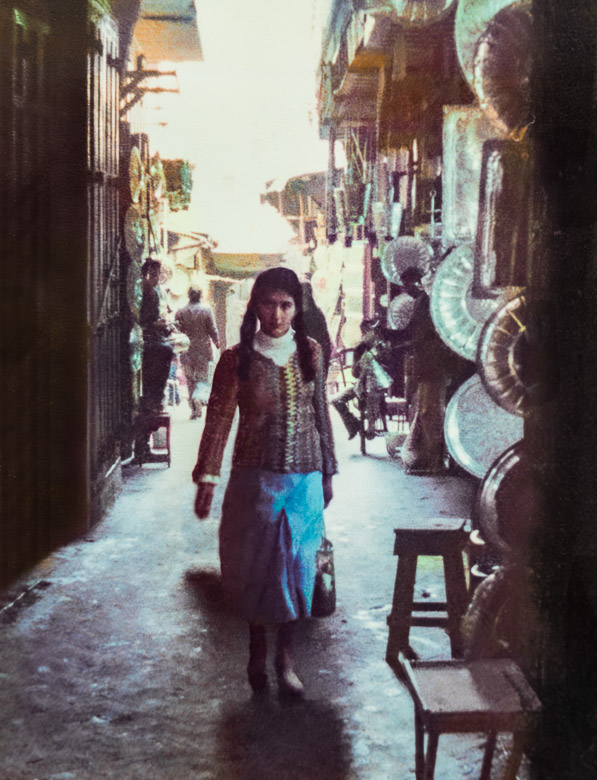
a maze that is such a rabbit warren of crowded convoluted streets that getting lost would be easy.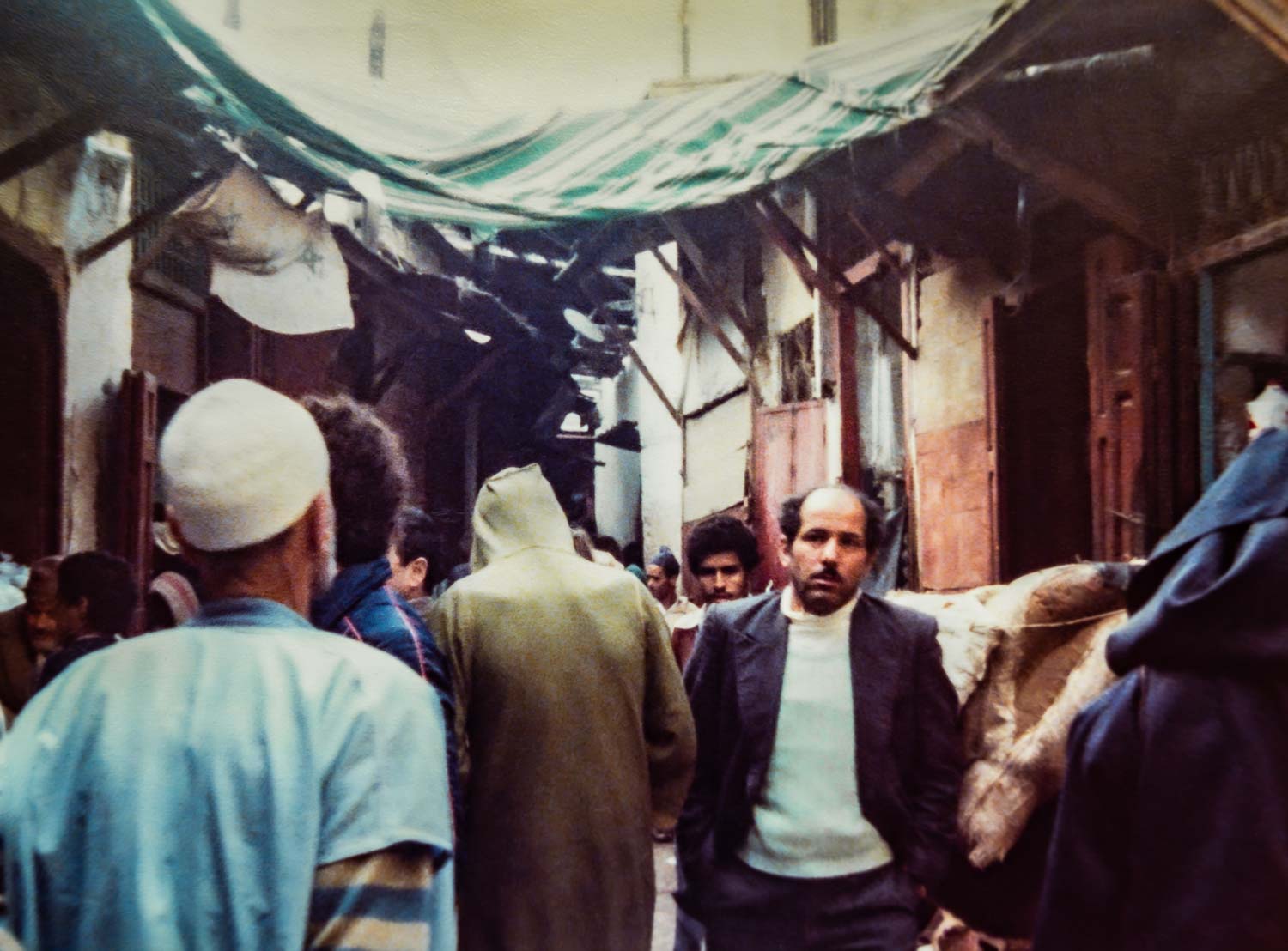
Down the narrow cobbled streets we go, the ancient buildings rising high on either side. Along the street where fabric is dyed,
winding our way past donkeys and many mosques,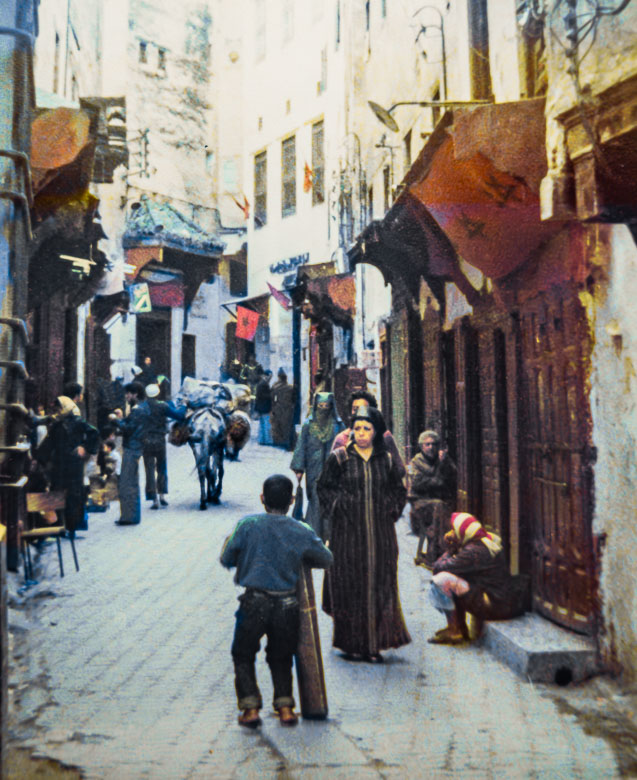
almost drunk with the medley of competing aromas, colours and sounds. Here for sale is everything you could imagine. We pass shops selling vividly coloured pyramids of spices, brassware, baskets,
exquisite hand made ceramic tiles, equally exquisite pottery,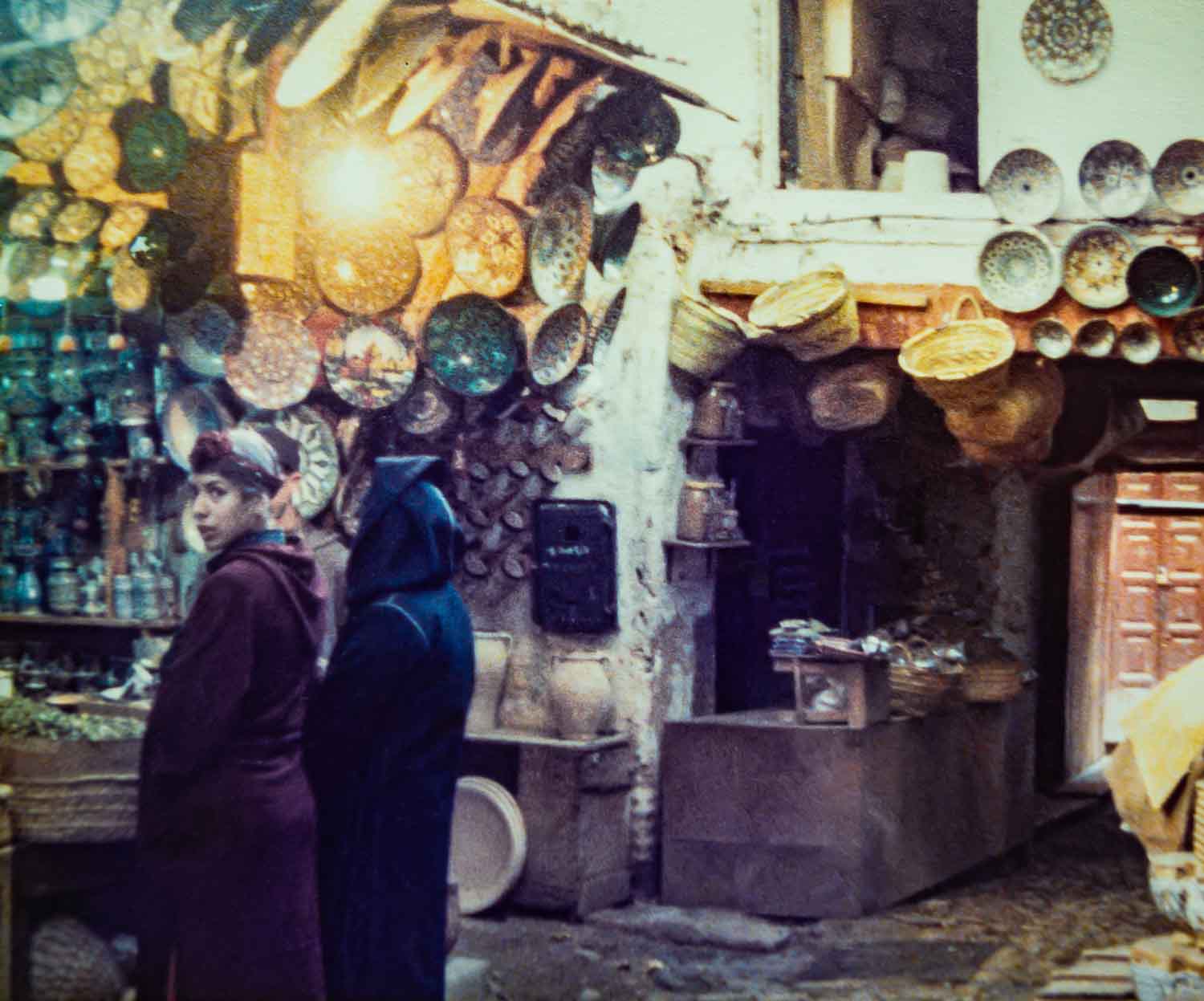
dried fruits, dates, nuts piled high, beaded shoes, all kinds of leather goods, apothecaries, and market stalls. In a clothing store I try on a djellaba, the long, loose-fitting unisex outer robe that is worn in Northwest Africa.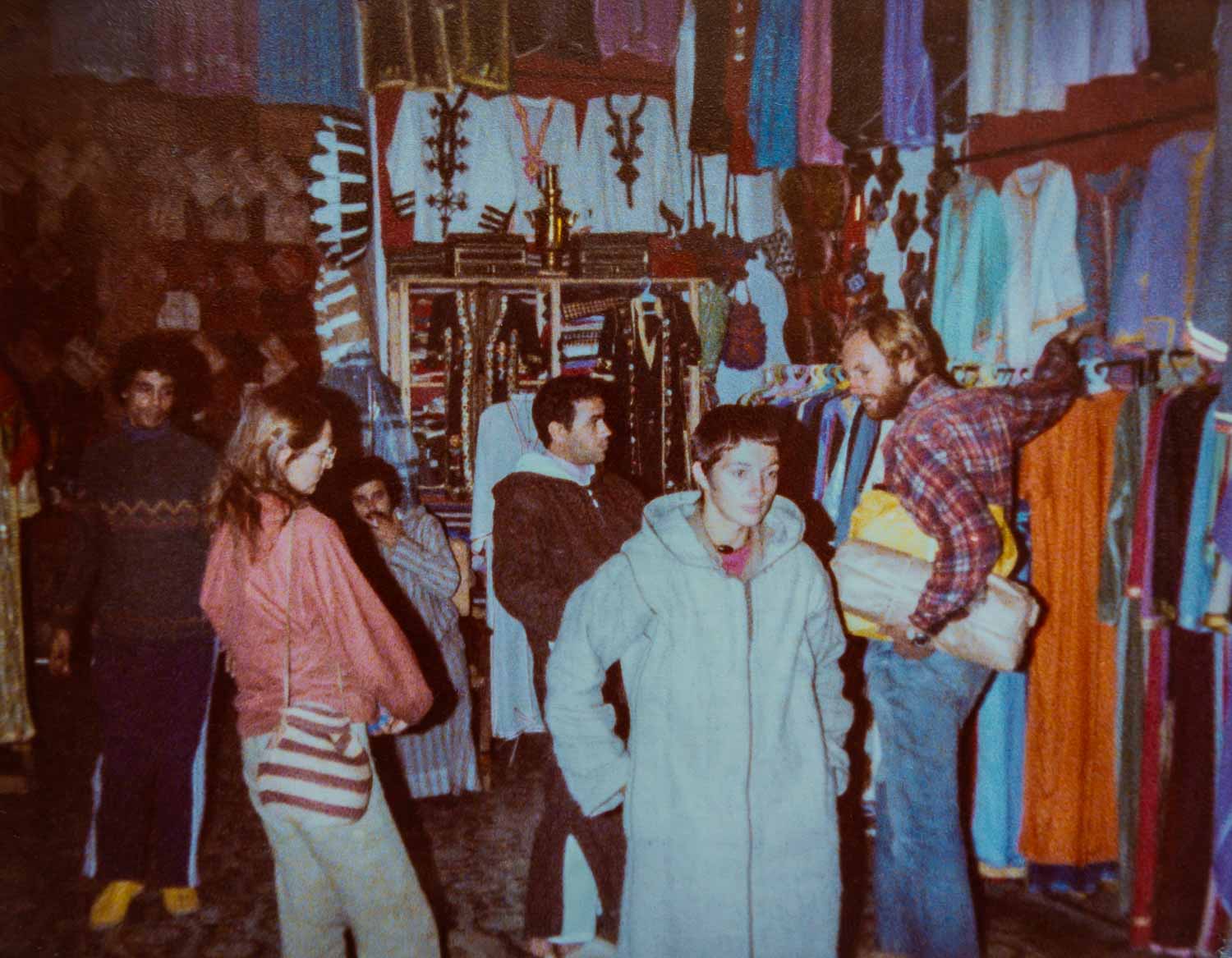
Fès is a historical centre for trade, and for crafts such as pottery and leatherwork, and the crumbling Medieval medina, a vast vibrant network of dark stores and workshops lit by shining metal lanterns, is intoxicating.
We are brought to a balcony overlooking the Chouara Tannery, the largest and oldest of three tanneries in Fès. While before there was a mix of aromas, here it stinks – the pungent, overwhelming combination of urine and decaying flesh. Animal hair and skins (sheep goats camels cows) lie everywhere around the stone vats of coloured dyes. The dyes are natural – poppy for red, indigo for blue, and henna for orange.The entire process, operating for over five hundred years, uses only manual labour and has not changed since Medieval times. The butter-soft leather is sold to craftsmen who produce Morocco’s famed leather goods.

I don’t really understand the process, but I certainly understand the result, and buy myself a beautiful pale-peach coloured overnight bag. I have never before or since felt leather so soft and supple.
In stark contrast to the tannery, Al-Attarine Madrasa, founded in 1325, is all quiet calm elegance, a masterpiece of Islamic architecture. Situated in the heart of the medina, the school housed students who studied verse by verse the entire contents of the Koran.
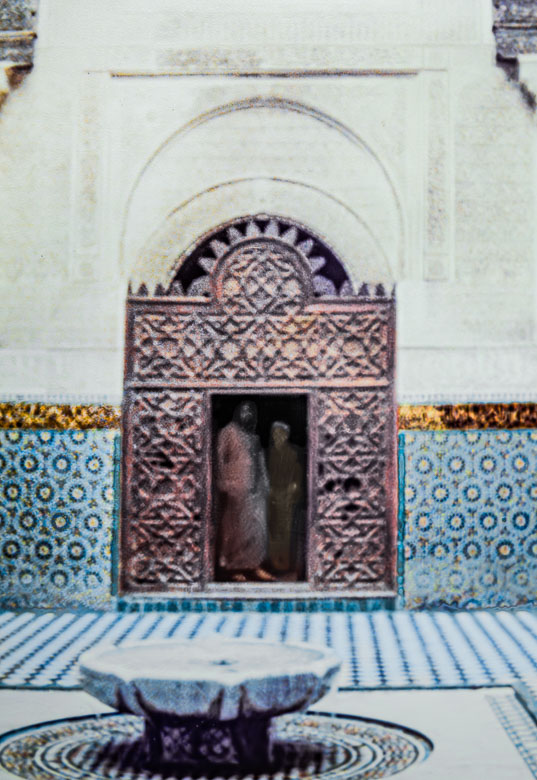
And so we come, finally, to a carpet shop, an inevitable end to the tour, where we have a party drinking mint tea and looking at all the beautiful rugs.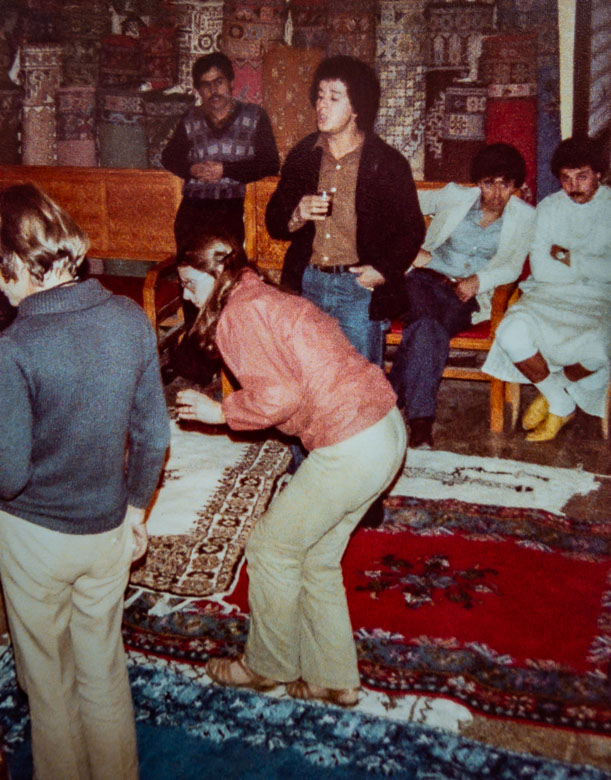
I buy a small one. I sign the back with a felt marker, and when I return to Australia a year later it is there waiting for me.
It is in the carpet store that I meet Abdul. And one of the other women in our group meets Mohamed. I am amused by their names, which must surely be the most common Muslim names; it’s as if we’ve gone to England and met John and Johnny. They ask us out on dates. We are both wary, me more so than the other woman. I try to organize a double date thinking that would be safer, but the guys are having none of it. I decide to chance it. The voice inside my head is telling me to just go for it, so I do.
In Fès we are in a regular campground for a change, rather than wild camping outside of town. Abdul meets me there and we walk, first to a lovely restaurant, then later to a bar. I have a wonderful evening, and like the perfect gentleman that he is, he escorts me back to the campground. Not once does he make any moves on me. He’s a really good guy. A year later, when I finally return home, there’s letter from Abdul waiting for me. We stay in touch, and soon after he emigrates to Australia and we briefly meet again in Sydney. He is always kind and courteous. If you read the letter remember that English is his third language after Arabic and French, and his second alphabet.

To this day I do not understand why the other woman got into a car with Mohamed. He said he wanted to take her to a village to meet his family. He stops the car at the side of the road and rapes her. It is the risk of travel, the things we do to have an immersive experience. When we women travel the odds are not in our favour. I got lucky is all. The other woman is stoic. To this day I wish I’d known better how to comfort her.
And so we travel on. To Marrakesh. At last. In many ways it’s very much like Fès, and if my hippie heart was looking forward to Marrakesh, I find it has already been hugely nourished by Fès.
Marrakesh, one of Morocco’s four imperial cities, lies in the centre of a fertile plain and vast palm grove. The medina, known as the pink city for its ancient buildings of beaten clay, is a densely packed, walled Medieval city. By the late 1960s it was an essential part of the new hippie trail, frequented by seekers of all kinds – here may be spiritual enlightenment, and hopefully enough hash to dissolve western conditioning.
Like Fès, all your senses come to life here, with the noise, the colour, the energy. The medina is a place of maze-like cobble-stone alleys where busy souks sell spices, brass and silverware, leather goods, traditional textiles, and pottery. I haggle over the price of a hand-woven vest, buying myself a piece of true hippie clothing, and hang out with some of the others, and a couple of new friends, for a mint tea refresher.
We take a two-hour carriage ride in a traditional caleche, rolling gently by the ancient walls, a soft pink in the afternoon sunlight, and past 12th century palaces, mosques, and tombs of sultans, while inhaling the heady scent of orange trees.
But above all, the greatest show in town is Djemaa el-Fna Square. Situated at the centre of the medina, this vibrant market place is so huge it’s not really a square at all, just a vast open space where everyone gathers – touts and tourists, traders and merchants, street-food vendors, locals and visitors alike; all activity in Marrakesh begins and ends at Djemaa el-Fna. The activity, the street theatre, the deal-making, the visiting, have been non-stop here since the 11th century. In hippie parlance: It’s all happenin’ man.
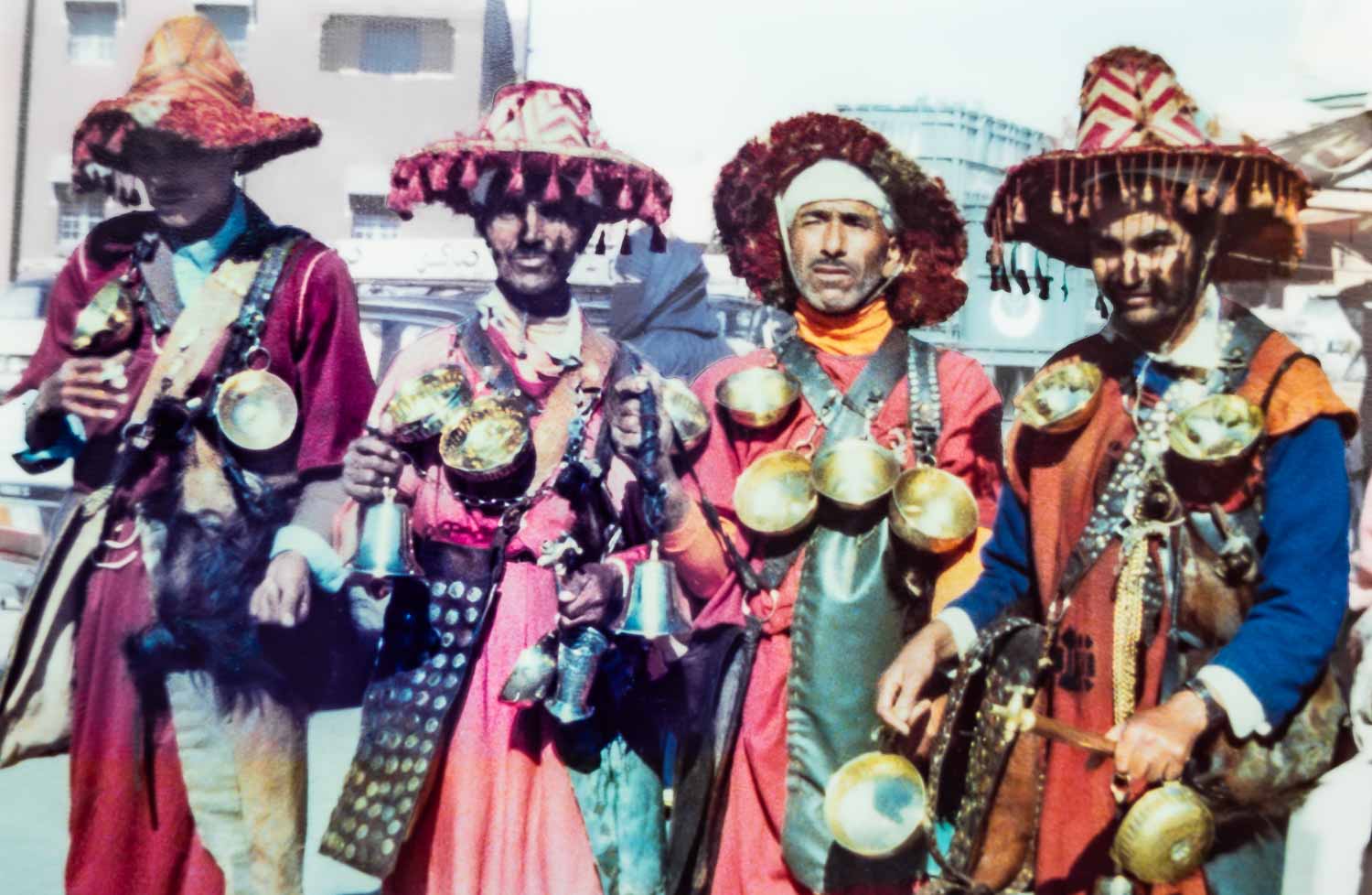
And probably the most exotic of all are the water sellers, who played an essential part in the ancient trade business of the Moroccan desert. They carry tar-lined goat skin bags filled with fresh water for sale to thirsty travellers. They ring the brass cups to attract attention, and even now Moroccans consider it lucky to drink the water they sell.
From Marrakech we drive to Ceuta on the far northwest coast of Morocco. It is a Spanish exclave, military post, and free port, and is an autonomous city administered by Spain. It is from here that we take a ferry to Spain for the final leg of our journey to London.
In Fès Abdul helps me score a chunk of hash, a bit smaller than a golf ball. Then I learn that it is actually illegal in Morocco. Who knew?! So except for a tiny amount, no bigger than my smallest fingernail, I flush it down the toilet.
Next post: through Spain and France a mad dash, two decisions that are rash, a drunken farewell bash, the scrapbook cache. And the hash.
Disclosure:
1. I’ve changed the names of everyone involved for privacy.
2. Obviously any photo with me in it was taken by another member of the group, but I’ve no idea who. We all swapped photos when we got to London.
Previous posts:
1. The Drums Of Africa. Botswana and Zambia.
2. Tanzania Mania
3. Wildlife And Tribal Life In Kenya
4. The Opposite Of Glamping
5. Turn left At Sudan
6. Mud Luscious and Puddle Wonderful. Central African Republic
7. Becoming Unstuck. Central African Republic
8. Waiting For The Rabbit To Die. Bangui, Central African Republic
9. Between The Jungle And The Desert: Cameroon and Nigeria
10. Sahara Prelude – traversing Niger
11. The Land Of False Borders – the Sahara and Algeria
All words and images by Alison Louise Armstrong unless otherwise noted
© Alison Louise Armstrong and Adventures in Wonderland – a pilgrimage of the heart, 2010-2024.

 Adventures in Wonderland
Wonderful post. I love the shot of the water men. When I was in Morocco 2 years ago they were mostly for entertaining tourists. The fabric dyer street looks the same,, with bunches of yarn hanging to dry.
LikeLiked by 1 person
Thanks so much Marie. It pleases me to hear some things are still the same. It’s such a vibrant and unique culture that it would be a pity if it was lost to globalization. The water sellers are almost like a Unesco site – maybe a “world cultural heritage”. They initially played an important role for the trade caravans from the desert.
Alison
LikeLiked by 1 person
Another great read. Although I’m back in the more familiar landscapes of southern Morocco and the beautiful city of Marrakesh, which I’ve also visited, there’s still something exotic about your story.
LikeLiked by 1 person
Thank you so much. Are you in Morocco at the moment? How wonderful. I’d love to go back one day. I didn’t get to southern Morocco so much more to explore. I found both Fès and Marrakesh to be extremely exotic, and unlike any other part of Africa that I went to.
Alison
LikeLiked by 1 person
Oh no, unfortunately I’m not in Morocco at the moment. Unlike the other countries you’ve crossed, Morocco is more familiar to me, especially the south after Marrakesh. I’ve travelled there on a road trip between the Atlas, the Anti-Atlas and the desert.
LikeLiked by 1 person
That sounds like an amazing road trip!
LikeLiked by 1 person
Blame Canada!! Your excitement comes across in every word of this chapter! We are actually going to Morocco this fall so I will bring your words and excitement along with me. 😊 Maggie
LikeLiked by 1 person
I was soooo excited to be there! What a fabulous place it is, and still is if everything I’ve read is true. You’ll love it! I look forward to your posts.
Alison
LikeLiked by 1 person
I read that the locals in Morocco are generally not too keen on people taking their photos, but it looks like back in the 1980s they seemed more relaxed about this? Or at least that’s the impression I got from your photos. Abdul sounds like a courteous person. If he had bad intentions to you, he would’ve probably done it. The letter he wrote to you is kind of sweet actually. How nice that you still have it after all these years, and that you were able to reconnect with him, in Sydney of all places!
LikeLiked by 1 person
I never had any problems taking photos of the people there, though I didn’t do any closeups, just quick snaps. No one ever said anything. Abdul was a total sweetheart. I was very lucky. To this day I have no idea if our meeting had anything to do with him deciding to emigrate to Australia. He never spoke to me about it.
Alison
LikeLiked by 1 person
You must be so enjoying these memories. Relieved you got the good guy in Morocco. The letter is so sweet.
LikeLiked by 1 person
I’m having so much fun reliving this journey. And sharing it. It was quite something, as you well know. I too am relieved I got the good guy. I’ve been very very lucky.
Alison
LikeLiked by 1 person
Hurray to be out of the desert! I always thought that you could just be a hippy, the same way you can be a librarian or whatever. Is it instead like being “cool?” As in, someone else has to decide that you’re in? I feel like this whole trip has been pretty hippy!
Curious about going by Linnet (but only if you’re comfortable sharing, of course!) I didn’t like being Felicity for all my childhood because no one had ever heard of that name or could say or spell it. I actually went by Fey (a nickname given my first week of college) all through university and into my early 20s before finally settling into Felicity in my late 20s/early 30s.
LikeLiked by 1 person
I don’t think I know exactly what being a hippie was – except living an unconventional life, and I’ve certainly done that. Tuning in turning on dropping out – I did all that, so I guess I qualified. It was more than being cool – it was a rejection of conventional norms. And you’re right, the whole trip was a hippie trip for sure, though I think, while I continued to live an unconventional life, I suspect many of the others went on to live more normal lives.
My birth was registered as Alison Louise Armstrong, even though my mother hated the combination of Alison Armstrong. After a year my parents decided to change it to Lynette Ethel, but were told they couldn’t change it, they could only add names on. So I became Lynette Ethel Alison Louise 😳. I was mostly called Lynne. Linnet was a diminutive, and my favourite name for a while. Then in my early thirties I decided I needed to go back to my original birth name.
I think Fey is lovely! But clearly you’ve grown into Felicity, so that’s what it must be.
Alison
LikeLiked by 1 person
I was curious about this, too … I did not expect this answer (that your parents changed your name)!
LikeLike
I was curious about this, too … did not expect this answer (that your parents changed/added on to your name!)
LikeLiked by 1 person
They apparently they had no choice. As I was the 4th girl they’d run out of names 😂 and I got Ethel 🫣 because Dad had 4 girls and none had been named after his mother. (Gee. I wonder why?!)
LikeLiked by 1 person
Normally I have trouble picturing folks with alternate names, but Linnet suits you. It’s also very hippy. 😛
LikeLiked by 1 person
Your writing paints such vivid imagery, Alison. I visited Marrakech about ten years ago, and it was truly breathtaking. When we arrived, we found ourselves in a bar overlooking the Square, where we could watch the lively afternoon activities unfold below. As the day turned into evening, the area slowly and magically transformed into a bustling scene of restaurants, stalls, and eateries. I can imagine that this daily transformation has been happening for centuries. It was an unforgettable experience.
LikeLiked by 1 person
Thank you so much David. Your trip to Marrakech sounds amazing. I never did see Djemma el-Fna at night. From what I’ve read it sounds like one of the best things about Marakesh. Still, I loved my whole experience in Morocco. It’s so different from anywhere else in Africa.
Alison
LikeLiked by 1 person
Another great tale, Alison. It could easily be a book. Your writing captures both the world you travelled through and your experience of it so very well. I, too, was fascinated by the hippie culture but never made the leap. (All my years going to Burning Man, speaks to my fascination with alternative life styles.) It amazed me how much the world changed while I was in the Peace Corps. From 1963/65 I was at Berkeley involved in the beginnings of the student revolution. I lived in the Bay Area. In 1967 when I was wrapping up my time as a Peace Corps Volunteer, some new volunteers came in and threw a Haight-Ashbury Party, which I went to but I didn’t have a clue about what a Haight Ashbury Party was. In just the two years I was away from the Bay Area, Haight Ashbury happened!
LikeLiked by 2 people
Thanks so much Curt. I think you’re a hippie at heart – just in a different disguise (Peace Corps, all the Lung Assn hikes, Burning Man! Counterculture loud and clear!). That’s pretty funny that you went to Haight-Ashbury party in Africa, but didn’t know what it was. What a change in two years! In Australia even during my years of library training I was marching against Apartheid and the Vietnam War. I think we were both radicals right from the beginning.
Alison
LikeLike
Maybe a wee bit, grin. My more conservative relatives certainly see me as such. (We avoid talking politics.)
LikeLiked by 1 person
I felt the change from desert to trees and mountains from your words alone; I can imagine the relief even if you were not aware of how much you were seeking it at the time. I have tentatively booked a trip to Morocco (my first) next spring, and Marrakech (just the name alone!) is a big draw!
LikeLiked by 1 person
We weren’t really aware of the challenge of the desert until we left it behind – such a relief. I’m with you – just the name Marrakesh is exciting. Make sure you go to Djemma el-Fna at night – I didn’t get there at night but I’ve read that’s when it really comes alive. Have great time!
Alison
LikeLiked by 1 person
I loved your opening paragraphs, Alison. I saw a stage production of Hair in London and was filled with the same urge to live a different life. I never managed to make it happen, and there are regrets for sure. But you had a measure of luck or good sense and came through unscathed. When did Don come on the scene- many years later? I still haven’t been to Morocco, even though it’s a hop and a skip away. Who knows if it’s in my future?
LikeLiked by 1 person
Thanks so much Jo. That era really was a time of great change for many of us wasn’t it. I did have a measure of luck, but also that first trip out of Australia really did it for me. “Hair”, and hanging out at the student union, was the first hint of things to come, but it was travelling that really tipped the scales for me into an unconventional life. I’d have been an awful wife, and even worse mother. Don and I didn’t get together until I was 49, by which time I was finally willing to let a little stability into my life.
I encourage you to go to Morocco! It’s amazing, even still. Much of what I saw/experienced still exists – the medinas and souks and ancient buildings. It’s so exotic. I think you’ll love it.
Alison
LikeLike
🤗🩵
LikeLiked by 1 person
Not only was that a fascinating step back into hippy history, it had a soundtrack! (Good old CSNY…)
LikeLiked by 1 person
Thanks Dave. It was a great look back for me – there was so much change, and promise, in that era. And yeah, good old CSNY
LikeLiked by 1 person
Well what an interesting read! Mostly, I’m very surprised to hear about Marrakesh’s hippie past, since I’ve always pictures Morocco as a super strict Muslim country where women need to cover their shoulders. I got this impression from when I lived in France (Paris, Nice and Montpellier) and sooooo many Morroccan and Algerian men were always harassing me. In Paris, I’d walk on the street at 8am towards the office I worked at, fully clothed – jeans, a winter coat, all entirely respectable, no mini dresses (not that I think it should matter), and these men would yell at me from car windows, building windows… This happened daily for all the time I lived in France (maybe 3 years). Never would I travel there, in this lifetime, as a woman. So your story reminds me a little bit of Iran before the Taliban. 🤨 Interesting.
LikeLiked by 1 person
Oh Morocco was not then, and not now as far as I can tell from researching for this post, a super strict Muslim country. I do think women need to cover their shoulders, but I don’t think it’s generally any stricter than that, though there were (and probably still are) stricter groups within the country – eg I did see women in full burqa, but also the woman on the street like in the pic above in skirt and sweater and a bare head. Algeria on the other hand was then very strict, and maybe still is (I don’t really know). I would hazard a guess that the men who harassed you were more likely to be Algerian rather than Moroccan. I have friends who recently spent time in Morocco and loved it. And when I was there no one harassed us at all. I don’t think it’s at all like the impression you got of it.
Alison
LikeLiked by 1 person
Interesting to know this!
LikeLiked by 1 person
Yet another wonderful read, Alison! Your Africa trip would be a fantastic base for an adventure book! I very much enjoyed every paragraph of it and it made me think about how most of us live our lives on autopilot. We go to college, we get a job, we get married. And we never question any of it. But a few free spirits manage to break away from this social script. I am glad that I dropped out of college and moved to Ireland all by myself in my early 20s because early on I realised that there is no real happiness with the herd. While some of my deviations came with consequences ( my family and peers let me feel their disapproval and even hatred ), I am glad I pushed forward into unchartered territory.
You know, I would love to see a glimpse of what Marrakech was like back then when thousands of flower children made a spiritual pilgrimage through northwest Africa all while soul-searching, and looking for enlightenment and a connection to ancient cultures through the Moroccan lifestyle. Once our kids are old enough, I’d like to embark on the Morocco hippie trail. It would be fun to hike and camp through Paradise Valley then enjoy city life in Agadir, followed by Tangier, where I could retrace the footsteps of beat writers, like Burroughs and Kerouac, Thanks for sharing, and have a good day 🙂 Aiva xx
LikeLiked by 1 person
Thank you so much Aiva. I’m so glad you’ve been enjoying all my stories from Africa. I do hope to turn it into a book one day. I love your story about breaking away and moving to Ireland. What a huge adventure that must have been. Kudos. I was lucky that my family supported me in all my choices.
Morocco was quite amazing back then, and I’ve wanted to return ever since. I do hope that you get to do your Morocco journey one day. Even though it’s now a different era I don’t think it will disappoint. Thanks for your thoughtful comment.
Alison
LikeLiked by 1 person
🥰🥰🥰
LikeLiked by 1 person
What an adventure. No wonder why you can consistently write about your travels for 14 years and more! By the way, I have worked with a guy developing online systems for him to run his tours in Morocco. Its not exactly an acquaintance like Abdul, but that is my connection with Morocco. If you’re planning to revisit, I know someone 😉 Thanks again for sharing such a detailed travelogue.
LikeLiked by 1 person
It for sure was the most amazing adventure. I can hardly believe I did it! I think I keep going with blogging because of being committed to it, but also because no matter how difficult it is to get started on each post, and no matter how much the initial writing is a real slog until the flow comes, and no matter how often I have to rework the writing, it always feels so good when it’s done. There’s a huge feeling of achievement and satisfaction from the hard work of creation.
I’d love to get back to Morocco one day. It’s always good to have a connection.
Alison
LikeLike
Now you’re in more familiar territory… welcome back to civilization. Although I wasn’t there in my hippie days (I had them too but just traveling around the US), I was charmed by Morocco and Marrakesh.
LikeLiked by 1 person
Yes, finally out of the desert, and into more hospitable lands. I loved Morocco! Maybe one day I’ll get to go back and see it with new eyes. I imagine I’ll find it as exotic as ever. Ah the hippie era. What a time it was. I don’t think I ever entirely left it behind.
Alison
LikeLiked by 1 person