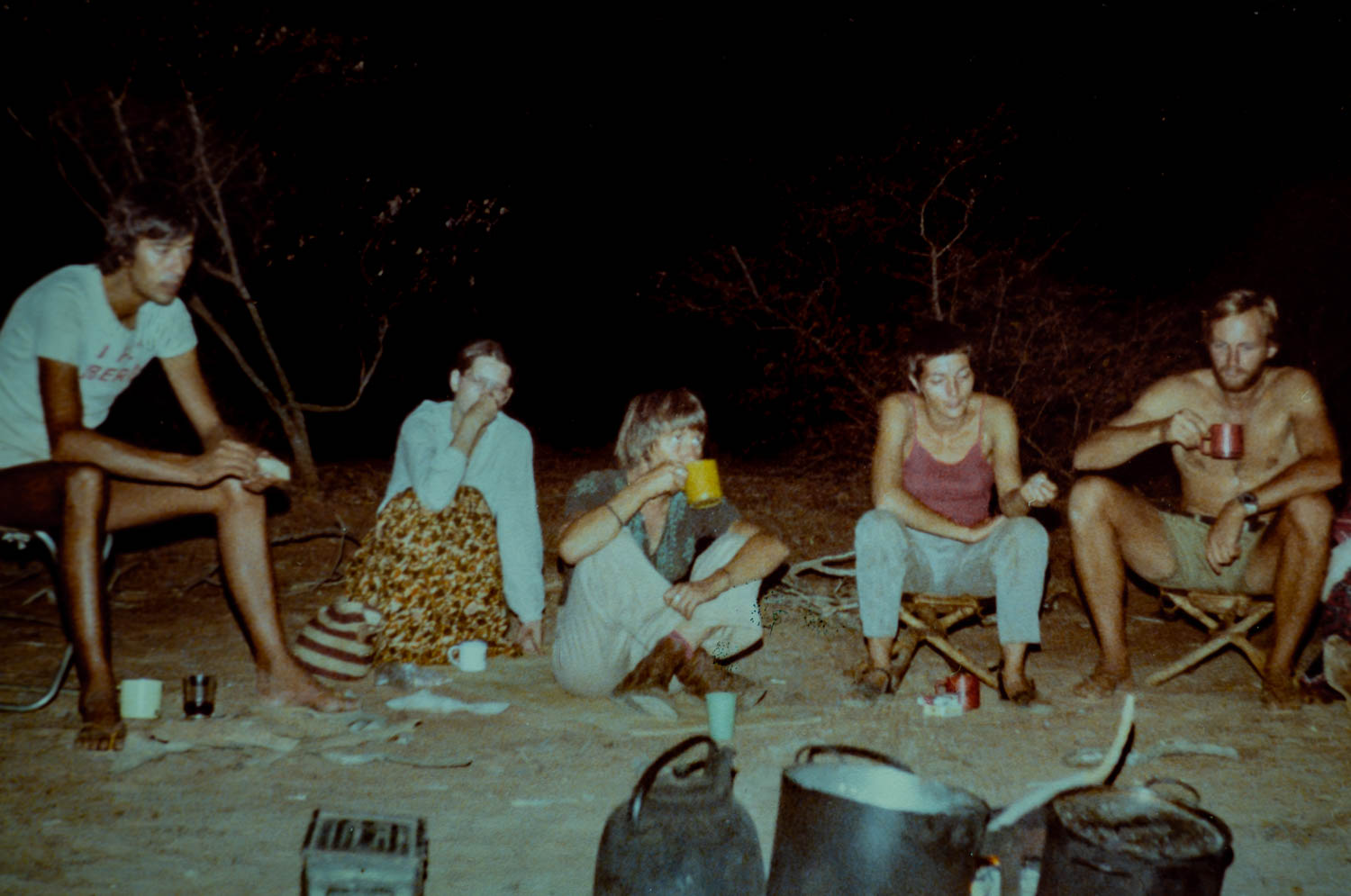
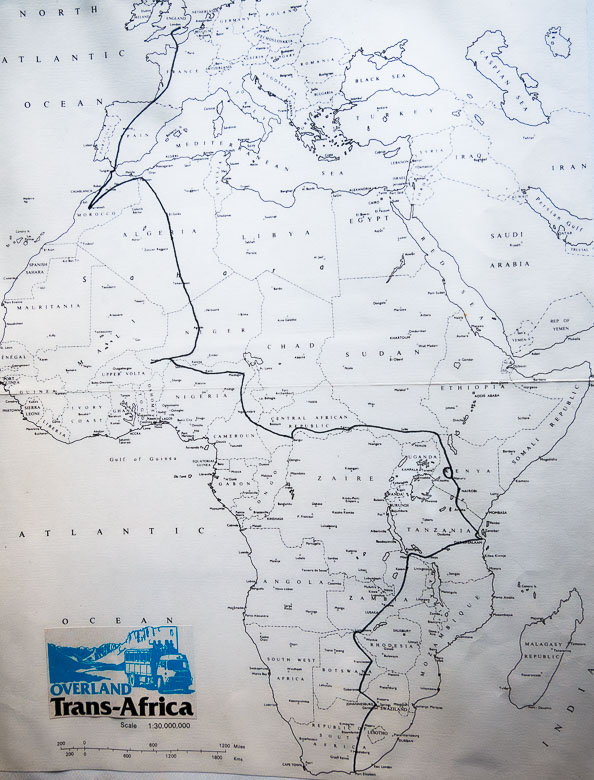
This is the fourth instalment of a four-month trans-Africa trip from Johannesburg to London that I did with Exodus Expeditions in 1980, travelling by ex-army truck and camping. We were not sightseeing, though we did see some incredible sights. Our goal was to see and experience Africa from south to north by whatever route was open. Four months. Twelve people. One truck. Fifteen countries. 18,000 kilometres. You can read the first instalment here (Botswana and Zambia), the second here (Tanzania), and the third here (Kenya).
***********************************
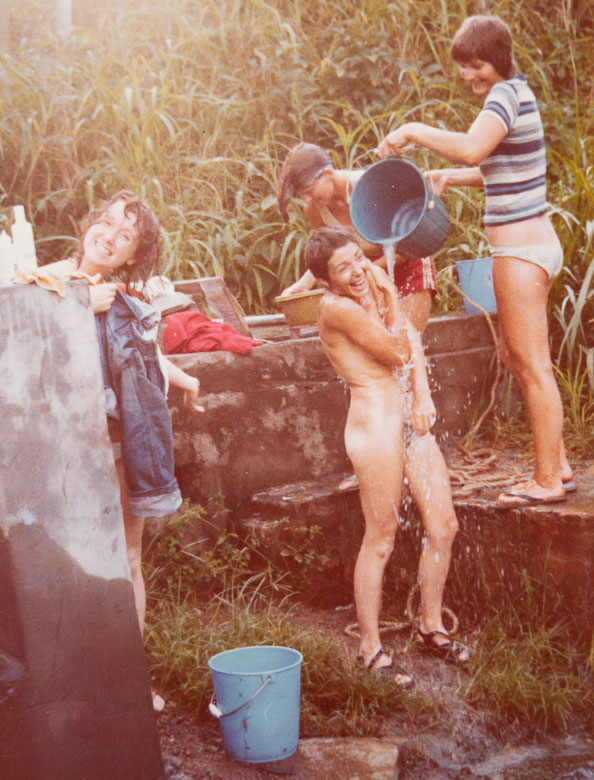
. . . . . We also got to wash body and clothes in a tiny stream just out of the village; all of us standing or squatting in a line in the narrow stream in various stages of undress. I bet the villagers have never seen so many white bums in their lives. Another time we took over the local well. I can never truly express what heaven these washes are! You’re sweating all the time, and all day as we’re driving dust and grass and leaves and insects blow in on you, and in your hair. And then it rains and everything gets covered in mud. And you never change your clothes because there doesn’t seem any point when you’re so dirty.
Sitting on the vinyl seats in the truck and you get up and find the dust on your legs has turned to mud with sweat, and the sweat runs down your body in rivulets picking up grit along the way, and your whole body feels sticky and greasy and clammy until you’re just about at screaming point. No wonder such excitement at getting clean, yelling and laughing and shouting. Such joy! Such a treat! Such a feeling of relief!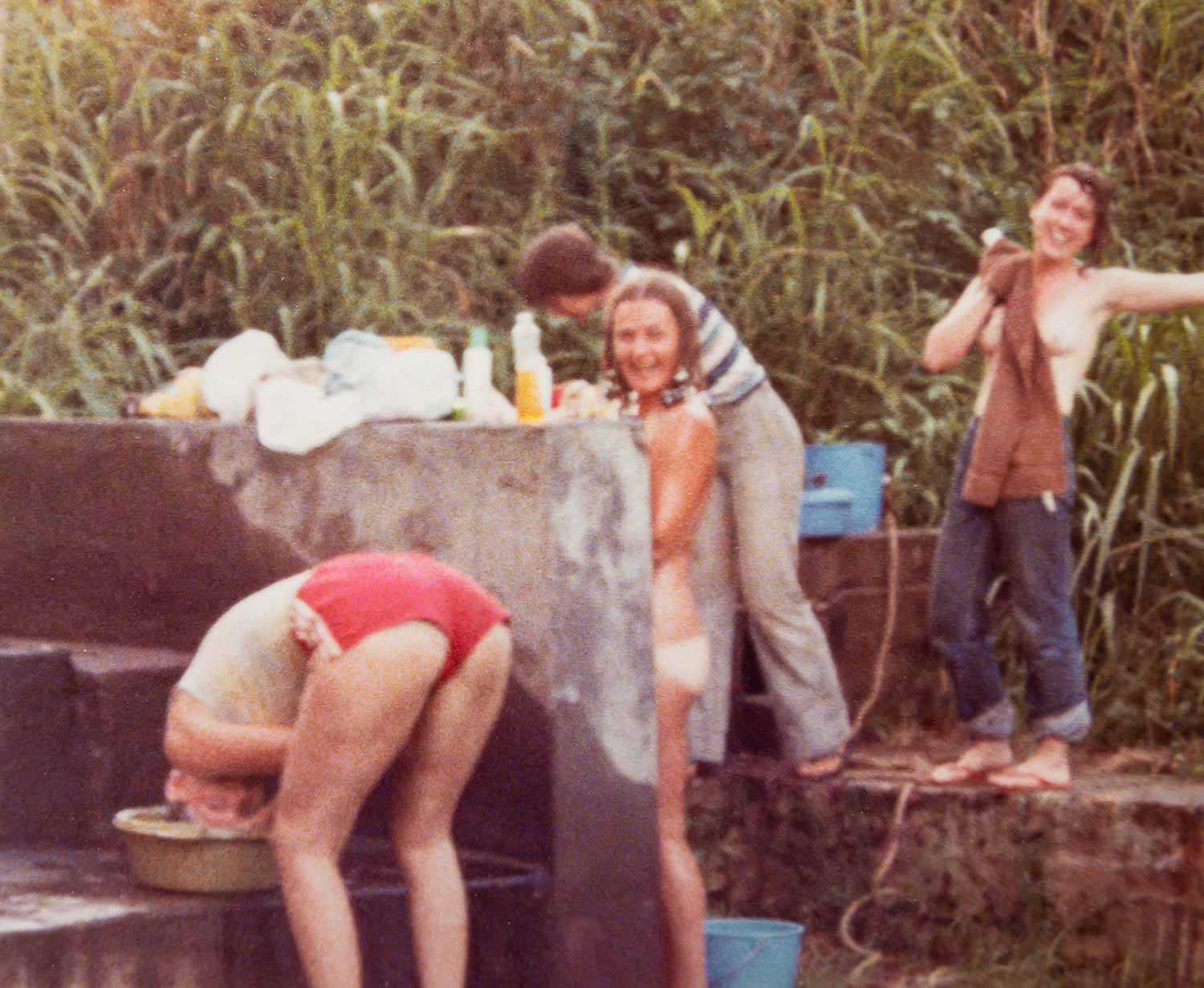
On travelling days we usually stop in the middle of nowhere for lunch. We’re all sitting around on the ground at the side of the road, and those on cooking duty have put a big communal plate of finger food in front of us. Cameron is the first to reach for some. Like a bullet I hit him with it:
Have you washed your hands?!
No.
Then get your hands out of my food!
It’s one of the most important rules of the expedition – never never go near food without first washing your hands, with soap. No matter what, there’s always water for hand washing. It’s the first rule of staying healthy. The water tank is behind the cab, and we fill it wherever/whenever we can – from streams, from village wells, from waterfalls, and then it has purification tablets added to it to kill the bugs.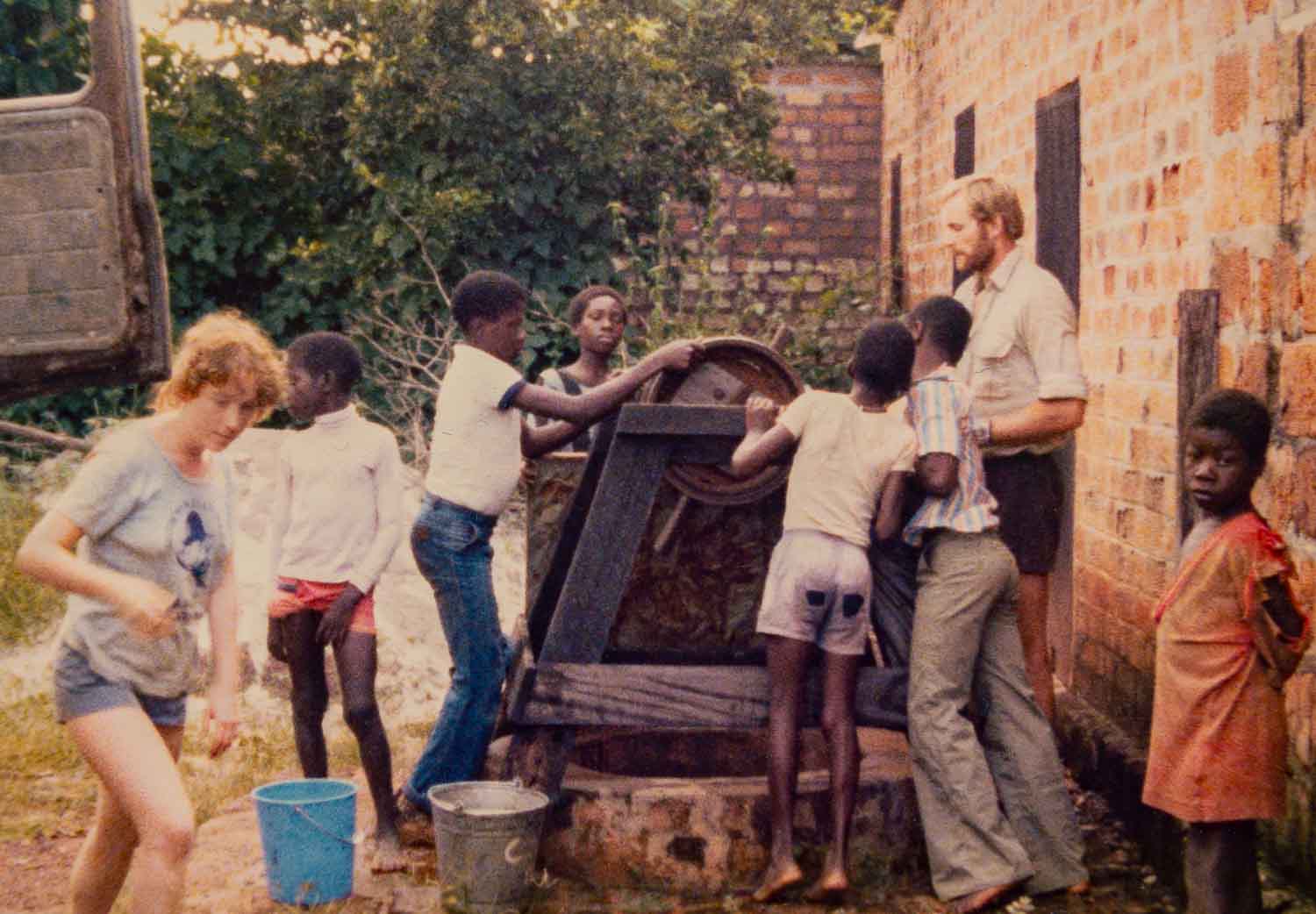
Teamwork is essential. Some people are better team members than others. Some go above and beyond. Some do the minimum they can get away with.
At the pre-departure meeting we’re given a list of chores – necessary activities to make the expedition functional. Cameron, he of the unwashed hands, announces I’m not doing any chores. I’m on holiday! It’s interesting how a person’s personality is heralded by pretty much their first words. One morning we’re all packed up and ready to leave and Cameron is still asleep in his tent. A couple of the guys take the tent down around him. That wakes him up.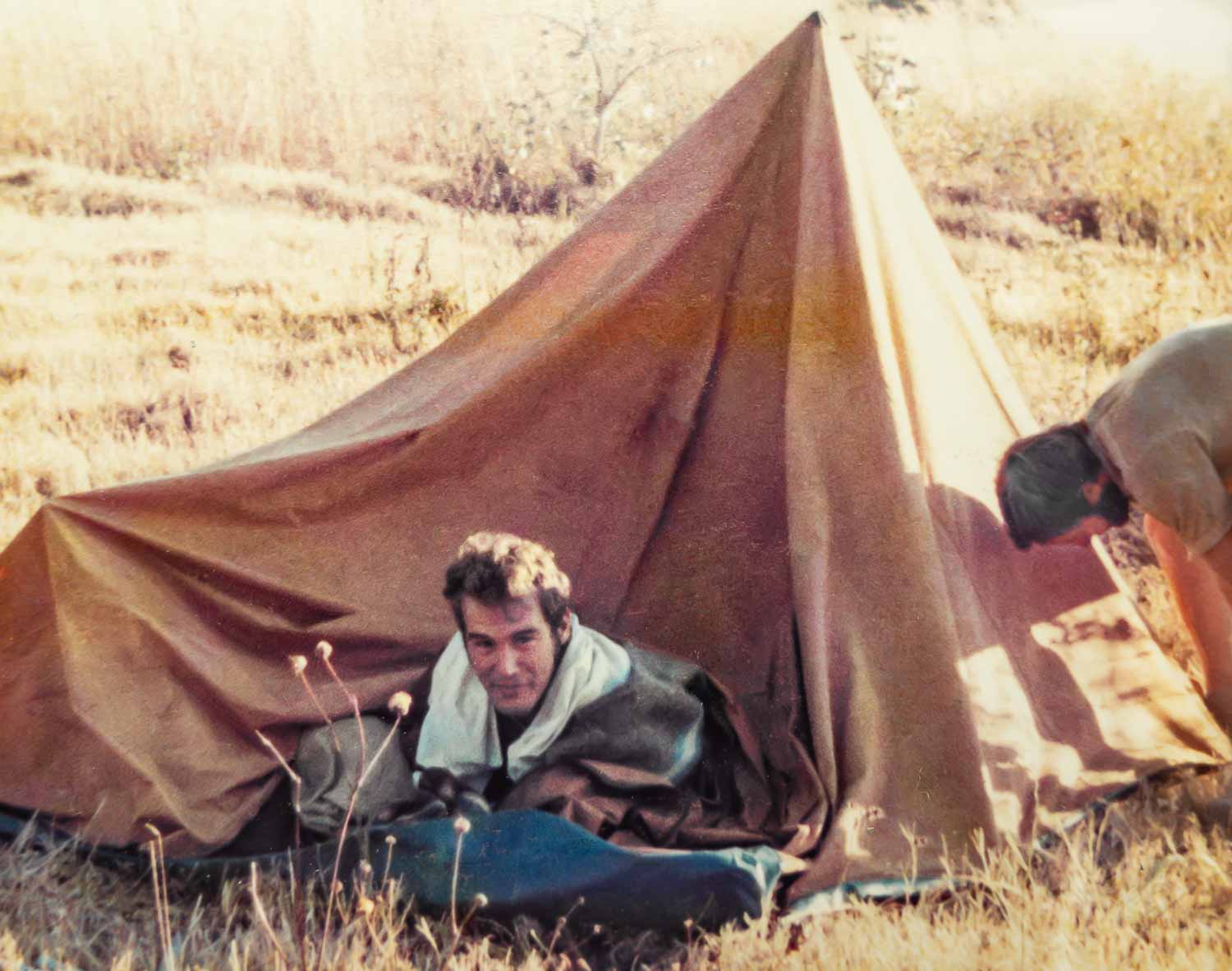
As mentioned in a previous post Helen’s first words are I’d like a non-smoking seat please! As for me, my language is, um, salty, and I think it’s because of this, with nothing being said, that at least one person doesn’t really warm to me. But the journey is so rough even with lazy Cameron and entitled Helen and me swearing a blue streak, we manage to make it work. We have no choice. Most of us most of the time enjoy each other and work well together. There’s a fight one night. More on that in a future post.
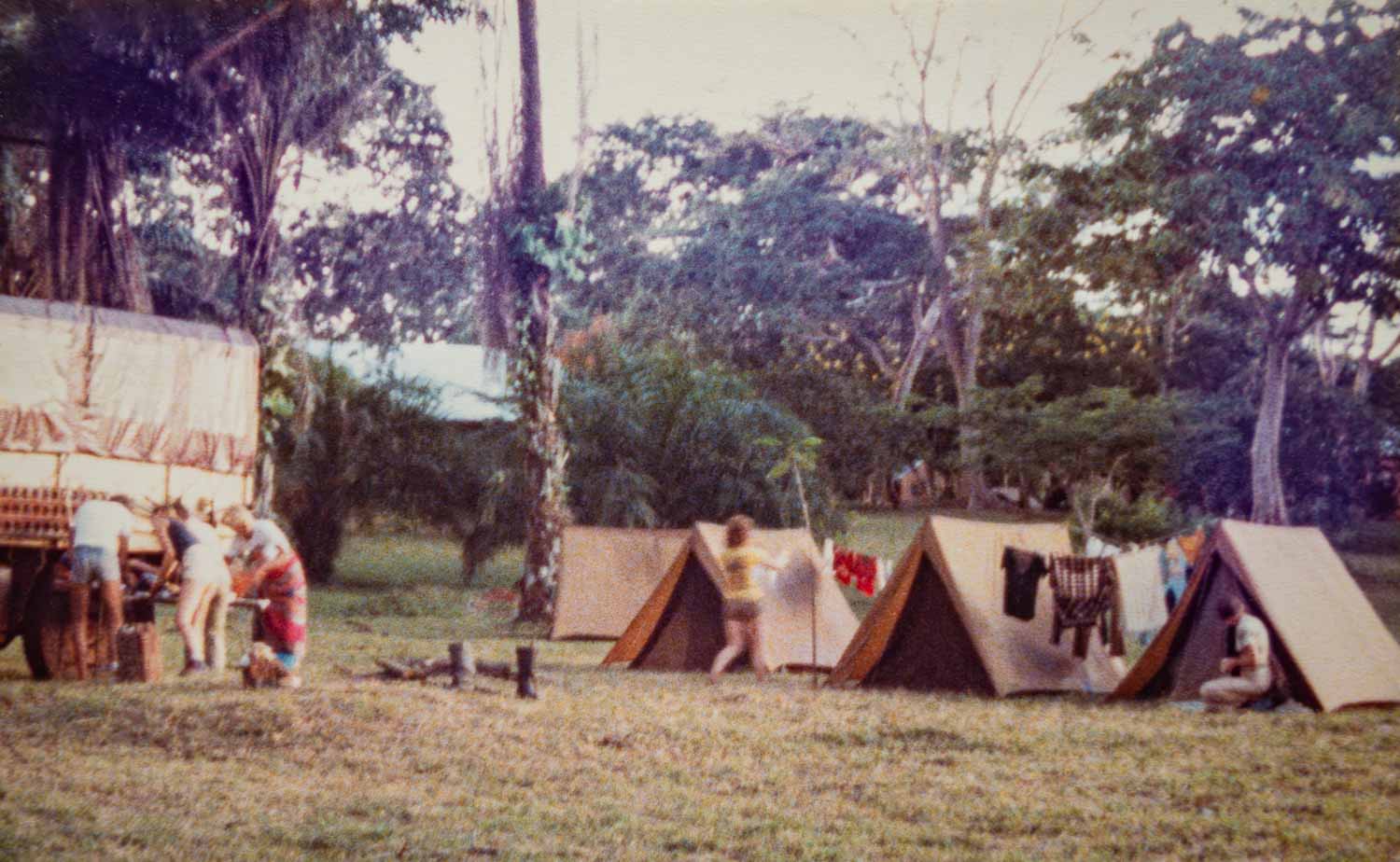
We’re divided into pairs and rostered onto a cooking schedule. In rotation one pair cooks and another cleans up. Post-lunch dish washing at the side of the road can look like this: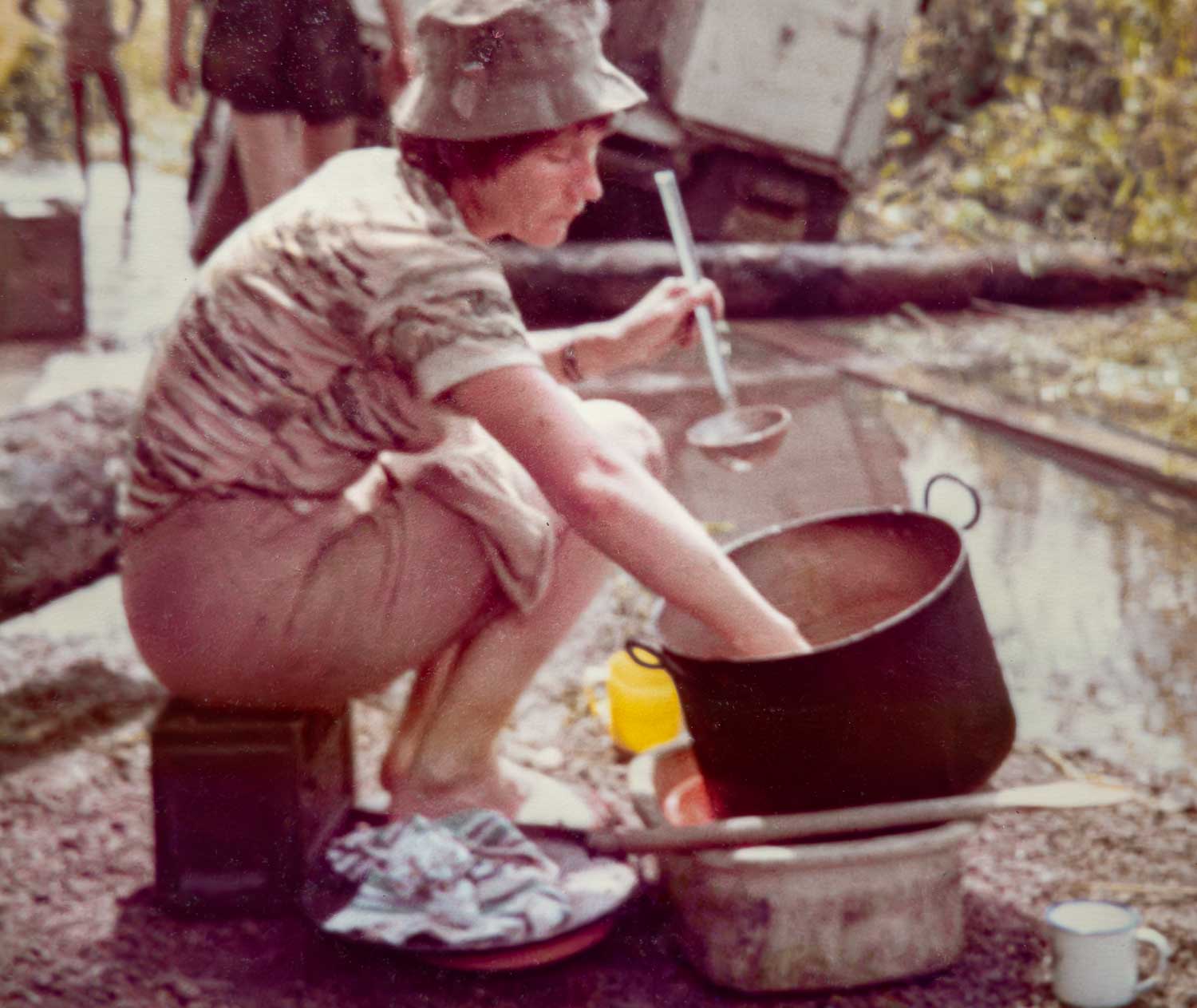
We’re also all given an extra chore. Steve and Eric are responsible for getting the tents down from the roof of the truck’s cab at the end of each day and strapping them back up there in the morning. We erect our own tents and pack them back up. No, I’m not about to clock Helen over the head. I’m about to climb out of the truck with one of the mallets to join Gail to pitch our tent.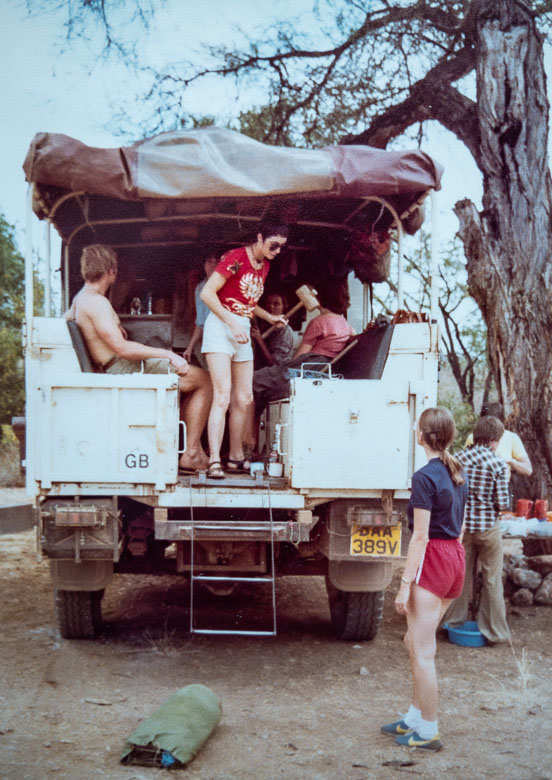
Mary’s responsibility is to monitor and organize the bulk food stocks, moving food from bulk containers to smaller ones for daily use. Here she is digging deep into the storage bins in the truck.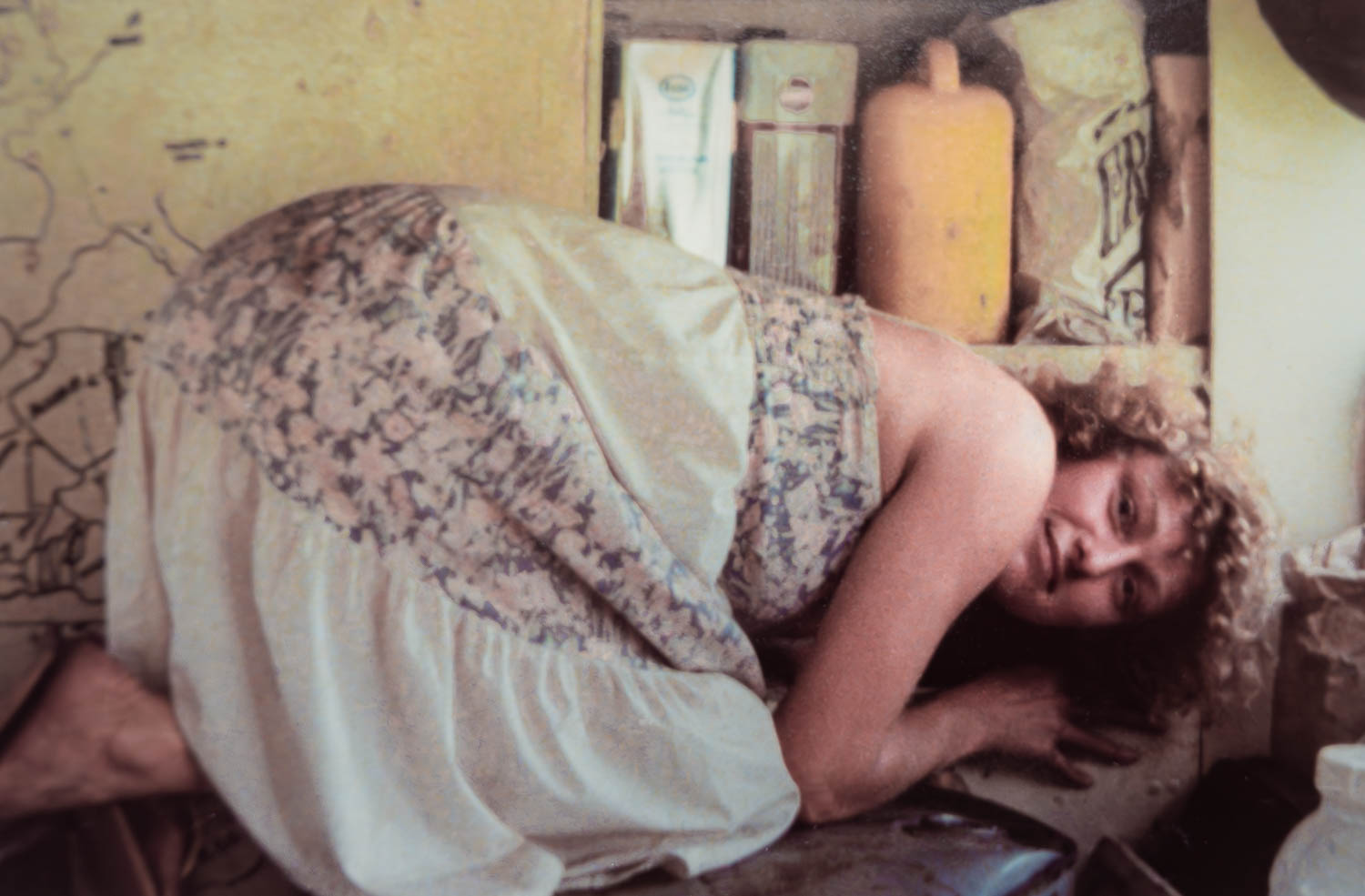
Someone else does the food budgeting, calculating in the local currency how much to spend each day so that the food kitty lasts the whole trip. Butter? You have butter?! This is Craig, the expedition leader, towards the end of the trip. There’s judgement in his outburst, but we’ve budgeted so well that somewhere in Morocco we could afford butter, a true luxury.
There are two large fold-out tables stored behind the water tank. Two people are responsible for getting them out and putting them away at meal times. It’s everyone’s job to collect firewood at each campsite, and to collect as much as we can, especially if there’s an abundance of dry wood lying around. Surplus is strapped on top of the water tank for future use.
I choose to run the bar. I ran a bar on the four-month South America trip I’d taken two years earlier so I know what to do. I’ll just say that it was a whole hell of a lot easier to get liquor in South America than Africa. Usually I can find soft drinks, especially coke and sprite, and most places have local beer. In Tanzania there are vineyards so I buy wine; I manage to find a bottle of scotch in Dar es Salaam; I pick up some liquor in Nairobi; in Juba, southern Sudan, I score a case of Heineken through a couple of westerners who live there; I meet a man from the World Health Organisation in Central African Republic who sells me some of his liquor ration that he gets through diplomatic channels; in Kano, Nigeria, we camp in the grounds of the house of a man who works for another international aid organisation and I’m able to buy some liquor through him. And so it goes – Cinzano, Jim Beam, Dubonnet, brandy, vodka, Drambui, Advocat, whatever I can get – soft drinks and alcohol for four months for twelve people through twelve countries.
I start with a kitty, in US dollars, the same amount from each person. In each country I convert to the local currency, buy what I can, and figure out how much one drink would cost in US dollars. I have an on-going (and constantly changing) list of prices. When we stop to camp I set out what’s available. It’s an honour system. Everyone has a page in the bar book, and writes down each drink they have with the price next to it. This is of one of my pages. The prices just kill me! 40 cents for a shot of scotch! 35 cents for a coke!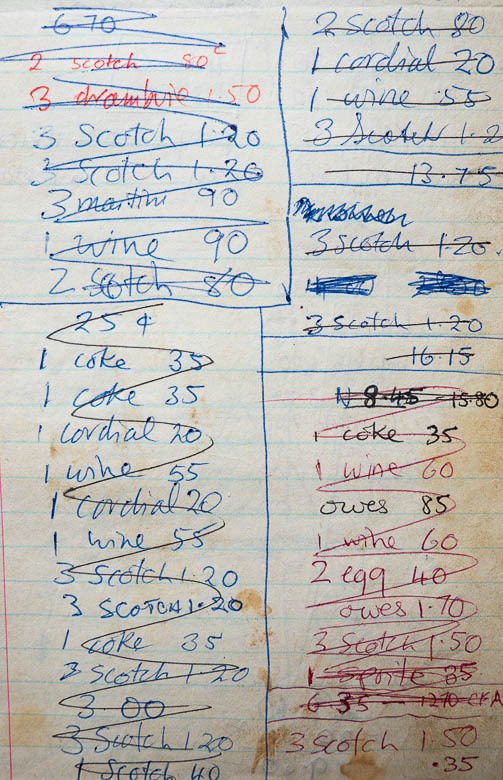
A couple of people don’t drink much, but most of us drink quite a bit. The honour system works well most of the time. After one night of particularly heavy drinking by Cameron and Brett I see the next day there’s not much scotch left, and not much written in the book. Too drunk to remember or care. Grrr. I trust Brett when he’s drinking with Craig. When he’s drinking with Cameron not so much.
After dinner drinks – you can see the bottles clustered at the end of the table.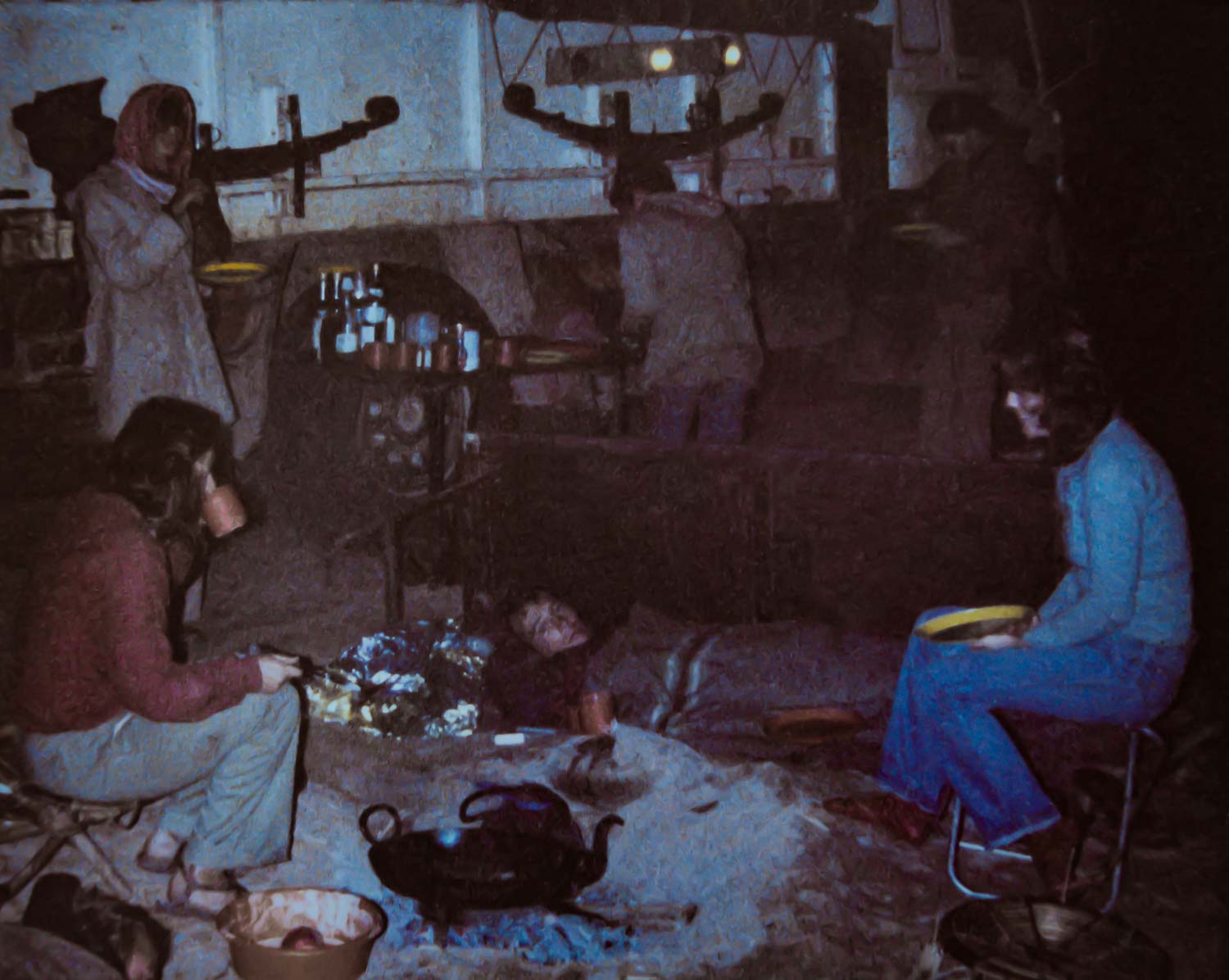
We usually camp in the middle of nowhere, wherever it’s safe to drive a little way off the road, away from villages, away from thieves. We are completely self-sufficient. In the middle of the jungle in central Africa we come across a church – it’s a clearing in the ever-encroaching greenery with a makeshift alter from wood, and logs laid on the ground as pews. There’s no one around. It’s the perfect place to camp.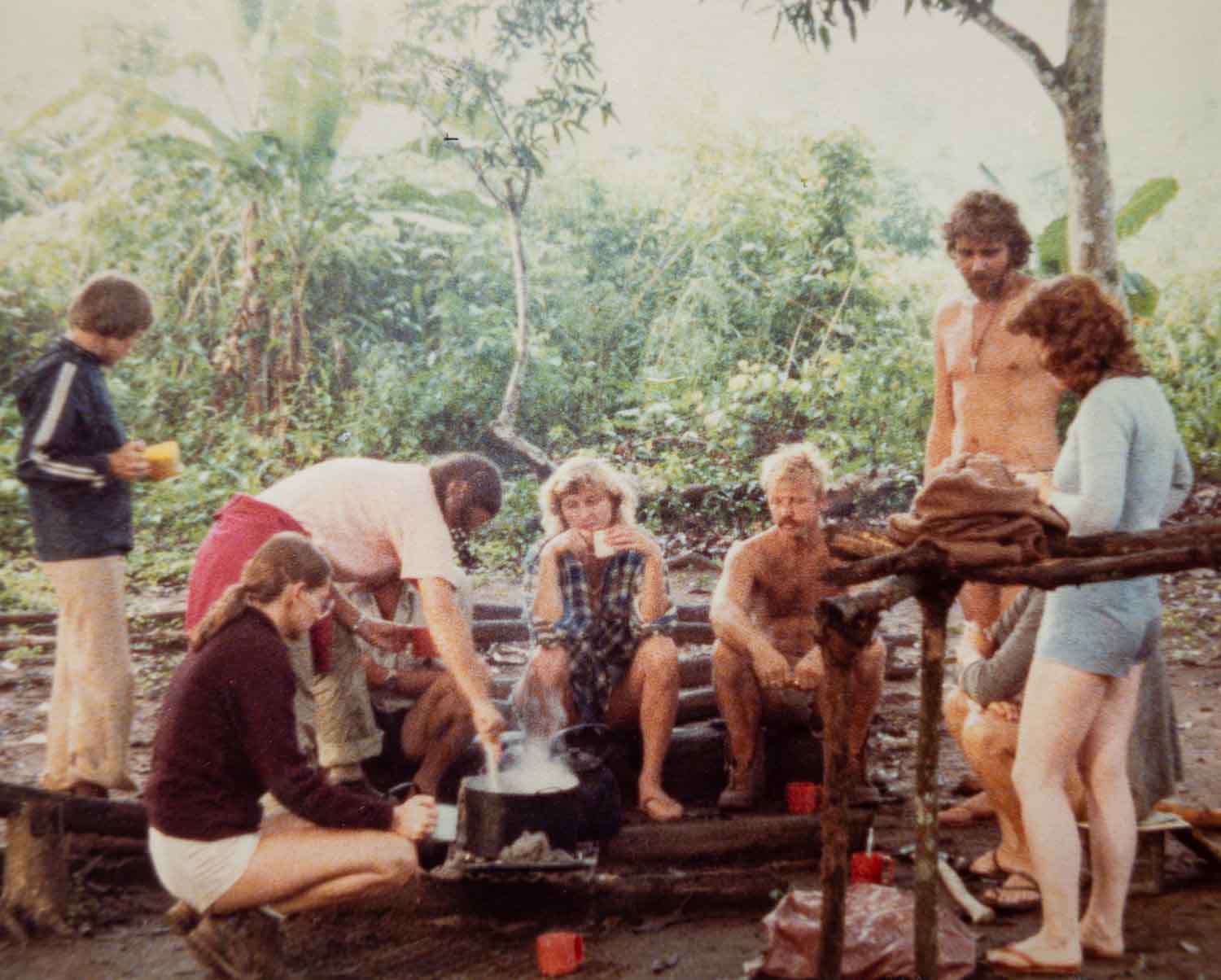
Every travelling day, as we’re trundling along, inevitably the conversation turns to food. For hours. We’re living on an adequate, if not sparse then certainly uninteresting diet. We dream of, and talk about, all the things we can’t have, like bread, like butter, like steak, and ice cream, like treats and desserts. It is here in the middle of Africa that I first learn about Nanaimo Bars, a staple of Canadian bakeries and coffee shops. Along with what’s going in, or we wish was going in our bodies from the top, we also talk a lot about what’s coming out the other end. Speaking of which, the toilet is behind whatever convenient bush you can find a little way from camp. Unless there are no bushes.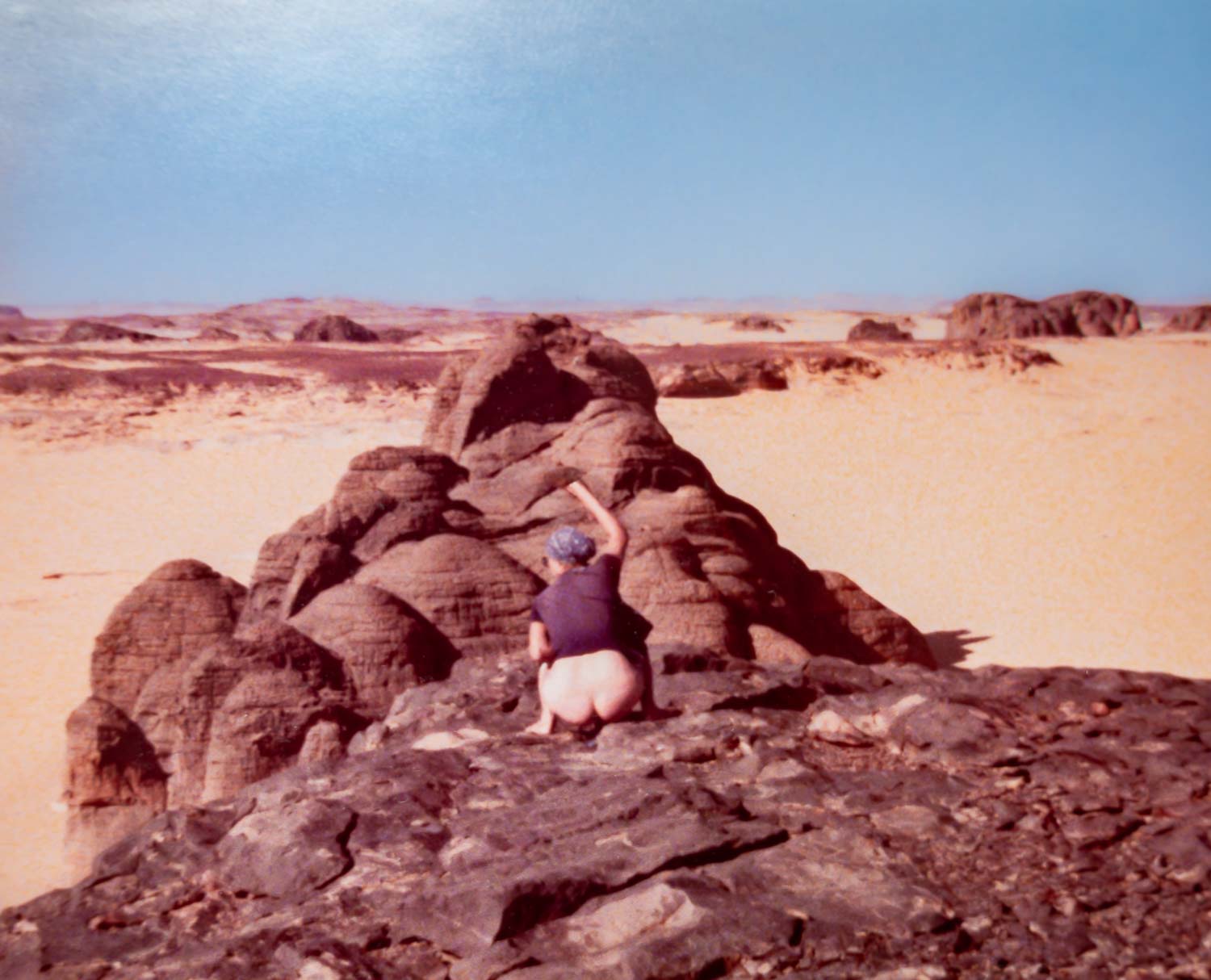
The non-perishable food stocks on the truck include tea bags, instant coffee, milk powder, cocoa, flour, sugar, oats, pasta, rice, some herbs and spices, cooking oil, vinegar, salt and pepper, canned mystery meat, canned tomatoes and other vegetables, and tall cans of things I call frankfurts. Americans would call them hot dogs, perhaps others would call them sausages. Either way they’re dire.
We stop almost every traveling day at a local market to buy whatever fresh food we can find to augment the truck stocks. There’s meat available, often goat, but we never buy it, not trusting the cleanliness of the butchering process. Also the skinned monkeys look far too much like babies to even consider them.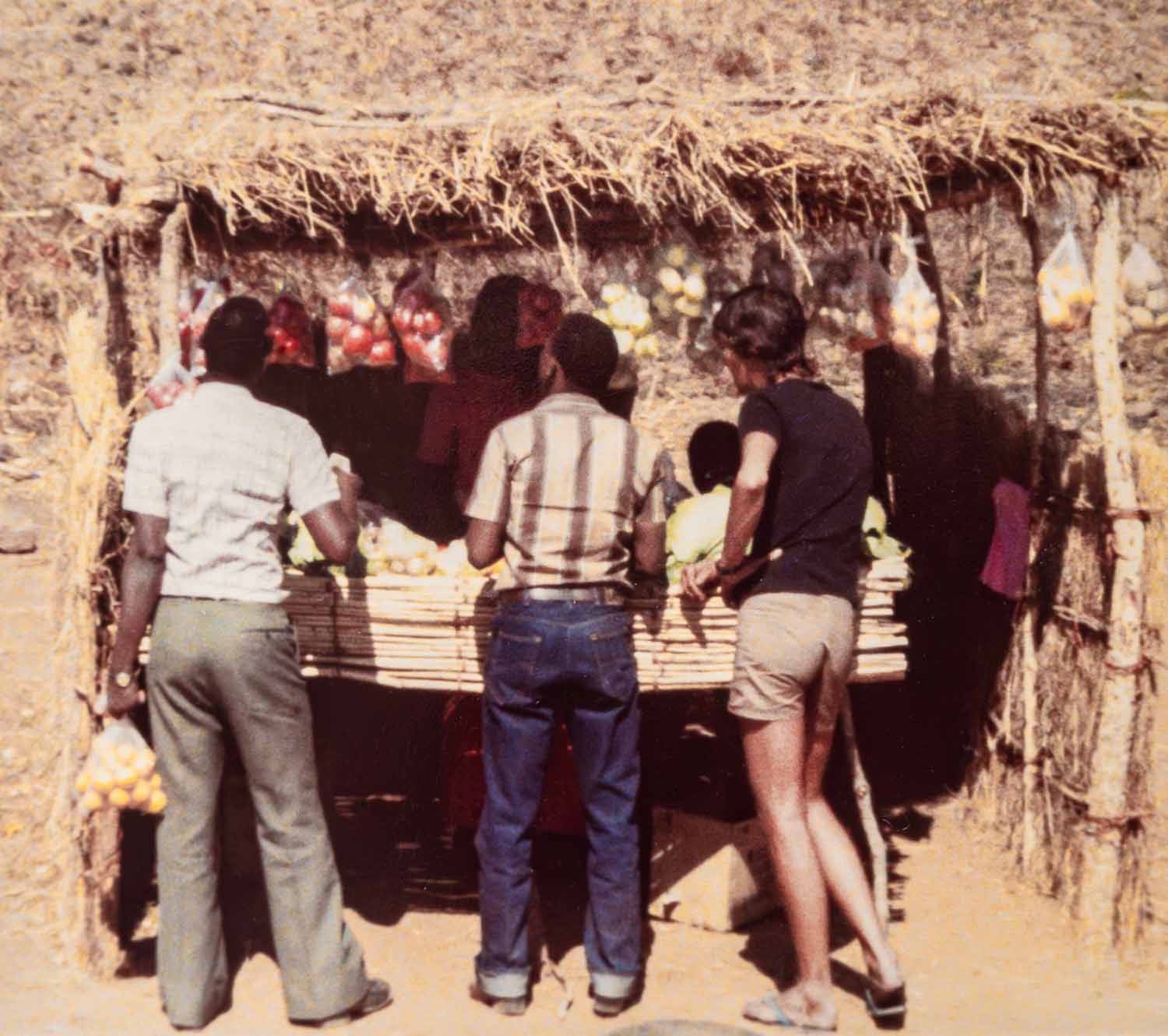
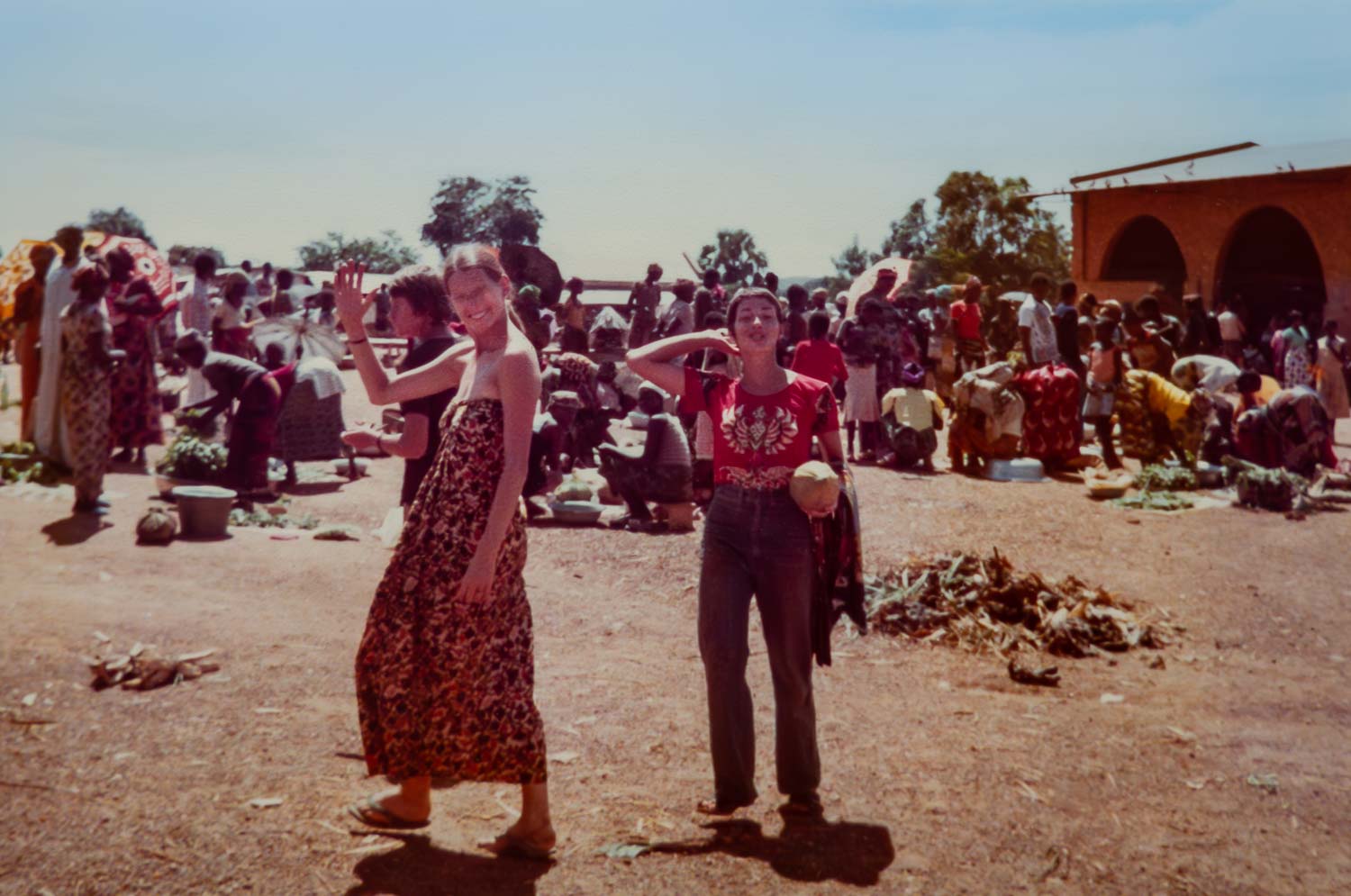
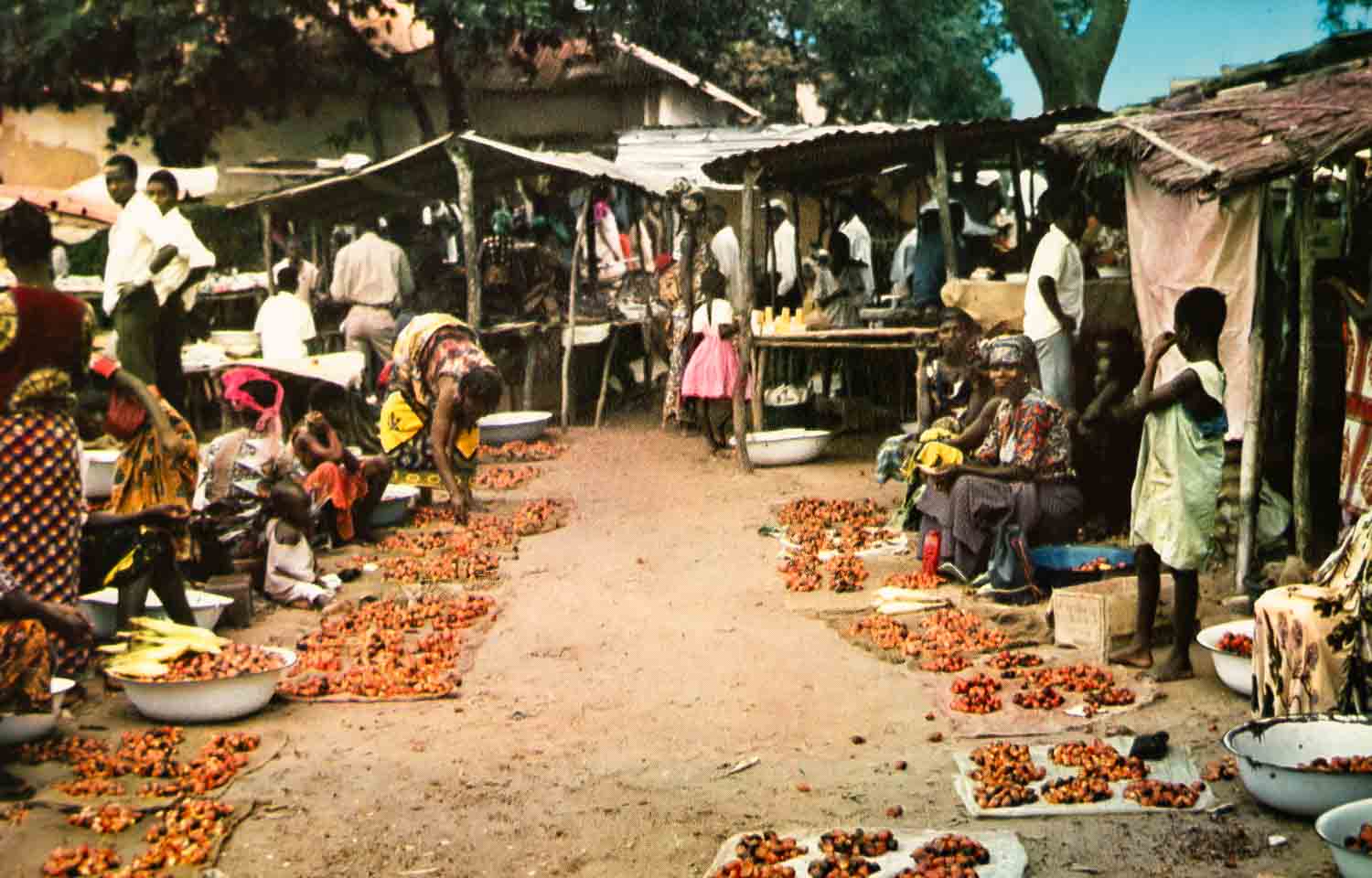
At a small deeply-shaded market in the middle of the jungle women are sitting on the ground, their items for sale displayed on banana leaves. One women has tomatoes, maybe six or seven of them. They are the only tomatoes available. We buy them all.
A man walks down the quiet road carrying an entire stem of bananas. He is happy to trade it for a couple of our large empty cans.
We cook with fire. The sand-mats that hang on the side of the truck for crossing the Sahara are raised each end by metal storage boxes, and the fire built beneath, thus creating a surface for pots and the kettle.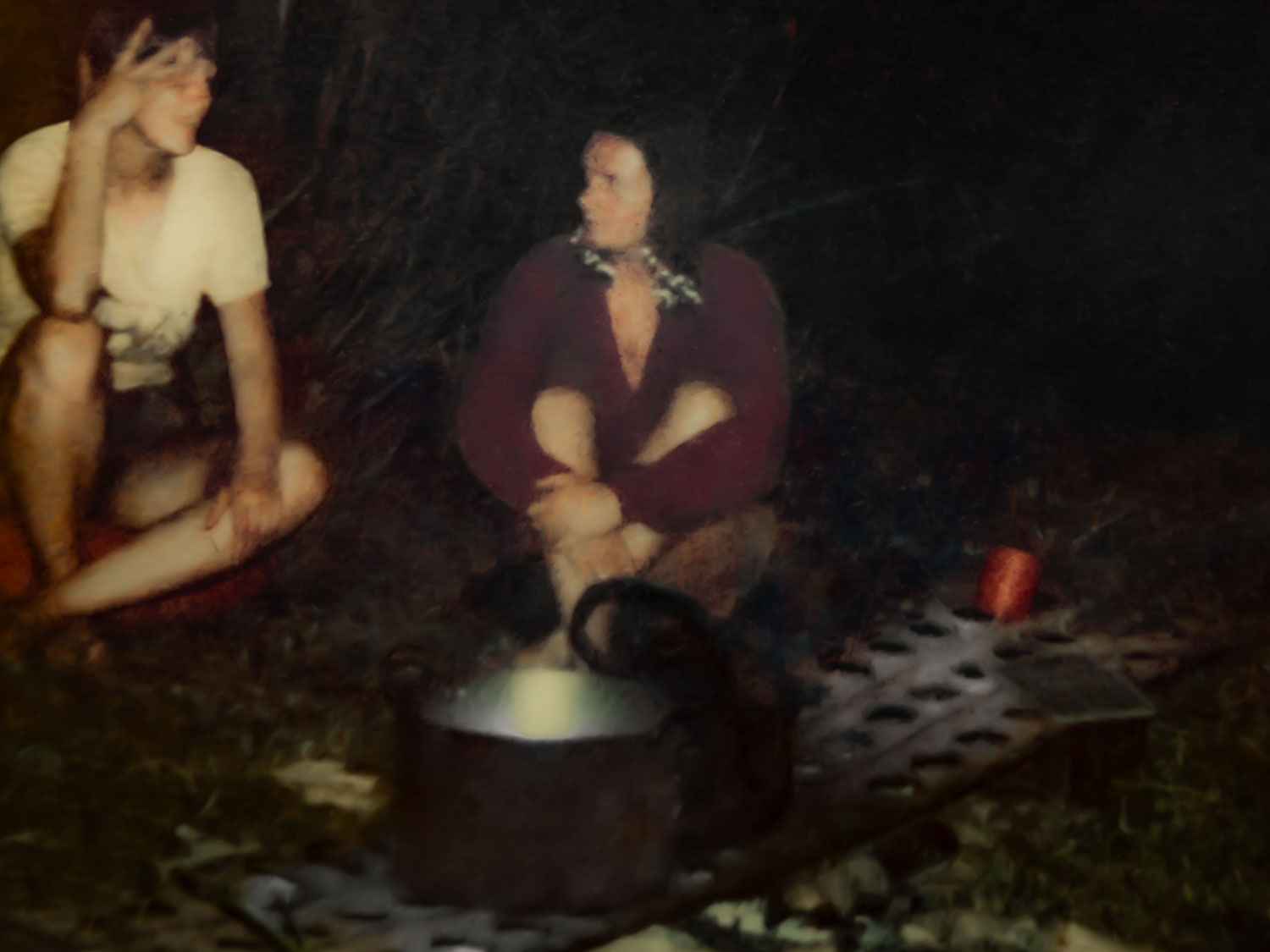
Sometimes we stop just to make a cup of tea: build a little fire at the side of the road and put the kettle on. It doesn’t take long to get the caffeine hit we need.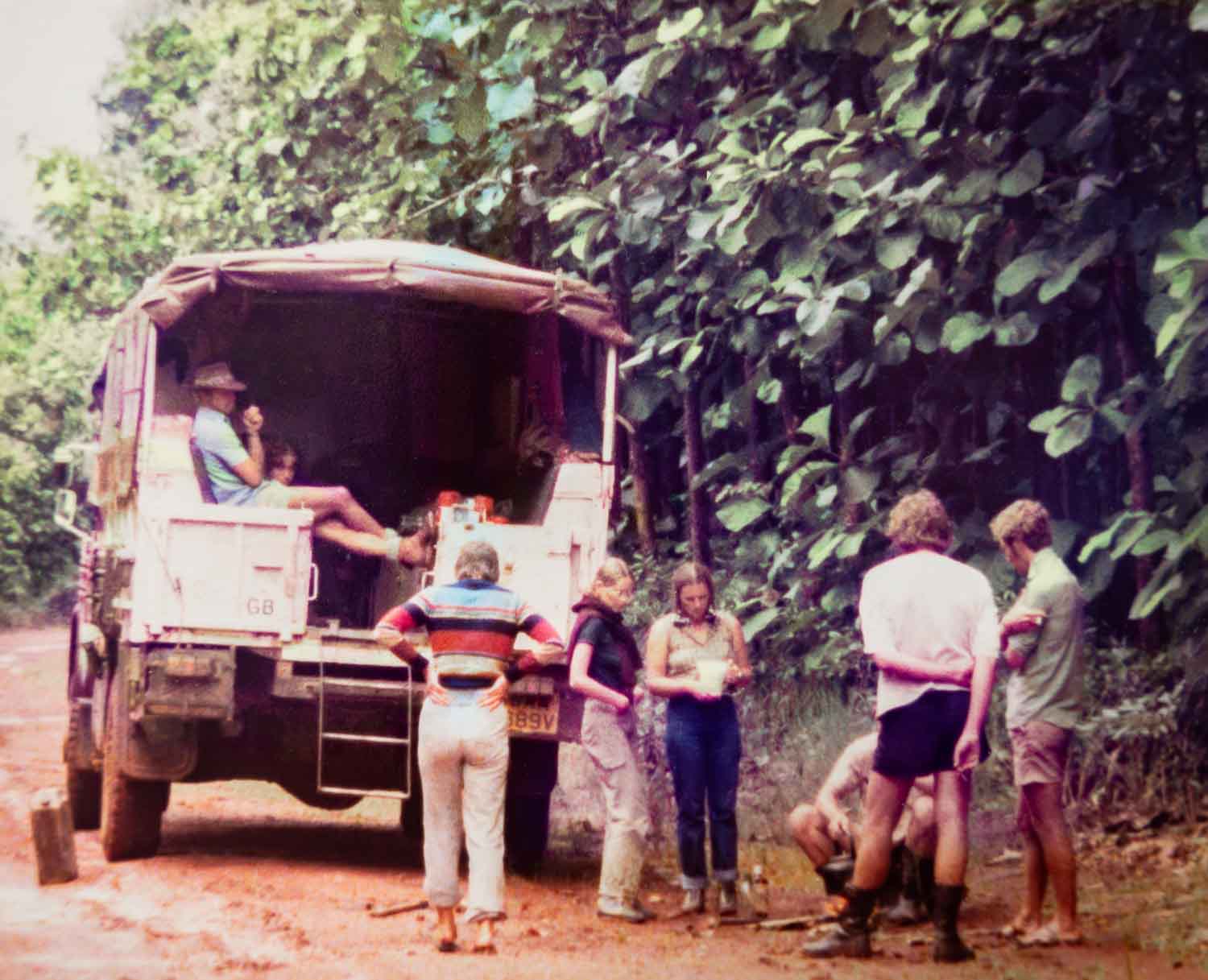
Lunch prep at the side of the road: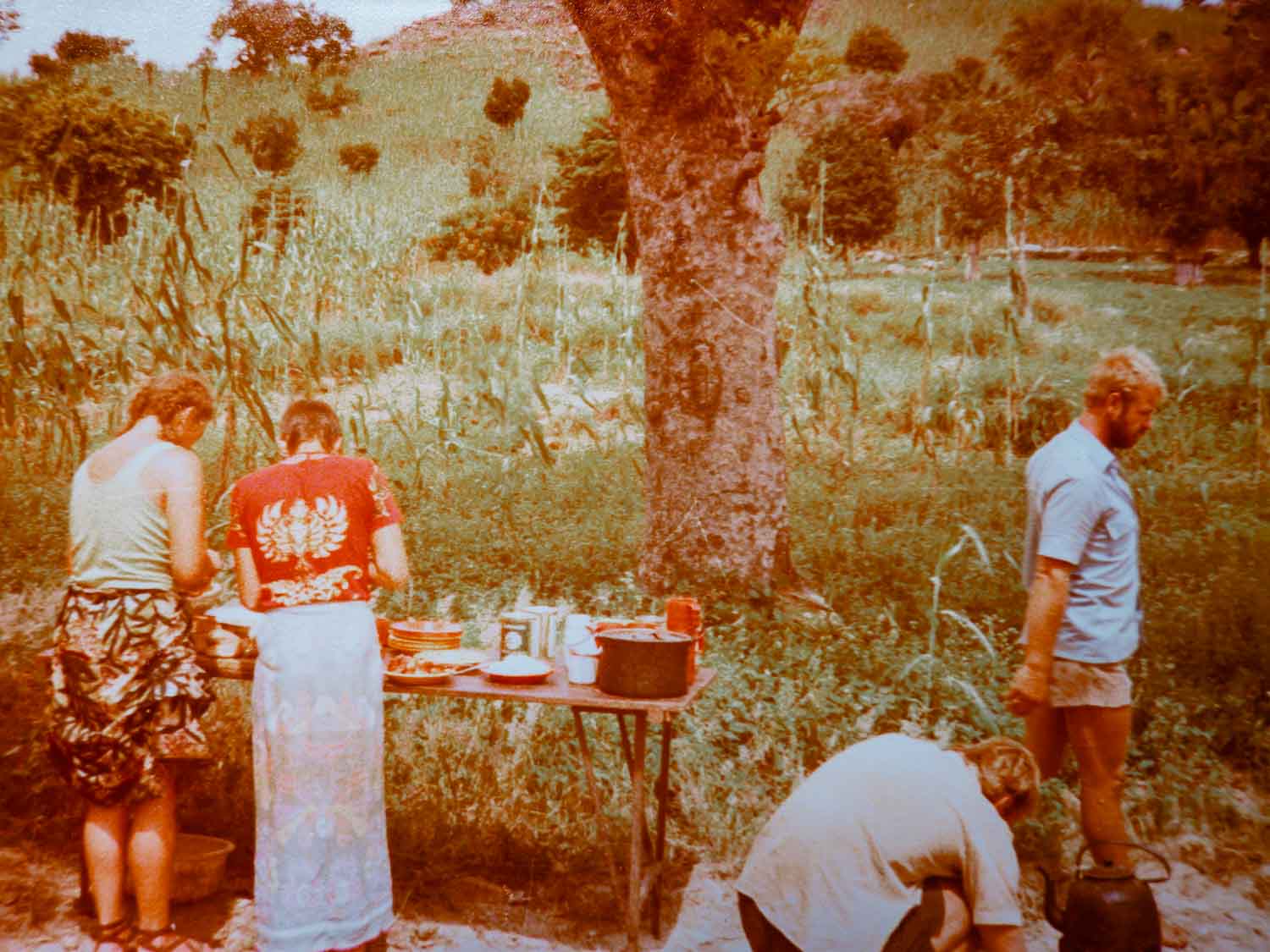
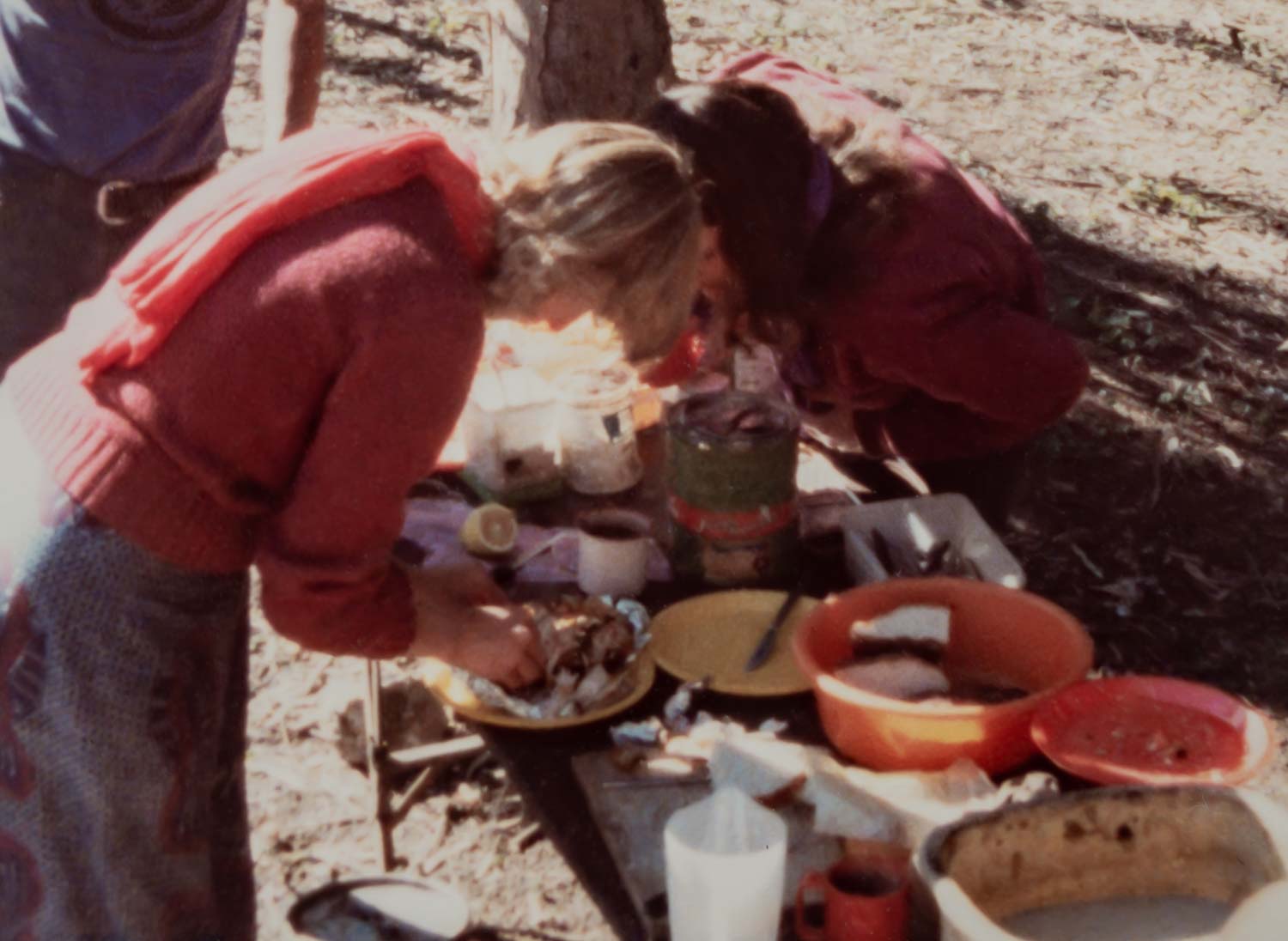
Dinner is served: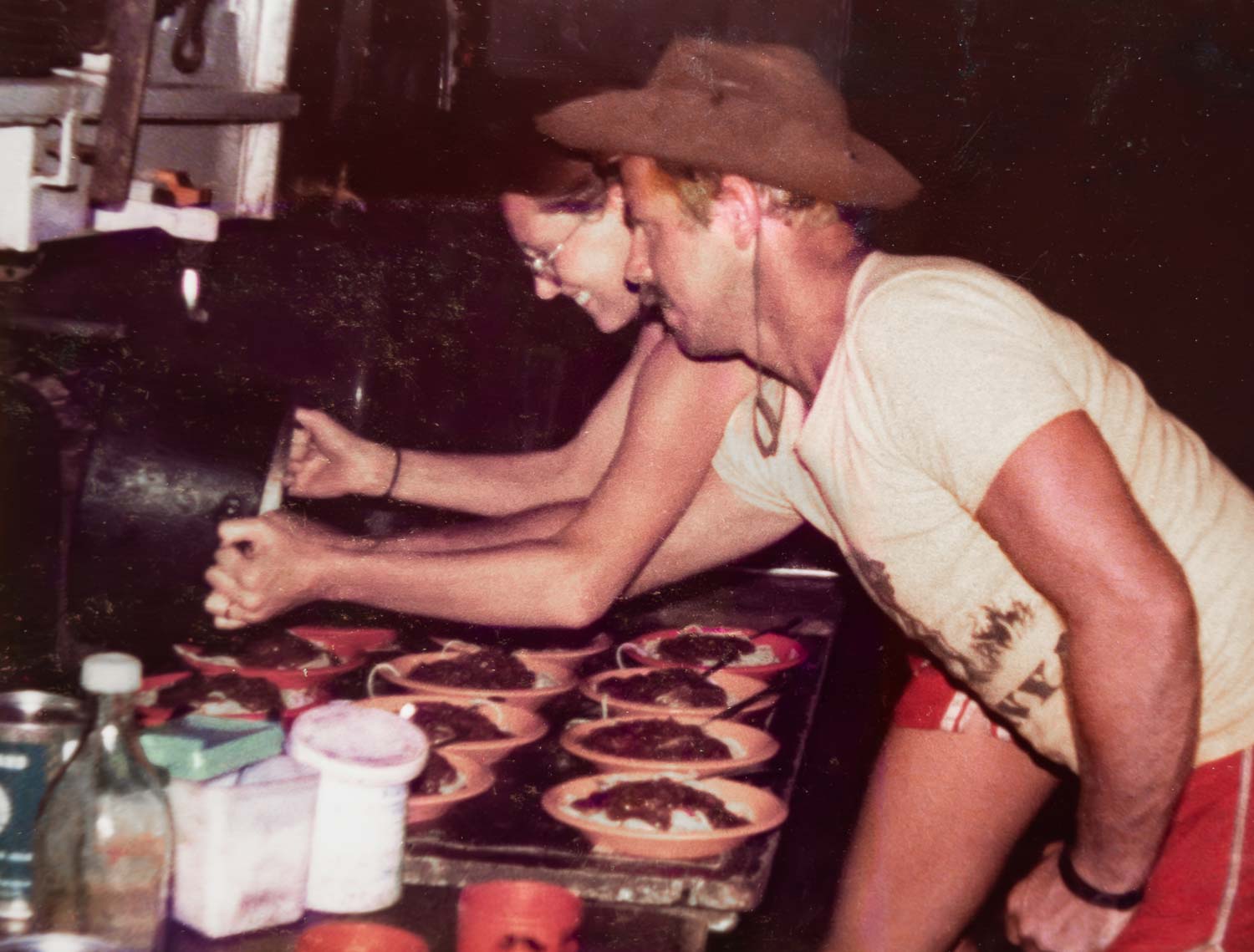
What we eat is not memorable. Breakfast is almost always porridge, with some raisins if we’re lucky. Lunch is frequently some kind of cold rice salad with bits added to it – tomatoes, pineapple, onion, peanuts. Dinner is pasta and something, rice and something, some kind of stew. It’s all very basic but nourishing enough. I figured out the best thing to do with those dire canned sausages was to mash them up and add onions and canned tomatoes and make a kind of spaghetti bolognese.
Apart from my own birthday, there are four more birthdays during the four months we are on the road. I make birthday cakes on the campfire. Like this: beat up a batter of flour sugar baking powder oil cocoa. After dinner get a big pile of red hot coals. Put the biggest pot on the coals. Put the batter in the smallest pot with the lid on and put it inside the biggest pot. Surround the smallest pot with coals and cover its lid with coals, put the lid on the biggest pot and cover it with coals. Bank the coals up around the biggest pot. Wait. When it’s time (intuition) I pull the oven apart there’s the cake. Mary’s birthday: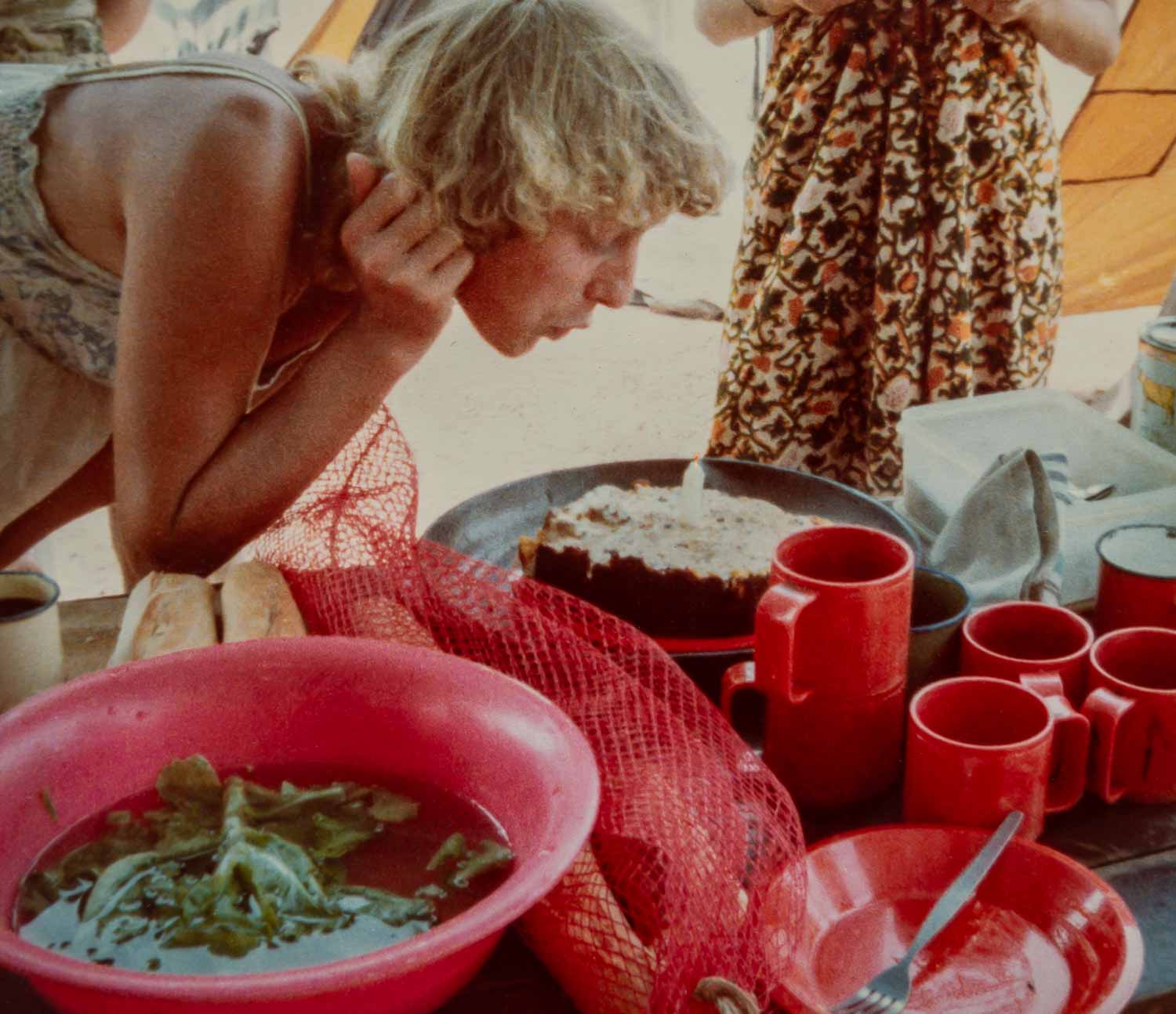
Cameron’s birthday: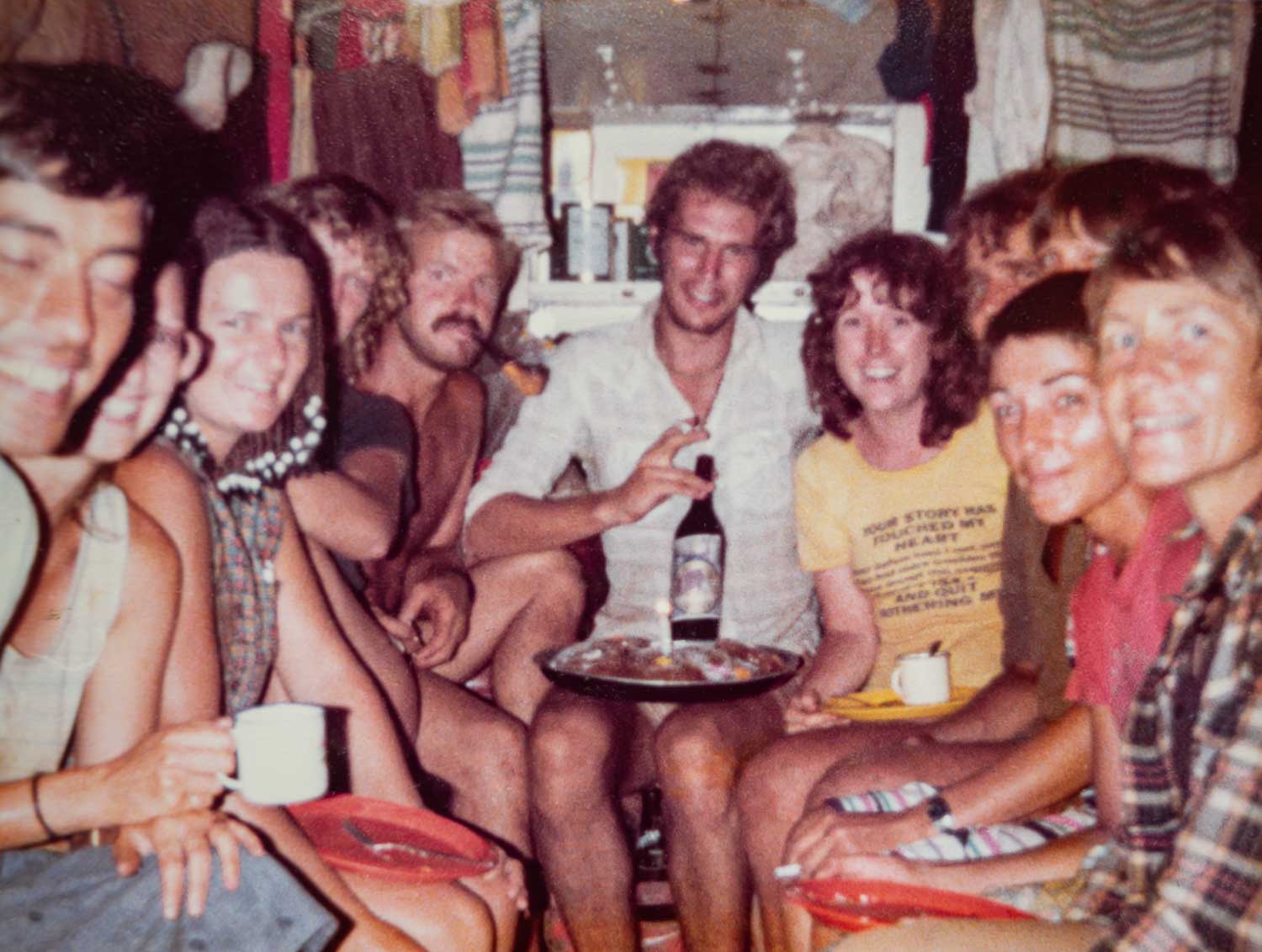
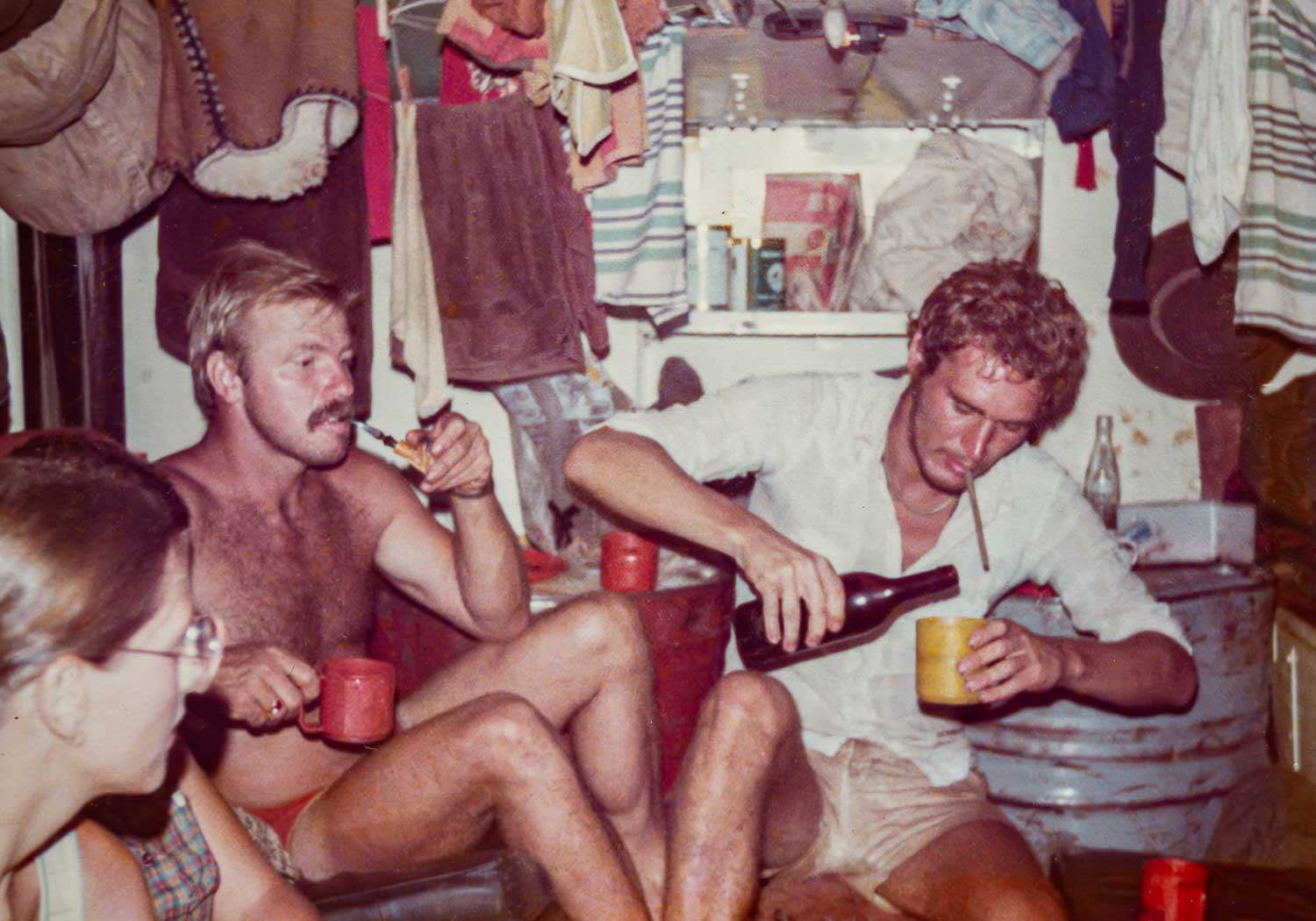
The truck is our home. Our personal gear is stowed under the bench seats. There is always an assortment of laundry and towels hanging from the ceiling. We do laundry wherever/whenever we can. One morning Brett hangs his laundry in the truck. Lynne and I pull it down piece by piece and wring it out. Brett sees us and thanks us. No Brett! We’re not wringing out your laundry for you. We’re doing it so it doesn’t drip all over us. And so it goes. All of us crowded into a truck discovering foreign lands and each other.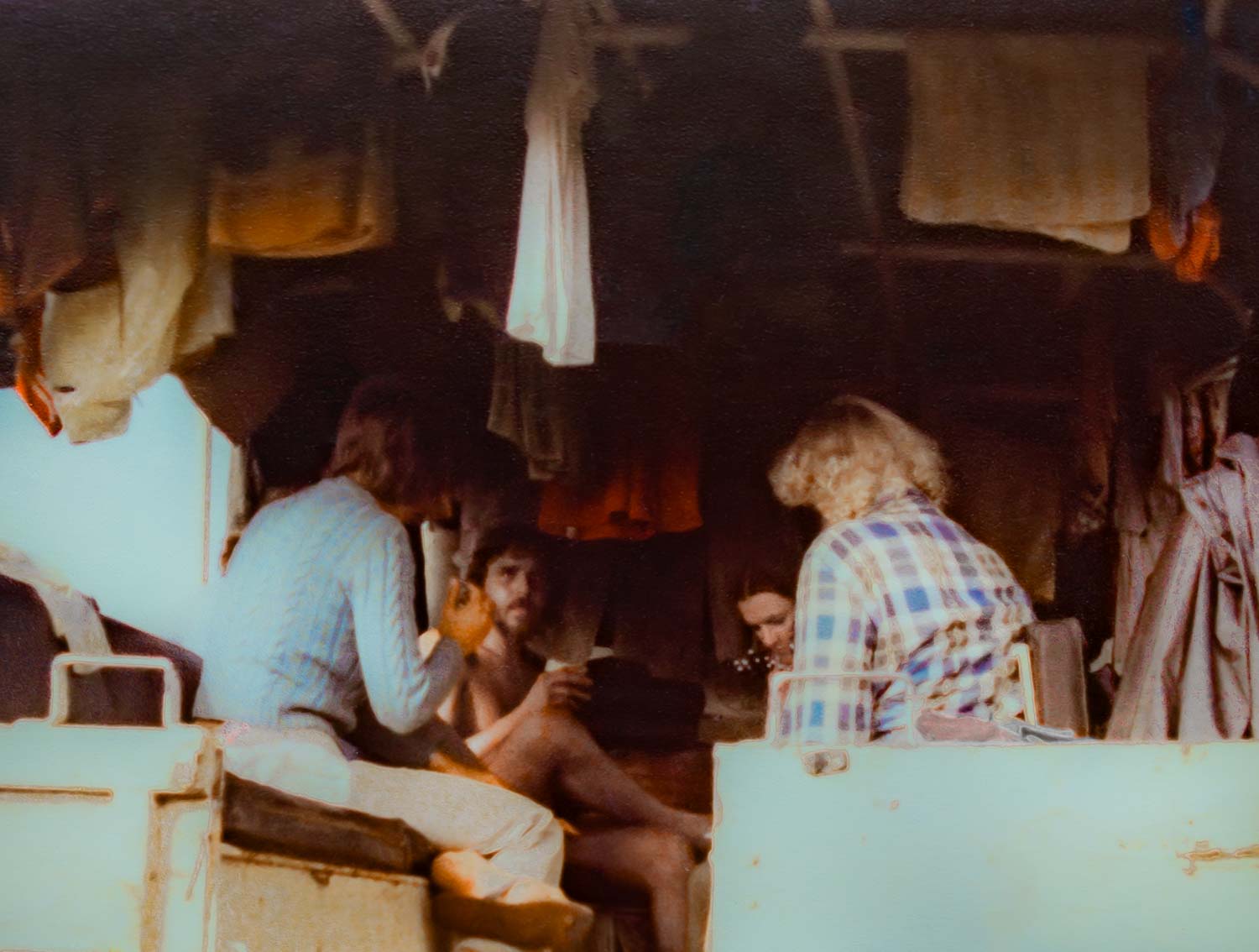
The truck has long-range fuel tanks; extra suspension springs are strapped to the exterior, and other spares including gaskets, filters, oil and grease are stowed away on board.
In various places we find banks to cash travellers’ cheques. In a few places we go to the local post office to mail letters home, ever hopeful they will be delivered, and ever hopeful there will be a letter at poste restante waiting to be collected. There rarely is.
************************************
It all seemed normal to me, this camping, and cooking over fire, washing where we could, peeing in the bush, and living with a bunch of strangers in a truck. I think it did to all of us, if not initially then certainly by the end. We were on this huge amazing adventure, and if it presented us with challenges, well that’s what made it an adventure and we just got on with it. We drove for days through mud. We literally built a bridge, and repaired another. We crossed the Sahara. We encountered interesting and curious and helpful people. And then there were the many conversations around the campfire, sometimes rowdy and hilarious, sometimes quiet and contemplative. We traversed the entire continent being almost completely self-sufficient. It truly was epic. Four months, twelve people, one truck, 18,000 kilometres.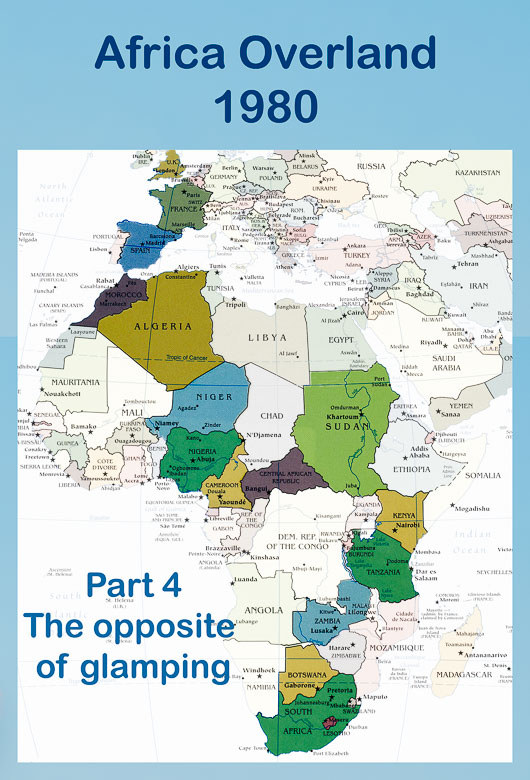
Next post: we go straight west across the south of Sudan – one of the locals gets sick eating our food, most of us get sick eating theirs; a curious local appears in the night, and returns next morning with friends and family.
Disclosure:
1. I’ve changed the names of everyone involved for privacy
2. Obviously any photo with me in it was taken by another member of the group, but I’ve no idea who.
All words and images by Alison Louise Armstrong unless otherwise noted
© Alison Louise Armstrong and Adventures in Wonderland – a pilgrimage of the heart, 2010-2024.

 Adventures in Wonderland
Reminds me of so many treks and adventures I’ve had, Alison. River trips are quite similar in terms of responsibility and cooking. Backpack treks are quite similar in terms of keeping clean and bathroom facilities. Bike treks were like moving an army. The longer events I’ve never done with a group. Those tended to be solo. I’m loving your adventure and photos. This one brought it home for me in so many ways. As for food, I ate just about everything west Africa had to offer. LOL
LikeLiked by 1 person
Thanks so much Curt, I’m glad you’re enjoying this romp through Africa. I’m not at all surprised to hear that you related to much of this; all those years of leading people into the wilderness, and your own solo journeys. All challenging, but so rewarding.
I’m amazed your diet in west Africa didn’t kill you 😂
Alison
LikeLike
Chop was our go-to meal. Some type of meat — sometimes from the market— but, more often, canned corn beef, tomato paste, local greens, palm oil, hot peppers and rice. Once a week we would eat European/American food. We were careful with out food. Never got sick from it.
Laughing, yes, lots of similarity with your experience…
LikeLiked by 1 person
We wouldn’t go near meat from the markets. We didn’t trust the hygiene of the butchering. More than once it was monkeys, and that seemed a bridge too far.
LikeLike
One trip to the butchers and I started sending Sam, the young man who worked for us. The meat was then cooked to beyond well-done! Eventually, we decided that canned beef from Argentina really tasted good. That’s when we should have started worrying. Grin. I passed on the monkey meat…
LikeLiked by 1 person
Well. There you are Alison. Different and amazing always.
LikeLiked by 1 person
Aww thanks Cindy. I started travelling when I was 23, and it led me to stop being who I thought my parents wanted me to be. Since then I’ve never been able to live a conventional life. Challenging at times, but I couldn’t have done it any other way.
Alison
LikeLike
Oh wow, Alison, this brings back so many memories. Every overland has a Cameron and a Helen. We had the same handwashing rules.
LikeLiked by 2 people
I’m not surprised to hear it brought back memories for you. Life on the road eh!
Your comment about Cameron and Helen made me chuckle. I want to do another overland trip to test your theory!
Alison
LikeLiked by 1 person
Never did an overland trip, but most of my group hiking treks have also had a Cameron and a Helen!
LikeLiked by 2 people
There’s one in every group I guess, though the 4-month trip I did in Sth America must be the exception that proves the rule – 24 of us and not a Cameron or a Helen in sight. Thank goodness!
LikeLiked by 2 people
What a fantastic way to experience Africa’s nature while camping out at night and sitting around the campfire. I loved your photos from a visit to the local market as it would offer an incredible opportunity to learn even more about the cultures and traditions of Africa. Thanks for sharing, and have a good day 🙂 Aiva xx
LikeLiked by 1 person
Thanks so much Aiva; I’m really enjoying sharing this adventure. Experiencing Africa this way showed us the reality of life there, and I feel so lucky to have been able to do it. The markets, and the people, were so authentic.
Alison 🤗
LikeLiked by 1 person
🥰🥰🥰
LikeLiked by 1 person
Having never been on a bike trip, hiking trip, etc., I found this post fascinating. It makes sense that everyone have their own thing to be responsible for. It’s like living in a mobile tiny house before tiny houses were a thing!
LikeLiked by 1 person
Thanks Felicity, I’m glad you enjoyed it. I get what you mean about a tiny house – it won’t function well if it’s not organized, and that’s how it was for us – a lot grubbier, but organized.
Alison
LikeLike
Brings back so many memories of our Trans Africa Encounter Overland trip, also in 1980. I don’t recall the canned franks but sure remember the canned pilcards in tomato sauce. And after handwashing a rinse in dettol water. I will never forget the smell of the dettol.
LikeLiked by 1 person
Oh the pilchards! We didn’t have them, that I remember, but we must have had some kind of canned fish. I went with Encounter in South America in ’78. I would have gone with them Africa, but the travel agent I went into only had the Exodus brochure, and it was the right dates for me so I booked it. We didn’t have the dettol – must have been awful!
Alison
LikeLike
Absolutely hilarious. (and I thought my own 3 months camping in Europe had its rough moments).
It’s funny the things you do when you’re roughing it with complete strangers, that you might never do at home.
At least our dedicated cook (occasionally with the aid of another) managed to buy good raw materials in the markets of the towns and cities we visited.
Not sure I could cope with being so dirty for days on end.
LikeLiked by 1 person
Thanks Vicki. Things we do with strangers camping that we’d never do at home – so true!
Oh, you had a cook – luxury! 😂
I don’t know how I’d go being so dirty now. Back then I just took it in stride – it’s not that I didn’t moan about it now and then, but then we’d have a chance to get clean and it felt like such a joyous luxury.
Alison
LikeLike
Thanks for this Alison. It prompts so many memories of my Exodus Kathmandu to London trip in ’85. Africa was going to be the next journey, but life happened and that trip didn’t unfortunately. I think we were so lucky to have those adventures back then, the simplicity of it all, living in the moment. My how the world is such a different place now. Enjoy your travels.
Dave.
LikeLiked by 1 person
My pleasure. It’s a really enjoyable and rewarding project for me to be finally documenting this journey.
I wanted to do London-Kathmandu! Like you life happened and I never got to do it. I did do Sth America with Encounter.
I agree we were really lucky to have travelled back then. It really was a different time, though there are a couple of companies still doing Africa overland trips – a little more luxurious, but the same idea.
Alison
LikeLiked by 1 person
Wow, what an intense read, Alison. I felt like I gained a much larger scope view of your life journey and tendencies in this form of Alison. I also felt some gained insight into my youngest daughter’s lifestyle as she journeys throughout central and south america on her own. Not passages for the picky or overly delicate ones among us, and worth the effort and discomfort, it seems. Precious peek! x Marga
LikeLiked by 1 person
Thanks so much Marga. How lovely to hear from you! Ever since my early twenties when I sloughed off being who I thought my parents wanted me to be, my life has been about change and adventure. I never could succumb to a conventional life, though I tried at times. It didn’t stick. Adventure always called. For nearly a decade from early 20s to early 30s I devoted my life to travel, and at this time also began the inner journey that led me to live my life more and more from the inner truth no matter how challenging it got. This journey through Africa was for sure the roughest travel I did, but there were other journeys that were similar. And every time it was definitely worth the effort and discomfort.
I wish your daughter well on her travels!
And you too. xo
Alison
LikeLike
I have experienced things like you mentioned before — camping, cooking over fire, peeing and pooing in the bush — but only for a few days. It’s incredible you did all these and a lot more for months! I wonder if people still do such adventures these days. Although I can’t see myself taking part in it, I have a great respect for those who are brave enough to do it.
LikeLiked by 1 person
I’d previously done the same thing in South America – 4 months overlanding and camping with a bunch of people, so I kind of knew what to expect though it was much much tougher travel in Africa, and the roads much worse, so although I didn’t know that part, I did kinda know what I was getting into. There are companies that do these kind of long overland trips, though they’re a bit more comfortable these days – like camping in campgrounds that have facilities. But they’re much the same as what I did. And of course they avoid the trouble spots in Africa, as did we.
Alison
LikeLiked by 1 person
Despite the personality quirks, you seemed to all get along pretty well, especially when it came to chores. Reminds me a bit of my days camping around the U.S., but your story is, of course, much more rugged. Clever cake!
LikeLiked by 1 person
Thanks Ruth. We actually did all get along. Some people did more than others, but it was never too out of balance. And there were times the travelling was so rough, so challenging, that we had no choice but to pull together.
I was pretty darn proud of the “oven” I invented for the cake. And I enjoyed doing it for sure.
Alison
LikeLiked by 1 person
Still loving this series, Alison. I am seeing more and more overlaps with some of my longer hiking treks with strangers, as well as several work trips to various countries with people I’d never met but had to find a way to work with. Nevertheless, nothing can compare to the length and depth of your overland trips, and I continue to suck up every word with great envy and amazement!
LikeLiked by 1 person
Awww thanks Lexie. Looking back I’m amazed at what I did, though at the time it just seemed normal. I come from a travelling family, so no one was making noises about how I shouldn’t do that.
I have no trouble imagining the parallels with long treks with a group of strangers. You just have to find a way to make it work no matter how aggravating people are.
I’m glad you’re still loving the series. It feels like a huge rich creative project for me.
Alison
LikeLike
I had to wait until I had enough time to sit down and read these latest two editions. As others have said, why are there always Camerons and Helens. And why do they go on these adventures that seem oppposite to their personalities?! Did you keep in contact with anyone from the trip? Maggie
LikeLiked by 1 person
Helen was a bit entitled for sure, and could be a bit of a bitch, but at least she pulled her weight. Cameron was just a lazy ass and I’ve got no idea why he thought this kind of travel would suit him. Weird.
I’ve not kept in touch with any of them. I was closest to Lynne and we became good friends, but I lost contact with her. She lived in Melbourne, but it was another year after this trip before I returned to Australia and by then I guess she’d moved. No email or internet or facebook in those days, and I can’t remember anyone’s last name. I am thinking one day I’ll contact Exodus and see if I can reconnect with any of them
Alison
LikeLiked by 1 person
ow you guys sure did it rough. Enjoyed your photos. No privacy in those circumstances.
I can associate with the dust. in 1966 we crossed nullabour before the road was sealed and you had to open gates between stations. My husband sealed up the vents and instead of keeping dust out it worked in reverse we looked like little picaninnies. We could not even read maps as all brown.
LikeLiked by 1 person
Thanks so much. We definitely had it rough, but also pretty exciting. Your Nullabor crossing sounds challenging.
I wonder if you realize picaninny is a racial slur.
Alison
LikeLiked by 1 person
I am in my 80’s and grew up and went to school with aboriginals some were really nice and some not like any human being. I still love black boys (now grass trees) you cant change anything just by changing the name so too old to change the way I learned things at school now.
LikeLiked by 1 person
I had guessed that you were older. Things have changed a lot in your lifetime, and I understand it must be hard to keep up.
Alison
LikeLiked by 1 person
Yes too old to change our ways now that is for sure. And as I said there are good and bad in everyone no matter where you come from. So just enjoy life and be happy thats all you can do.
LikeLiked by 1 person
Here I am with my questions again! 🤣 I was just wondering if you did similar posts about your South America tour? And also, ever wonder that those water purifying tablets had in them? 🧐
LikeLiked by 2 people
I have no idea about the purifying tablets though would guess they at least contained chlorine.
I’ve not written about the Sth America trip though I’ve included parts of it in the posts I wrote about Don’s and my 6 months in South America in 2013. Eventually I’ll post about the whole journey.
You can ask as many questions as you like!
Alison
LikeLiked by 1 person
I also wondered what was in the purifying tablets that can cleanse all those bacteria, without harming our body. And how does it taste? By the way, your photo with the mallet is awesome 🙂
LikeLiked by 2 people
These days you can get purification tabs effective against ghardaia, bacteria and viruses. I didn’t notice any difference in the taste. Thanks re the mallet photo. One of the others captured us at exactly the right moment.
Alison
LikeLike
Ah Alison, I was completely drawn in by your account of cooking and washing and staying self-sufficient while on the road. I was amazed at how you all managed to keep things together (even though people like Cameron didn’t pull their weight) and just how many details you could recall from that overland odyssey. I can be pretty forgetful and have trouble remembering things from much shorter trips just a few years ago! The oven you improvised for making birthday cakes sounds like an ingenious solution.
The longest I’ve gone without washing is three days when I did a volcano trek with Bama, and we were quite a sight (caked in soot/volcanic ash/dust) when we checked in at a small hotel after coming down the mountain. I’ll always remember the shower water turning greyish-black and the joy of being clean again!!
Your story about running the bar reminded me of a fun little anecdote I heard just last year. A friend of mine does the marketing for a restaurant here in Jakarta and he told me the South American chef uses diplomatic channels to get wines and other booze to circumvent Indonesia’s (very high) taxes on alcohol. It sure pays to be friends with the ambassador…
LikeLiked by 1 person
Thank you so much James, I always like to hear readers are drawn in.
Looking back I’m also a bit amazed how well we kept it together, but we were all adventurers and at least had some understanding from the start what kind of trip it was.
As for the details – I so very much wish I’d written more at the time. Peering at the photos for any details I can glean has been helpful. Also when I was a child my dad would tease me saying I had a memory like an elephant. Lucky that way I guess. Also I’ve been researching other Africa overland accounts of that era – they are few and far between, but have jogged my memory a bit.
I remember your volcano treck with Bama! What a journey that was. So you have some idea of how we felt when we were able to get clean. Apart from waterfalls, and swift-flowing creeks, we were allowed one litre of water a day for washing. You’d be amazed how clean you can get with that.
Alison
LikeLiked by 1 person