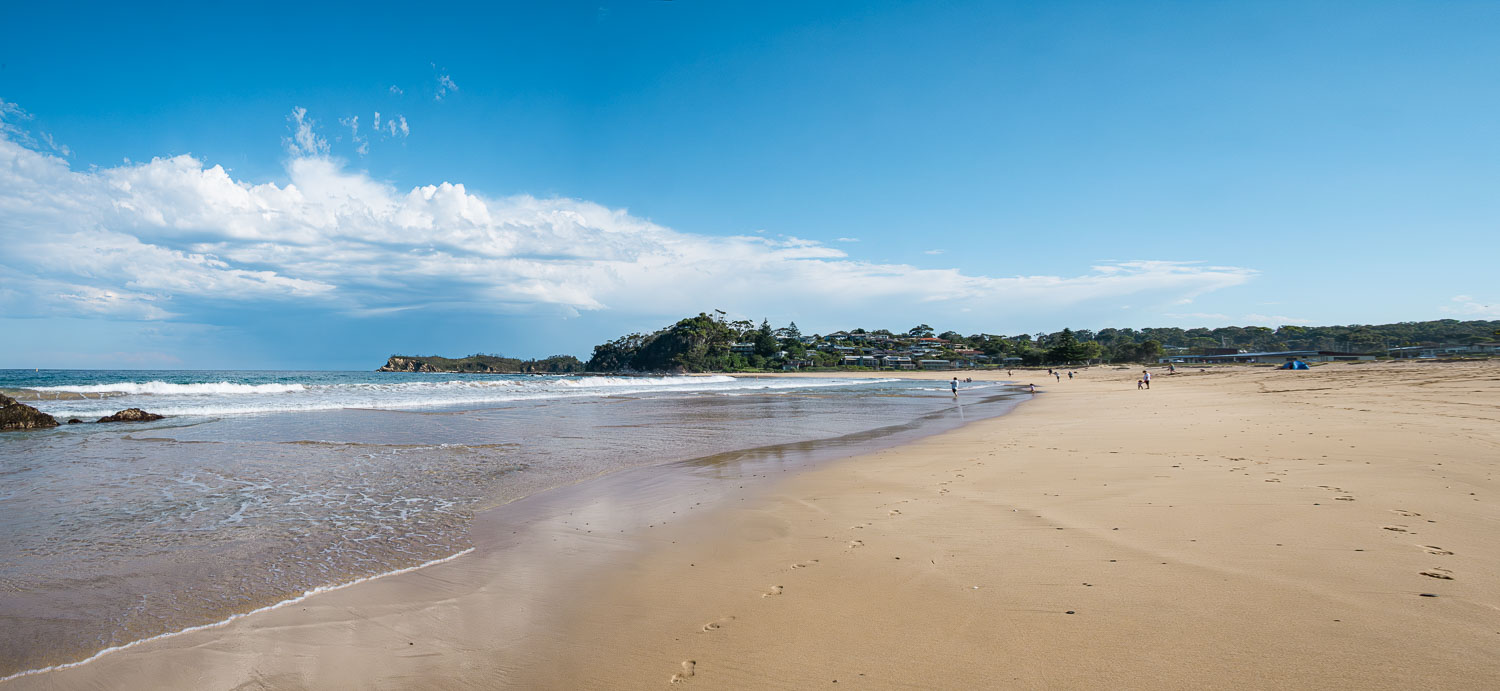
Seaford. Mornington. Frankston. The names live in my memories from childhood. Today they are regarded as outer suburbs of Melbourne even though these towns are up to 40 kilometres from the CBD*. When I was a child, back in the 1950s and early 60s they were a world away; a world away in time and distance; and a world away from ordinary life, suburban home life, working parents, school every day, squabbling sisters, set the table, wash the dishes, do your homework, into bed on time, and a bedtime story from dad.
Seaford or Mornington or Frankston – this was the world of four or five-week summer holidays in the sun at the beach. Freedom.
Every year my parents would rent a house with two other couples and we’d all bunk in together, six adults and ten children, the mums there full-time, and the dads down on weekends or longer as their jobs allowed. Us kids ran wild on the beach, our little bodies turned brown in the sun, splashing and paddling, building castles in the sand, screaming with joy and playing for several bright-shining weeks. I’ll never forget it. Freedom.
Another memory, a few years later: I’m sitting on the top bunk, looking out into the dark living room. It’s first light and the curtains are still drawn. The floor of the small room is carpeted with sleeping bodies. My best friend is still asleep in the lower bunk. I watch them all, taking in the dim light seeping through the edges of the curtains, my friends asleep on the floor, the silence.
Memories come and go, merge and fold in upon one another, like wispy clouds. I think I’m about 15 or 16. My parents have rented a small cottage at Batehaven for a couple of weeks, a seaside village four kilometres south of Batemans Bay, and my friends have come to stay with us for the weekend. I no longer remember their names, but I think one of them must be Tony, my boyfriend for a while back then, the same Tony who escorted me to my high school graduation Dinner Dance.
This is the only memory I have of being at the beach as a child after we moved to inland Canberra when I was 11, but I have plenty of memories as an adult. Every trip back to Australia included time at the beach, and this most recent trip (Dec ’22-Feb ’23) was no exception. But first we had to get there.
It’s a two hour drive from Canberra to Batemans Bay, the gateway to “Canberra’s coast”.
If you drive east from Canberra on Kings Highway you come to a geographic area known as the Southern Tablelands, southwest of Sydney. You’ll soon reach the village of Bungendore, a mix of artsy rural life, legitimate farming life, a few heritage buildings, and a fabulous woodworking gallery. Continuing on you come to Braidwood, the halfway point. It’s time for coffee.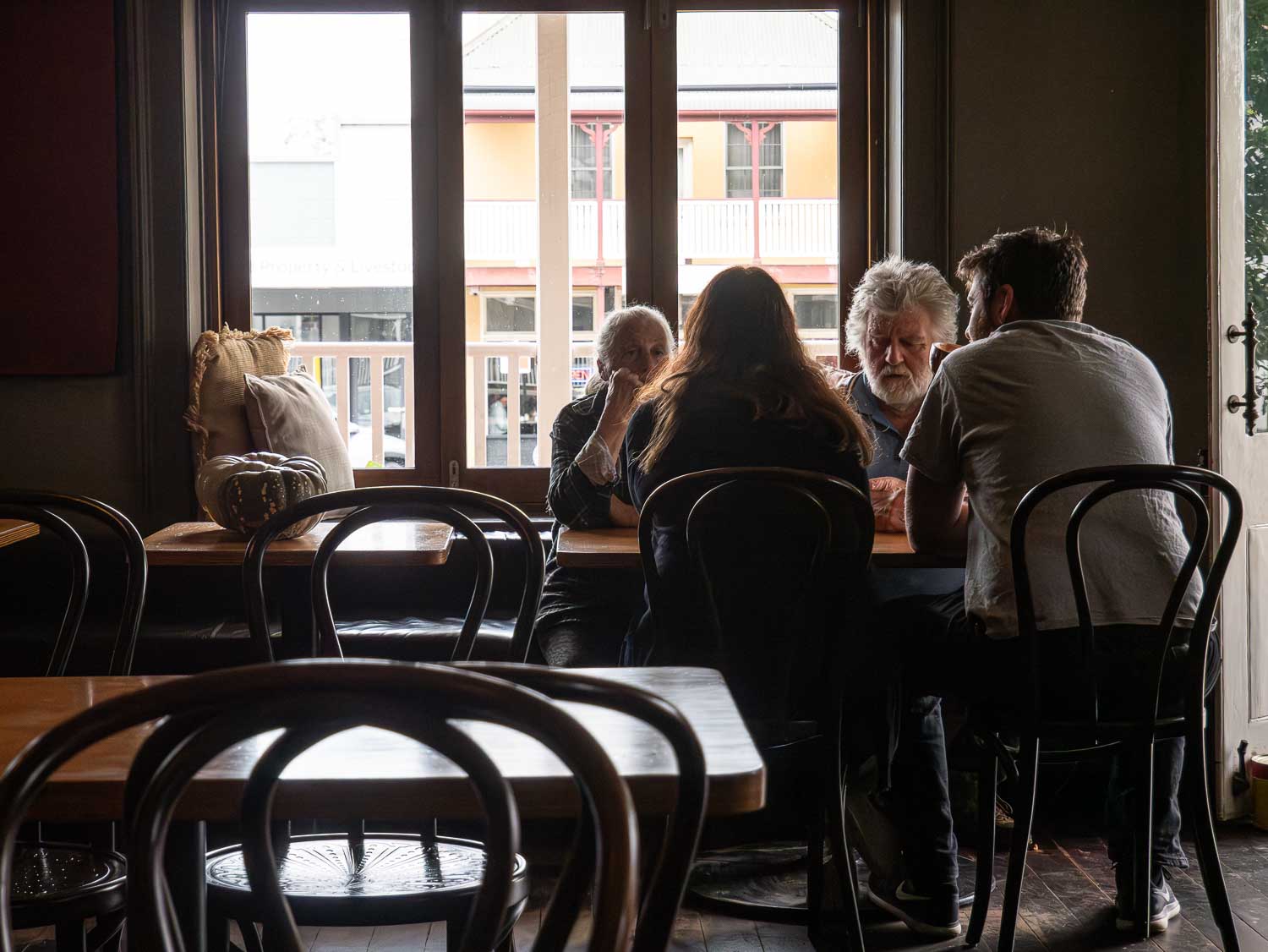
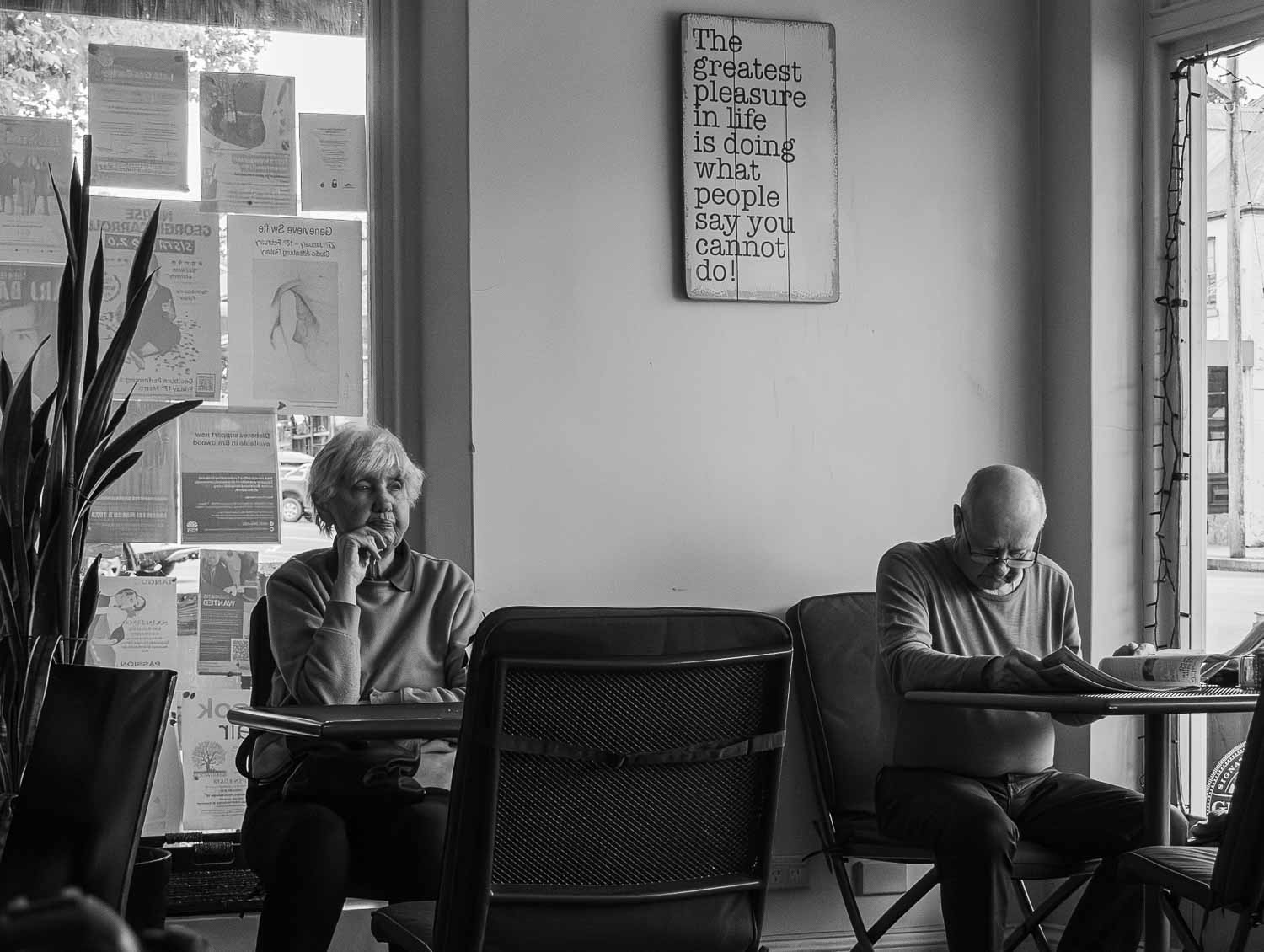
It’s almost like wandering a movie set. This National Trust-listed town is like stepping back in time, with a quirky modern overlay.
The Albion Hotel, built in 1872, was a symbol of modernity at the time, and was known to have the best accommodation in town, and exceptional food. I don’t know if there is accommodation now, but it’s still true about the food. The dimly-lit cafe has a welcoming hippy playfulness that’s lacking in the merely conventional.

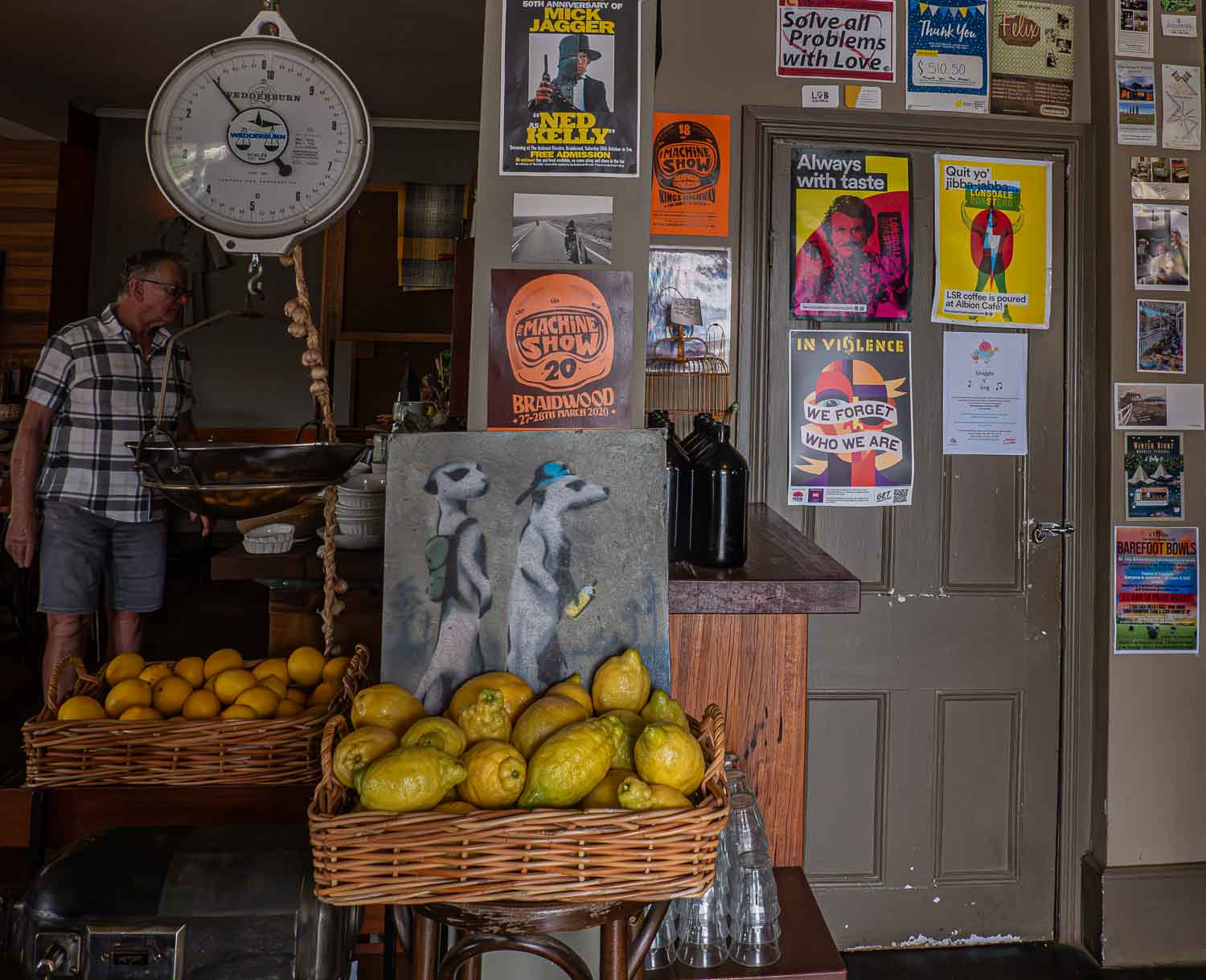
There’s so much to look at, and it’s such an eclectic but strangely cohesive collection – from a unicorn to dinos to a gnome head to what must surely be one of the characters from Wind in the Willows to a sign saying Solve all Problems with Love to meerkats standing tall – that the coffee and food are all the sweeter because of it. The vibe is real.
I must have been to Braidwood hundreds of times over the years and never really thought about it beyond it being one of the stopping points from Canberra to the coast. In many ways it’s a typical Aussie rural town that began as a local centre serving the surrounding farms and then expanded enormously with the gold rushes during the second half of the 1800s. What’s left behind is a whole pack of heritage buildings. The previously mentioned Bungendore is much the same though not as pretty, and on a road trip through Victoria we saw similar towns. I took it for granted that this is just how southeast Australian rural towns are; and in taking it for granted I never really saw them.
And here we are, and for the first time I’m really taking in the charm of Braidwood, the streets lined with Edwardian and Victorian buildings, and people hanging out getting food and coffee on their way to the beach.
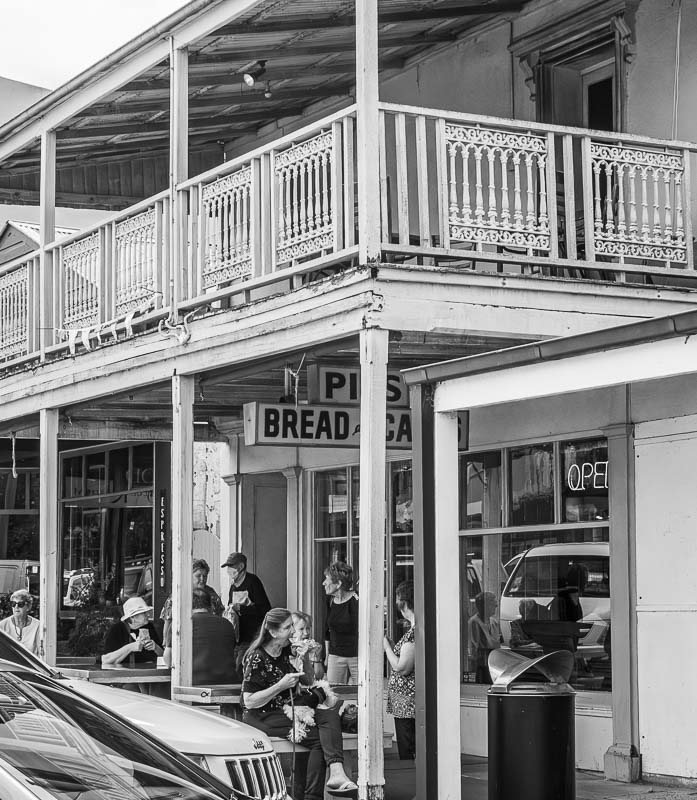


About 50 years ago Bungendore and Braidwood would have been nothing more than sleepy, somewhat dilapidated rural hamlets, the wealth and population of the gold rush era long gone, but with the growth of Canberra, and people needing to get to the beach, the towns developed as stopping points, giving rise to cafes, restaurants, galleries, antique stores, and the more considered renovation and maintenance of the Victorian buildings.
A sign on this building
says the following: The Dragon is one of a group of significant heritage buildings between Canberra and the coast. It was built during the early 1860s during the gold rushes as the Exchange Hotel in Georgian style and in 1890 the Bank of Sydney added a Victorian verandah. Over the centuries it has also been a saddlery, a stock and station agency, a second hand shop, a tea shop, and a Vietnamese restaurant to name a few. I suspect this could all apply to many buildings in the town.
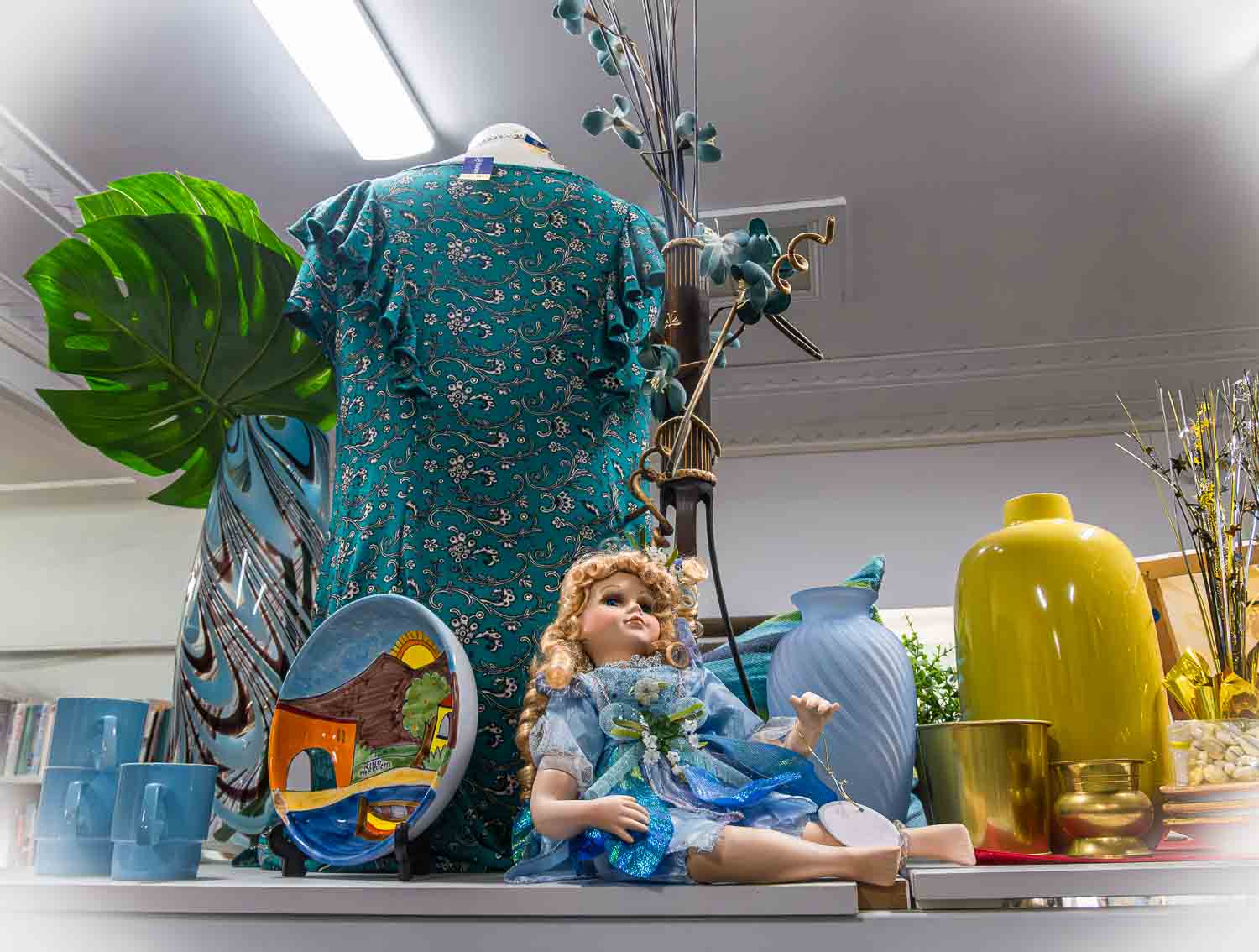
We drift around for a while, pulled by a languid curiosity, and discover a second-hand store full of vintage items, attractive in part because they lack the slickness of modern things.
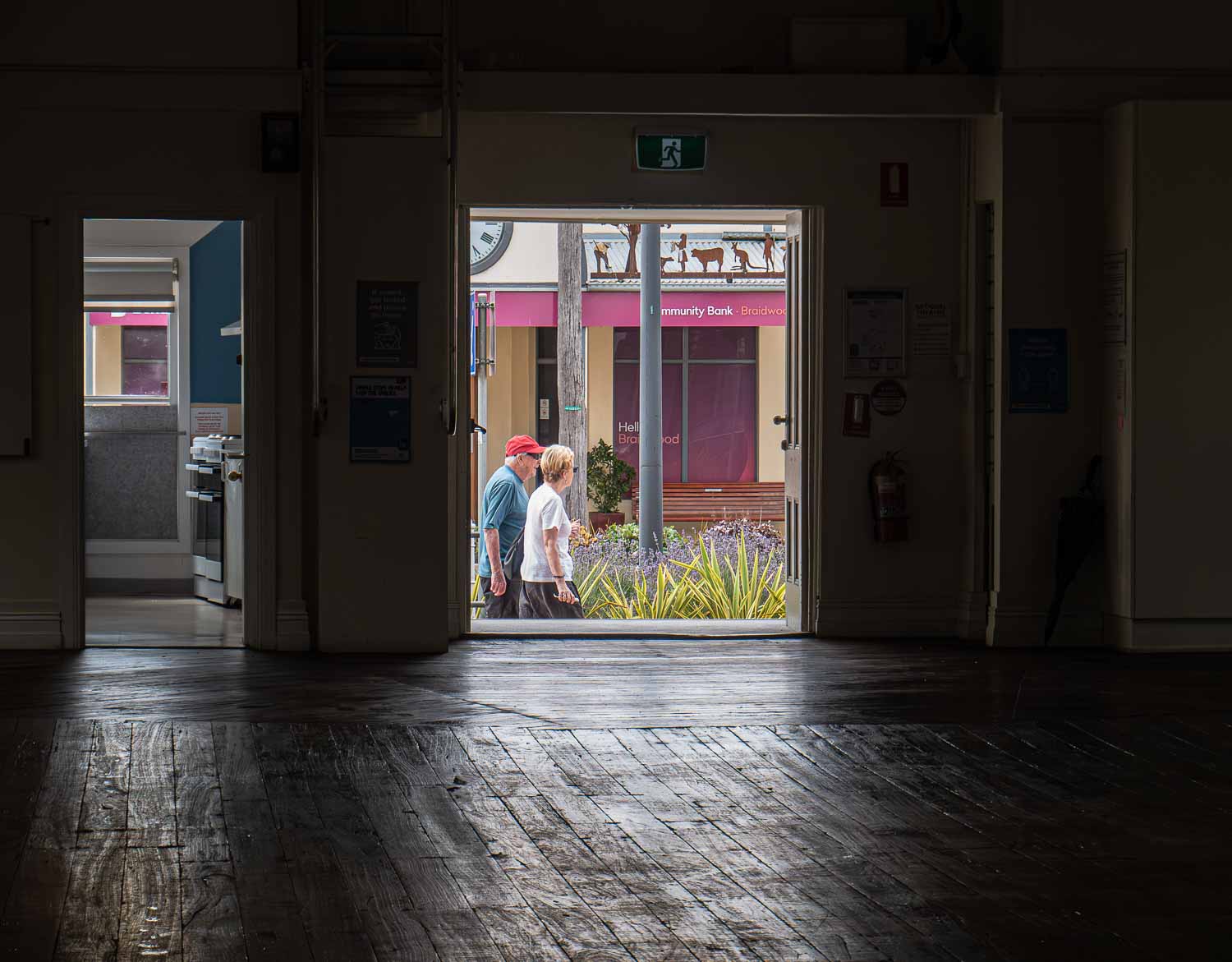
Pulled by the music we wander into the local hall. We stop for a while to read the endearingly out-dated skating instructions,
and listen to the cellist who has a found a quiet place to practice.
Looking towards the open front door I notice the garish juxtaposition of the electric pink sign that defaces the bank building across the street, and wonder how, in a heritage-listed town, it was ever allowed.
Just another little factoid – Braidwood is famous for its prized rare truffles. And several Aussie movies have been filmed there, including Ned Kelly starring, of all people, Mick Jagger. I want to put a laughing emoji here, an ROFL emoji. I remember all Australia being appalled at the casting; it was universally ridiculed. Ned Kelly was a murderous bushranger, in American terms he was an outlaw. He also was, and still is, a national hero. Casting Mick Jagger in the role seemed completely preposterous. A very American description of the movie (no Aussie would ever speak of the frontier, or use the word gunslingers): In this rousing, fact-based tale of the Australian frontier, Mick Jagger makes his screen debut as a notorious outlaw who heads a band of Irish gunslingers as they try to outrun British authorities. I vaguely remember seeing the movie (made back in 1970). It was okay.
Continuing on we navigate the switchbacks on Clyde Mountain and finally descend down to sea level at Batemans Bay. The population of Batemans Bay in 1964 was 2000. Indicative of how the growth of Canberra led to the growth of every town between it and the beaches, today its population is 17,500. The town sits in a fabulous location on the banks of the Clyde River estuary,
but poor Batemans Bay; it’s a regional hub and service town, and I have never seen it as anything else, and I’d guess most Canberrans feel the same. It’s the place you stop to get petrol and supplies on the way to the beach. To the south, is some of the most spectacular and unspoiled coastline in New South Wales. And that’s where we’re headed.
To get to a partway decent beach you have to head a little south to Corrigans Beach, or Batehaven, where I stayed with my girlfriend all those years ago (and even then it was considered a bit inferior), but life in the Bay is all about the famous Clyde River oysters, fishing, and hanging out in the river.


To get to a really good beach you head to Surf beach, or Lili Pilli, or Malua Bay, 13 kilometres south.
Malua Bay is one of a string of contiguous villages along the coast in a relatively narrow band of open space and bushland that fringes the foreshore. The resident population is under three thousand, and many of the houses are owned by Canberra residents who come for the summer.
We’re here! Two weeks at Malua! Don and I, and my three sisters and brother-in-law have rented a house in an urban setting a five-minute walk from the beach. Outside the house, beyond the lower deck, there’s a lushly overgrown back garden

with an iconic Australian Hills Hoist clothes line, and a resident skink.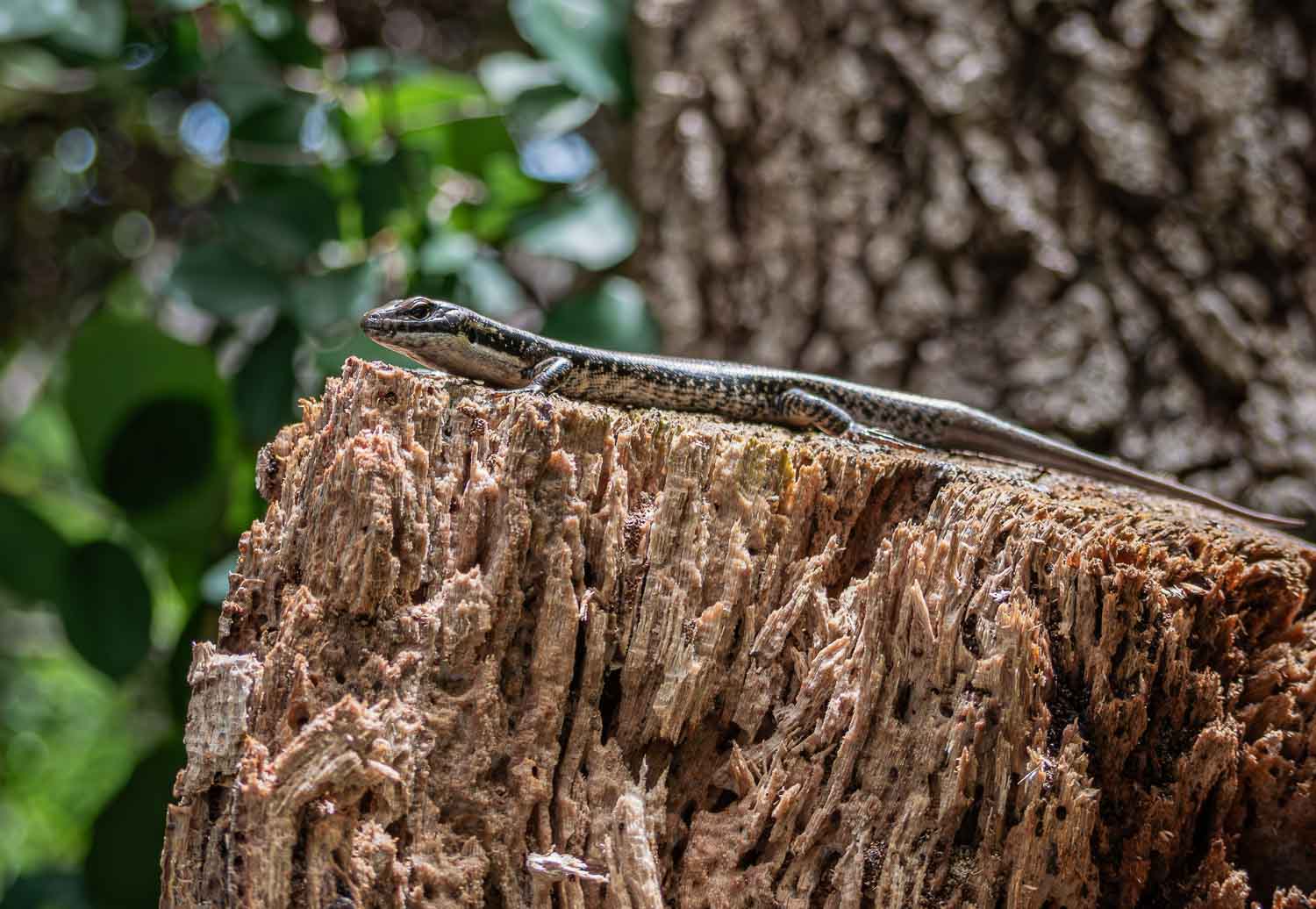

If we want to go to the beach via the shops we go down Tallawang Ave to a little path just before the main road and cross Reedy Creek via a small wooden bridge.
If we want go directly to the beach we cross Tallawang higher up, take the path between the houses,
and climb down a steep flight of sand covered wooden stairs. We arrive at the very north end of the beach, where Reedy Creek creates a small shallow delta as it flows into the sea. And there’s the beach spread before us; five hundred glorious metres of golden sand, and the best surf you come to after leaving Batemans Bay.
From the far end of the beach looking back towards the village:
Surfers: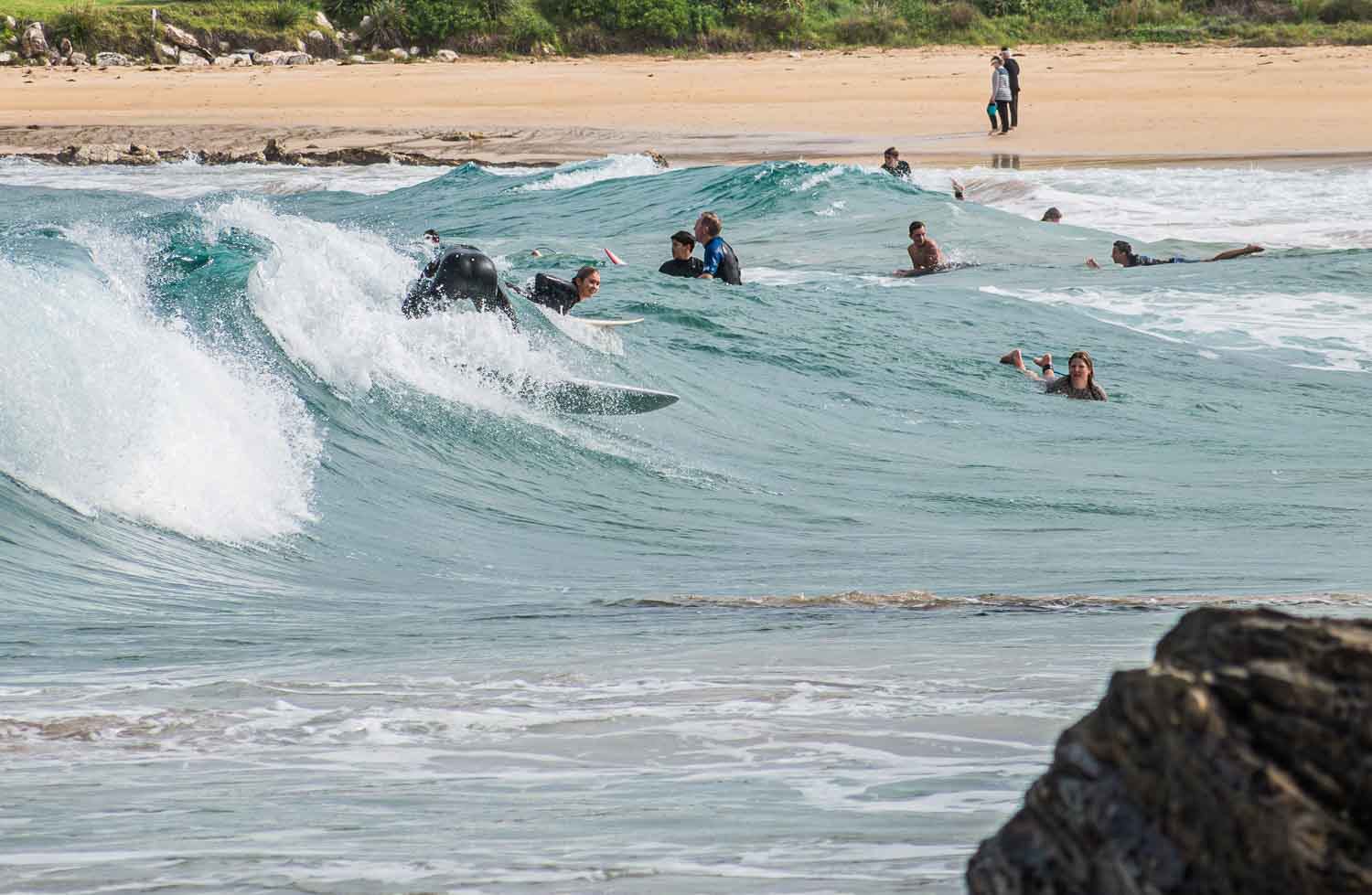
Photographers, photographing surfers: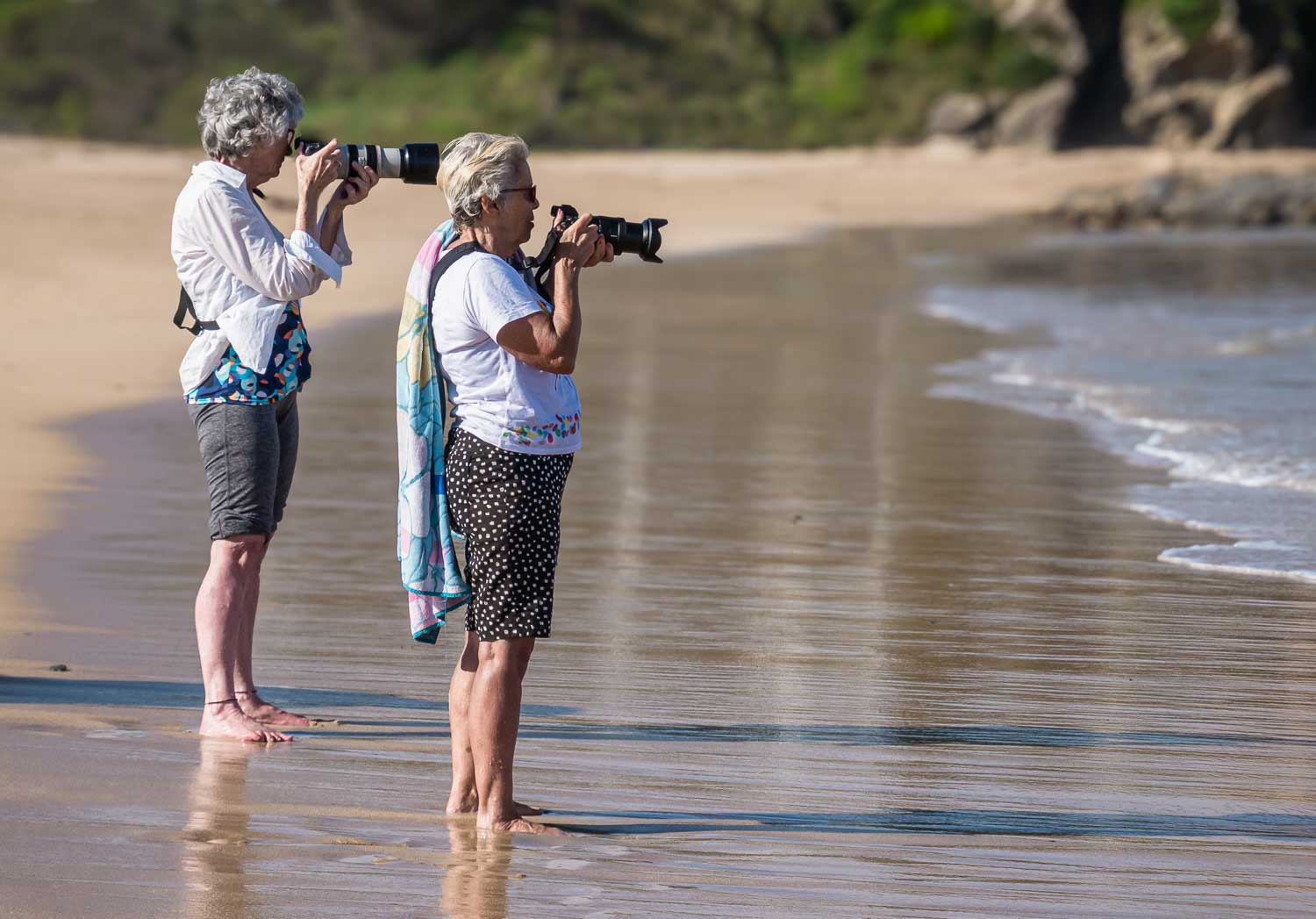
Lapwings:
Crested Terns:

And the inevitable seagulls:
On our last night we go to Club Malua, a lawn bowls club, for dinner. Just at dusk I look out the window. Of course. There are kangaroos. Grazing behind the clubhouse in the fading light.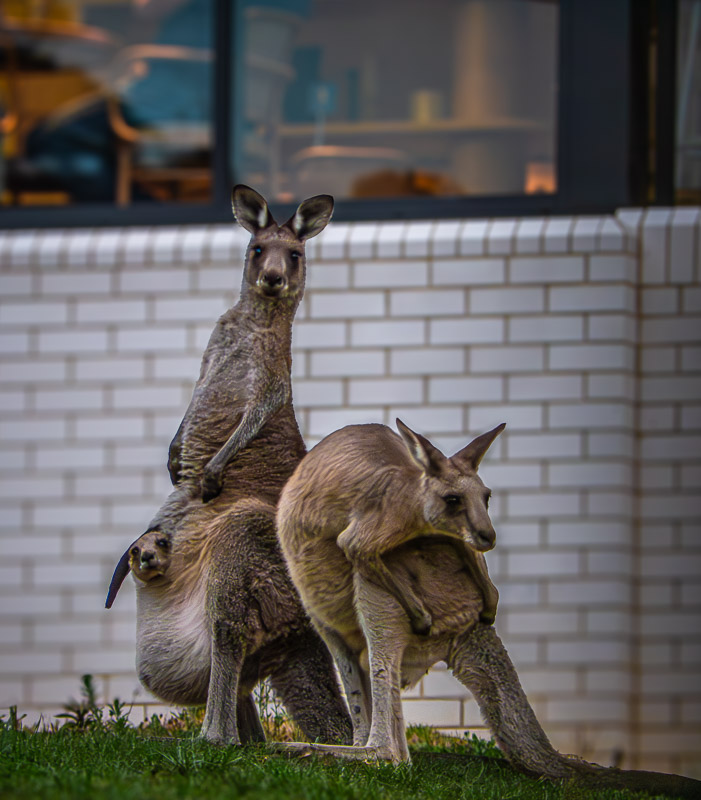
Beach time in Australia seems to be part of my DNA, embedded into the very cells of my being from my youngest memories, first near Melbourne, and later at the coast east of Canberra. The crashing and lapping of waves as a constant melody, the breeze, the salt air, the sand everywhere, the wet swimmers and towels. The freedom. A trip back to Australia would not be complete without it.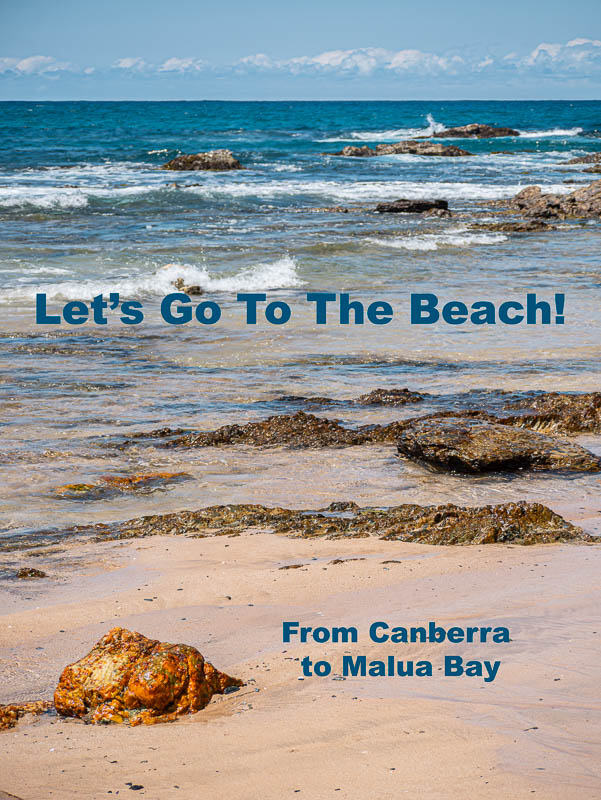
Braidwood, Batemans Bay, and Malua Bay are all situated on what was and always will be Aboriginal land; the lands of the Yuin Nation.
*CBD – Central Business District = downtown
Next post: I’ll dive deeper into our time at Malua, and also take a look at Aussie beach and surf culture; it informs the entire national character.
I’m taking a little break. There’s much busyness ahead with Christmas outings, and a ten-day trip to Montreal for Christmas with family. I’ll be back in 2024!
Thank you everyone, for following, for your likes and shares, and for your comments. I love every one; each one makes me do a little happy dance inside. Lol I remind myself of Sally Field collecting her 1984 Oscar and saying “You like me, right now you like me”!
Wishing you all a wonderful holiday season.
Merry everything!
See you next year.
All words and images by Alison Louise Armstrong unless otherwise noted
© Alison Louise Armstrong and Adventures in Wonderland – a pilgrimage of the heart, 2010-2023.

 Adventures in Wonderland
Yes, we like you. We really like you! I feel as though I journeyed back in time through the lens of your camera and your commentary, and it is a good feeling, grounded and content. And this quote from that sign is priceless and true: “Solve all Problems with Love” Many thanks for this wonderful post. Happy Holidays to you and yours!
LikeLiked by 1 person
Awww thanks so much babsje 🤗 I’m glad you enjoyed the post. It’s been really lovely to revisit my childhood memories. And thanks for following the blog all these years.
Solve all problems with love. I agree!
Alison
LikeLiked by 1 person
Smiling. Utterly charming, both you and the photos!
LikeLiked by 1 person
Thank you so much Cindy – for your lovely comment and for your support all these years 🤗🙏
Alison
LikeLike
What to wish? Everlasting youth? Contentment? Enduring love… I’ll go with that. It’s been great travelling with you, Alison. Here’s to 2024!
LikeLiked by 1 person
I’ll definitely go with enduring love too. If we could all just start and end with that what a world it would be. It’s great travelling with you too. And yes, here’s to 2024!
Alison
LikeLiked by 1 person
Another lovely trip down memory lane with you – very sweet Alison. Yes, we like you! A lot! I’m looking forward to beach explorations… Brisbane had to be creative and bring the beach into the city. (Southbank) Unless one travels north or south or to the islands. Currently enjoying what’s provided ☺️
😘
LikeLiked by 1 person
Awwww thanks Surati xo 🤗
I’ve really enjoyed doing these posts where I explore childhood memories; things I haven’t thought of for many years.
Yeah, no beach in Brissie, but from your pics of Southbank it looks pretty good.
Alison ❤️
LikeLike
What lovely memories. Love the photos and your post🥰
LikeLiked by 1 person
Thank you so much Arlene 🤗 I’m glad you enjoyed it. And thank you for following, and commenting, and being here. ❤️
Alison
LikeLiked by 1 person
I particularly love the photo of the kangaroos, especially the joey in the pouch. I almost squealed with delight when I saw it. Have a fabulous Christmas. We do really love you and look forward to more interesting posts in the New Year.
PS I’m going to Thailand in January, by myself. I remember you went to Japan and China by yourself a few years ago. That inspired me to do this.
LikeLiked by 1 person
Thanks so much Darlene for your support all these years. 🤗
I’ve been seeing roos all my life, both in reserves and more often in the wild, but it still thrills me. When I saw them through the window I went straight out to photograph them even though dusk was coming on. Couldn’t believe I got a joey as well!
Thailand solo! How totally fabulous. Have you been before? It’s amazing, a really wonderful culture. I’m sure you’ll have a great time.
Wishing you a fabulous Christmas too.
Alison ❤️
LikeLiked by 1 person
It will be my first time in Thailand or that part of the world. I’m so excited and a little bit nervous. I will be seeing a brother there who I haven’t seen for ten years.
LikeLiked by 1 person
So excited for you. I was nervous too, but excited as well. I always feel that if I’m excited about doing something then I must be on the right track. Safe and happy travels.
A.
LikeLiked by 1 person
A lovely reminisce.
There are many blogs with good writing, and plenty more with good photography, but not all that many that do both well. Encountering them gives us a little happy dance too.
Happy holidays.
LikeLiked by 1 person
Wow, Dave, what a wonderful compliment. Thank you so much! Happy dances all round then!
Happy holidays to you too.
Alison
LikeLiked by 1 person
Have a wonderful trip to Montreal, stay warm and practice skating rules if you go skating ⛸️.
I hope you are both feeling better and well.
Merry christmas, wonderful new year
(and of course we like you and Don))
LikeLiked by 1 person
Thank you so much Dana. Unlikely to be skating, but we should be able to stay warm 🥶❄️☃️ (I think it’s the Swedes who say there’s no bad weather, only bad clothes).
We’re both much better – well enough to travel, at least within Canada, which feels great.
Merry Christmas to you too, and may 2024 be all you could wish for! 🤗❤️
Alison
LikeLike
I enjoyed this account of yours down memory lane, Alison. I feel like memories created when we were young are the ones lasting forever. Just earlier today, when I was walking around one of Jakarta’s upscale residential areas, for some strange reason the sounds of people hammering nails, watering the plants in their garden, and even the quietness reminded me of my holidays at my aunt’s house in East Jakarta when I was little. Happy holidays! And “see” you next year!
LikeLiked by 1 person
Thanks so much Bama. It both fascinates and puzzles me the things we remember and the things that fade away. It’s like a movie with a million missing scenes, but those that remain seem to last forever. And get triggered at the most puzzling times – like you suddenly being reminded of holiday’s at your aunt’s house. And writing that I’m suddenly remembering times at my grandmother’s house in Melbourne. It’s lovely isn’t.
Happy holidays to you too.
Alison
LikeLiked by 1 person
A sweet trip down memory lane, Alison, and the beautiful photos to make it so alive. I had to laugh at the fisherman’s decolletage and I love the photo of the kangooroos. As a European it is hard to imagine seeing them in your backyard.
Good to read that you and Don are well enough to travel to Montreal. Happy holidays for both.
LikeLiked by 1 person
Thank you so much Astrid. I’m glad you enjoyed it. It was sweet post to put together for me – remembering all those happy childhood times.
I’ve seen kangaroos many times but it never gets old.
Oh that fisherman! I couldn’t resist photographing it; such a quintessential Aussie bloke.
We’re both well – it’s lovely!
Happy holidays to you too.
Alison xo
LikeLike
I like the facial expressions of those kangaroos. A mix of surprise and annoying 🙂 Have a lovely holiday to both of you!
LikeLiked by 1 person
Chuckle, kangaroos always do that – when they hear you they initially don’t run away, they look up, and you exactly captured their expression – surprised and annoyed.
Happy holidays to you too Len
Alison
LikeLiked by 1 person
Alison, as with your previous post you interwove those early memories with your most recent trip back to Australia with such skill and grace. Reading this made me think about my own idyllic weekend excursions to some of Hong Kong’s more beautiful beaches with the family.
Braidwood is such a handsome-looking heritage town. How wonderful that Canberra’s growth spurred a positive reversal in its economic fortunes. It looks like the kind of place I’d want to stay overnight. And the beach at Malua Bay – well, I can imagine spending hours just wandering the sand, wading or swimming, and relishing that sense of freedom you became acquainted with as a child. You were so lucky to get that shot of the kangaroos, complete with the joey in its mother’s pouch!
Thank you for introducing a part of Australia many of us never knew about. Happy Holidays/Merry Christmas, and I wish you both good health and more travels in 2024!
LikeLiked by 1 person
Thank you so much James. I’m always chuffed when you compliment my writing; you are such a skilled and compelling writer, and I think I’ve become a better writer through reading your blog.
Braidwood’s a lovely town, and I’m glad I got to explore it a bit this visit, and to really see it. And Malua Bay is just plain wonderful.
The kangaroos! What a moment that was! I had no idea what I was capturing really because there was so little light, but I managed to bring them out with some editing. I never tire of seeing them.
Happy holidays to you too, and all the best for 2024!
Alison
LikeLiked by 1 person
Have a wonderfully relaxing end of the year, Alison and Don! Enjoy your travels and family and being offline – I know I will. As for beach time, I share that piece of my history with you. For decades, our family of six would rent a little house on the east coast and bask in the sun and sea for weeks, my dad slipping away to work like yours did. Heaven, and a source of lasting memories. Now I need to follow your lead and go back; it’s been a long time.
LikeLiked by 1 person
From your description you know exactly what I’m talking about – those summer weeks at the beach. One of my memories, apart from the childhood play time, is that my mother seemed so relaxed. It was lovely.
Yes, go back!
Wishing you and Jeff a wonderful year end too.
Alison 🤗
LikeLiked by 1 person
Amazing post/photos. Really makes me want to go to Australia.
LikeLiked by 1 person
Thanks so much rabirius. I hope you get to Oz one day – it’s pretty extraordinary.
Alison
LikeLike
You’re probably off to Montreal for Christmas, but I’m catching up on my email and left this one til last. It did not disappoint. 😀
Wishing you and Don a lovely holiday season!
LikeLiked by 1 person
Thanks so much Felicity. I’m glad you enjoyed it.
May your holiday season be bright and beautiful.
And may 2024 be amazing!
Alison
LikeLike
You’ve made me even more excited to go to Australia – I just hope we can make it happen at some point. There are way too many things to enjoy here. The opening paragraphs about your beach memories are fun to read. I love the Braidwood coffee shop vibe and am sure I’d enjoy the vibe at many, many more places…and the beach looks wonderfully relaxed. I hope you’re enjoying your break! Have a wonderful holiday and may 2024 bring ease and creativity. 🙂
LikeLiked by 1 person
Thanks so much Lynn. I might be a little biased 😂 but Oz has much to offer. I hope you get there one day!
The beaches are amazing. We were there after school had begun for the new year; Malua over the summer is much busier, but there are literally hundreds of long sandy beaches, and it’s easy to find ones that are almost empty.
That Braidwood coffee shop is one of many such places – there’s a very strong coffee culture throughout the country. People are fussy about their coffee and small independent cafes thrive. Starbucks was rejected.
Hope you’re enjoying the holiday season. And I wish the same for you – ease and creativity for 2024! Perfect.
Alison
LikeLiked by 1 person
If and when we can swing it I’ll definitely be getting in touch for advice from the expert. 😉
LikeLiked by 1 person
This is such a sweet and wonderful post, Alison. I especially enjoyed your bird and kangaroo photos and how you beautifully captured a female kangaroo sporting a pouch on her belly filled with a baby kangaroo. Having lived in Ireland for 20 years and seeing nothing but fluffy sheep daily, makes me wanna go to Australia even more as you guys have so many incredible native animals. Thanks for sharing, and have a wonderful day 🙂 Aiva xx
LikeLiked by 1 person
Thank you so much Aiva. I’m glad you enjoyed it. Australia has amazing animals, and I’ve seen quite a few of them in the wild, though roos are the most common. I felt a bit lucky to get that shot as it was dusk and I didn’t know if I had enough light or not, but it turned out fine.
Cheers, Alison xo
LikeLiked by 1 person
Beautiful photos that capture everyday life. I love going out for walks and doing this kind of photography.
LikeLiked by 1 person
Thank you so much. It’s one of my favourite things to do too.
Alison
LikeLike